Iran war renews concerns about the lasting toll of traumatic brain
injuries to US troops
[August 07, 2026]
By BEN FINLEY and LAURAN NEERGAARD
WASHINGTON (AP) — When Joe Shearer was a Marine fighting in Iraq, a
blast from an enemy mortar round knocked him down and made him vomit. He
got up and kept going despite a searing headache.
When a roadside bomb struck his Humvee convoy months later, the
explosion’s shock wave swept through his body before headaches and
sleeplessness set in for days.
“As long as you got back up and could go back on patrol, that’s kind of
what you did,” he said.
Shearer, 40, of Colorado Springs, Colorado, links both events in 2005 to
traumatic brain injuries, which were only recently diagnosed. He's still
plagued with symptoms ranging from dizziness and migraines to forgetting
daily tasks and responsibilities to his wife and children.
The lasting effects of traumatic brain injuries are raising fresh
concerns about the toll of the Iran war on American troops who are
suffering those wounds during a conflict without a clear end. Nearly 700
U.S. service members have been wounded by drone and missile attacks on
bases in the Middle East and other fighting. Most have experienced
traumatic brain injuries, or TBIs, and returned to duty, according to
public statements from military officials.
The Pentagon's chief spokesman, Sean Parnell, last month called the vast
majority of injuries over a two-week period "minor concussions.”
Doctors can't predict who may have lasting effects from a TBI
Concussions often are termed “mild” TBIs, and many people recover within
weeks. But sometimes those with seemingly mild initial symptoms go on to
have problems persisting for months or years, such as headaches,
dizziness or difficulties with memory or attention that's sometimes
called “brain fog.”
Doctors have no way to predict who will suffer lasting problems, a
vexing enough question that there’s medical debate over whether to
retire the term “mild TBI.” Repeated blows are known to increase the
chances of lasting problems, including a degenerative brain disease
called chronic traumatic encephalopathy, or CTE. It has gained attention
for links to deaths in the National Football League and other sports.

It’s imperative that people recover from a concussion before doing
activities that put them at increased risk of another, said Dr. David
Okonkwo, a University of Pittsburgh brain trauma specialist.
Doctors also are still learning how explosive blasts injure the brain
versus a physical blow.
“The blast wave itself can be injurious,” said Dr. James Kelly, an
emeritus professor of neurology at the University of Colorado School of
Medicine and chief medical scientist at the Invisible Wounds Foundation,
which is focused on military brain injuries. “It’s a different cellular
injury. Blast is a different thing than a blunt injury to the head.”
Troops have been facing a new type of warfare with Iran in which drones
may explode closer to their heads, as opposed to the ground-level
roadside bombs and improvised explosives that were more common in the
wars in Iraq and Afghanistan.
Democratic lawmakers are calling for an investigation into the care that
wounded troops received following an Iranian drone strike in Kuwait that
killed six U.S. soldiers early in the war. Wisconsin Sen. Tammy Baldwin
pressed the military in a letter on Wednesday to release the findings of
its investigation into the March 1 attack.
“I spoke directly with Wisconsinites who sustained traumatic brain
injuries from (President Donald) Trump’s war in Iran and went weeks
without so much as a screening, let alone specialized care, for their
injuries,” Baldwin said in a statement.
Defense Health Agency spokesman Peter Graves said in an email that “it
is policy that service members are screened for TBI.”
Experts say the military has made strides in screening and treating TBIs,
a signature injury in Afghanistan and Iraq. More than 500,000 service
members were diagnosed between 2000 and 2025, with 82% of cases
considered mild and not all of them related to combat. But advocates say
the injuries could still be undercounted because symptoms often overlap
with post-traumatic stress disorder and other conditions.
A TBI diagnosis can emerge years later
Neither of the two blasts Shearer experienced in Iraq produced obvious
injuries, and medics prioritized Marines who were more badly hurt.

[to top of second column]
|
 “You don’t want to be the guy who
goes to sick call or says, ‘Oh, I’m hurt,’ because you’re away from
your team,” Shearer said. “There’s this culture of you don’t want to
be seen as lesser or weak, so you hide injuries inherently.”
When he came home at age 19, he denied he had PTSD and didn't know
what a TBI was. Plagued by nightmares, sleeplessness and headaches,
he initially turned to drugs to self-medicate and considered
suicide.
Shearer eventually got help for PTSD, but it took years for him to
consider that he suffered traumatic brain injuries. He was working
for the Wounded Warrior Project and screening fellow vets for TBIs
when he realized he checked many of the same boxes.
He's since been diagnosed and received treatment. But challenges
remain, including vertigo and light sensitivity. He also forgets
important conversations with his family.
“I know that some of that stuff is stereotypical, but for me, it's
got a different ring to it,” Shearer said. “There will be no memory
of the conversation happening.”
The brain can adapt with treatments and therapies
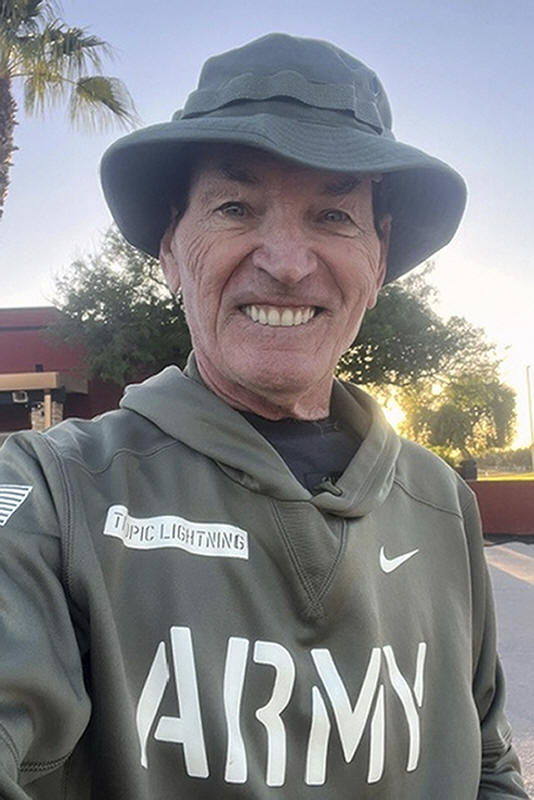
Memory loss is something Army veteran Frank Sonntag also experienced
following a TBI from a mortar blast in Iraq in 2004.
He was in his 50s and training reservists when he felt a blast of
wind against his ear from an explosion 70 feet (21 meters) away. He
didn’t know he was hurt and didn't seek treatment for two years,
ignoring intensifying headaches and brain fog.
It got to the point where it took 30 minutes to write an email,
while colleagues told him he spoke one word every 10 seconds. He
considered suicide and was diagnosed only after he got lost driving
home. Neurologists prescribed medication for his migraines, among
other treatments.
“Speech therapy was one of the greatest things I had,” added
Sonntag, 75, of Queen Creek, Arizona. “They taught me how to
practice the words I was speaking and how to put sentences together
again.”
Kelly Parker, director of independent services at the Wounded
Warrior Project, said it's hard to predict an injury's trajectory.
“If you've seen one TBI, you've seen one TBI," she said.
Screening, early treatment and support can be crucial to returning
to a more normal life. Physical, speech and art therapies can lead
to improvements, she said.

“There’s still so much we don’t know about the brain, but one thing
that we do know is it can heal itself,” Parker said. “We know that
new neural pathways can be created, and we absolutely believe that
the brain can adapt. We've seen it happen.”
Army veteran Spencer Milo said some people struggle to understand
why he's still dealing with migraines, seizures and forgetfulness
after so many years out of uniform.
His first TBI occurred in Iraq in 2008, when his Humvee smashed into
a wall to evade fire. His second came from the blast of a suicide
bomber in Afghanistan in 2011.
“I’ve had fellow service members that were even with me on those
days, and they’re like, ‘Dude, why can’t you just kick it?’” said
Milo, 41, of Parker, Colorado. “I really wish it was that simple.
It’s tough because when you can’t see something, it’s hard to
believe that it’s really there.”
___
The Associated Press Health and Science Department receives support
from the Howard Hughes Medical Institute’s Department of Science
Education and the Robert Wood Johnson Foundation. The AP is solely
responsible for all content.
All contents © copyright 2026 Associated Press. All rights reserved |