A New Mexico judge ordered new child safeguards for Meta. Advocates hope
other courts follow
[August 10, 2026]
By KAITLYN HUAMANI and MIKELLA SCHUETTLER
In a landmark ruling against Meta, a New Mexico judge likened the
company’s social media platforms to factories. The psychological harm to
children who use Facebook and Instagram, he said, can be seen as their
pollution.
Judge Bryan Biedscheid fined the company $567 million in his ruling
Thursday, but he also prescribed steps to clean up what he described as
its byproducts. He ordered new safety measures, including a time limit
of 90 hours per month for users under 18, AI chatbot restrictions, and
mandatory warnings on the platforms.
How easily those features can be implemented, and how effective they
could be at protecting young users from mental health harms, are
unresolved questions. They also would apply only to children in New
Mexico, Meta has no deadline to introduce them, and the company has said
it will appeal the ruling.
But the judge’s order showed a possible path forward for other court
fights around the country as Meta faces mounting legal, regulatory and
public pressure to do more to protect young people.
The ruling came in the second phase of a trial in a lawsuit the state of
New Mexico filed against the social media giant. The new financial
penalty is in addition to the $375 million in civil penalties that
jurors ordered against Meta in March after determining the company
knowingly harmed children’s mental health and concealed what it knew
about child sexual exploitation on its platforms.
Meta said in a statement Thursday that it works to keep people safe on
its platforms and has been transparent about the challenges of
identifying and removing bad actors and harmful content.
“We remain confident in our record of protecting teens online and will
continue to defend ourselves against claims that misrepresent the
facts,” the company said.

Implementation of court-ordered measures poses challenges
Many of the changes ordered by Biedscheid hinge on strong
age-verification measures. The ruling says Meta must improve its age
assurance models and tools in New Mexico and proactively request proof
of age for users they know or estimate to be under 13.
What that proof of age could look like, however, is unclear.
Age verification “can be done well in a privacy-protective way, but it
is not easy,” said Peter Ormerod, an associate professor of law at
Villanova University.
Federal children’s privacy laws prevent Meta from applying
age-verification tools to children under 13. The Children’s Online
Privacy Protection Act means the court cannot order Meta to request
children to submit personal data or be passively tracked online, even
for age verification purposes.
Identifying which users are in New Mexico, and subject to the
court-ordered protections, could also pose a challenge. Ormerod said
Meta could likely check if a user is accessing the platform from an IP
address associated with New Mexico, a solution “that works reasonably
well enough.”
Meta has several safety tools already in place. Instagram Teen Accounts,
for one, have built-in protections to limit who can contact teens and
what content they can see, and give parents the ability to set time
limits.
Brooke Istook, the president and chief strategy officer at the advocacy
organization Heat Initiative, said she was glad to see the judge's
reforms will be court-supervised.
“Now, we will have someone in an official capacity checking the homework
of these companies,” she said. “The fact that we have the court now
involved, they’re able to evaluate how they’re implemented, whether or
not they’re effective and whether or not they are actually working to
keep kids safe online.”
Experts say the ruling leaves out some of the most harmful features
Meta's critics say some of the most recognizable and potentially harmful
aspects of Instagram and Facebook's designs are untouched by the ruling.

[to top of second column]
|

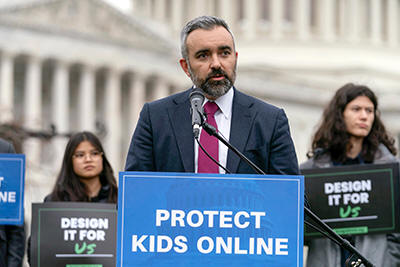
New Mexico Attorney General Raúl Torrez speaks during a rally to
protect kids online on Capitol Hill in Washington, Wednesday, Jan.
31, 2024. (AP Photo/Jose Luis Magana, File)
 Features like autoplay, infinite
scroll and algorithmic content recommendations have been the prime
targets of legal arguments that social media platforms are designed
to be addictive. But Biedscheid wrote in his ruling that these
features are used across the social media industry on other
platforms, so restricting Meta's features but not those of its
competitors would harm the company.
That was disappointing to see for Sophia Choukas-Bradley, an
associate professor of psychology at the University of Pittsburgh.
“Those design features have played a very important role in what
leads to problematic use of social media by adolescents and, in
turn, mental health problems,” Choukas-Bradley said.
Still, Choukas-Bradley said she was in favor of several safety
measures in the ruling, especially one that orders the “like counts”
on the apps be hidden by default on minors' accounts, a setting that
could only be overridden by a parent or guardian. She also supports
a measure that would create a stronger separation between children
and “unconnected” adults on the platforms. Meta would not be able to
recommend a child's account to an adult's account, and adults who
are not “friends” or followers of a minor's account would be barred
from messaging the child.
“There are just too many documented cases of sextortion,
sexploitation and sex trafficking that start in the online context
for us to ignore this any longer,” Choukas-Bradley said.
It is unclear which features on social media platforms are most
harmful for children's mental health, said Sonia Livingstone, a
professor at the London School of Economics and Political Science.
There is ample evidence, however, that more vulnerable children are
more susceptible to the companies' design features, she said.
“Tested one by one, the evidence for each design feature will be
weaker, as it is the combination of features that really will make
the difference for children’s outcomes,” said Livingstone, who leads
the Digital Futures for Children research center.
Some hope New Mexico's actions lead to further regulations
Because the measures in the judge's order are specific to users in
New Mexico, experts say piecemeal rulings and inconsistent
legislation at the state level could create a new crop of issues.

“It really needs to be uniform at the congressional level, it causes
all sorts of problems,” said Neama Rahmani, a former federal
prosecutor and president of West Coast Trial Lawyers. “It just
doesn’t make sense in today’s era of technology.”
Some advocates say they hope similar rulings in other states could
stir action in Congress, and spur new efforts to pass federal
legislation.
For parents in New Mexico, the ruling could change the conversations
with their teens about social media use. Heather Statum, an
Albuquerque mother of a 13-year-old girl, says her daughter is
constantly requesting access to various social media platforms.
Statum has heard horror-stories about predators lurking on Instagram
or Snapchat. She's also aware that among her daughter’s peers,
discussions of suicide and other mental health issues are prominent
online and worries about her daughter being exposed to disturbing
content.
“The stuff (social media companies) have in place to protect them, I
don’t think any of it actually works,” Statum said. “It does cause
major problems between us because she thinks that I’m too strict.”
Statum says the platform-level changes from the ruling could promote
safe usage, but said it will be hard to balance safety with freedom.
She believes educating kids on dangers is the best path forward.
All contents © copyright 2026 Associated Press. All rights reserved |