Trump pivots back to sanctions for Iran as other strategies to end his
war fizzle
[August 11, 2026]
By JOSH BOAK and FATIMA HUSSEIN
WASHINGTON (AP) — President Donald Trump likes to say that he started
his war with Iran after 50 years of economic pressure had failed to stop
its nuclear weapons ambitions — but he’s now betting that another
financial squeeze can bring an end to that war.
The Trump administration is hoping that months of bombing have pushed
Iran’s economy to a breaking point that will force its leadership to
cave to demands to end its nuclear program and fully reopen the Strait
of Hormuz to oil and natural gas tankers.
The president on Monday said that since Iran is seeking compensation as
part of any peace talks, he now intends to demand the same for the U.S.
side. It's part of a larger pivot this weekend by Trump to argue that
Iran is now on the cusp of financially collapsing, even though it has
already endured decades of financial sanctions, which are often a
longer-term strategy rather than an immediate tool of warfare that can
halt a conflict.
The shift comes as U.S. stockpiles of key weapons have dwindled and as
stop-start talks seem again to have stalled. But Trump insists the
pressure can lead to a breakthrough.
“Yeah, they can make trouble, but they’re broke,” Trump told reporters.
“They have no money. You know, Iran is broke, totally broke. And,
they’re not paying their soldiers. They have inflation of 300%.”
Inflation is running high in Iran, although Trump's estimates were
higher than what administration officials have been citing to reporters.
But the prospect of a longer war also carries inflation risks for other
nations, including the U.S. — where the war and higher gasoline prices
are unpopular.

Crude oil prices climbed on Monday as investors interpreted Trump’s
comments as a sign that fewer ships would be traversing the Strait of
Hormuz, continuing to limit global supplies of gasoline, jet fuel,
natural gas and other forms of energy. The Iran war largely closed the
waterway involved in shipping roughly 20% of global oil supplies before
the conflict — and attempts to reopen the strait have been short-lived
as it has become a source of leverage for the Iranians in negotiations.
Iran does not appear to be publicly intimidated by the prospect of more
financial sanctions.
“Whenever Washington proves itself incapable of pursuing diplomacy, it
retreats into sanctions; and whenever those sanctions fail to produce
results, it simply increases the dose,” said Esmaeil Baqaei, spokesman
for Iran’s Foreign Ministry, on social media. “The real risk is that
American politicians, clinging to this bad habit, will instead strangle
their own remaining chances of a less humiliating exit from a crisis of
their own making.”
The White House has called this ‘Operation Economic Fury’
The president didn’t say what additional financial pressure would be
applied, but the administration has since April 16 been engaged in what
it calls “ Operation Economic Fury ” against Iran. Treasury Secretary
Scott Bessent called this component the “financial equivalent” of a
bombing campaign as the countries that buy oil from Iran or bank with it
could be sanctioned.
But one problem with this pivot is that the sanctions are unable to bite
as quickly as the impact of the largely shuttered strait, said Richard
Nephew, a senior research scholar at Columbia University who helped
direct Iran sanctions strategy in the Obama administration.
Nephew stressed that the value of sanctions as a tool is limited because
Trump has not articulated clear strategic goals for the war, at times
stressing that it can't have a nuclear weapon, then emphasizing the
strait and then talking about ballistic missiles. Instead, Trump has
engaged in a massive series of aerial assaults and a level of
destruction that has not produced the quick end that he initially
promised.
“Economic pressure is a possible element in his strategy, but he’s yet
to explain the purpose,” Nephew said. “Trump has systematically weakened
his own hand through his inadequate use of force, inarticulate
elucidation of an objective, and vacillation on negotiations.”
[to top of second column]
|
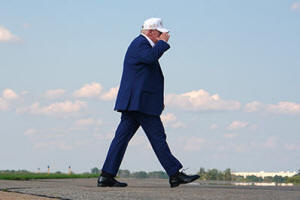
President Donald Trump walks to board Air Force One at Morristown
Airport, Sunday, Aug. 9, 2026, in Morristown, N.J. (AP Photo/Julia
Demaree Nikhinson)

Still, the sanctions and the ongoing U.S. naval blockade of Iranian
ports give the U.S. economic and financial leverage, said Juan
Zarate, a deputy national security adviser in the George W. Bush
administration. Zarate said the U.S. sanctions threatening
third-party countries doing business with Iran also have an impact.
But these things take time, he noted.
“The ultimate question will be how far the United States is willing
to go to constrict Iran’s oil trade and threaten third countries
with severe sanctions -- and whether it has the patience to test
whether the economic pain will change the regime’s behavior,” Zarate
said.
Past presidents used sanctions. Trump has said they didn't go far
enough
Trump's latest pivot to economic issues with Iran is something of a
flip-flop. Trump has long derided past presidents who used sanctions
to limit Iran’s economic ability to pay for its military and nuclear
development. In a speech last week in Las Vegas, he defended the
bombing, missiles and drone attacks that began on Feb. 28 by
indicating that the sanctions from previous administrations that
date back to November 1979 had failed to succeed.
“It’s been 47 years, but really, it’s been 50 years because they’ve
been saying 47 for three years, it’s been 50 years,” Trump said.
“And no other president has done what you should have done a long
time ago, because Iran cannot have a nuclear weapon, can’t have it.”
The Iranian economy has suffered gravely because of the war, with
the International Monetary Fund estimating the overall economy
shrinks by 5.4% and the Iranian government recently reporting an
annual inflation rate of 88.6%. The U.S. Treasury Department said
average loadings of Iranian oil have decreased from 1.8 million
barrels per day before the war to less than 500,000 barrels per day
over the past month.
The U.S. economy — the world’s largest — has continued to grow, but
inflation is elevated and borrowing costs have risen in ways that
have hurt Trump’s popularity and led to disapproval of the Iran war.
A senior U.S. official, insisting on anonymity to discuss strategy,
said the U.S. military has set back Iran’s ability to produce, sell
and ship oil and other energy resources. The administration sees the
naval blockade of the strait and sanctions as effective and views
Trump as having additional options that can be cranked harder in the
weeks and months ahead.

Trump is essentially arguing that U.S. voters are better able to
tolerate any economic inconveniences than Iranians, who have been in
a state of economic hardship for years.
“It’s not just what the military can do — we’ve got the most
powerful economy in the world as well," Defense Secretary Pete
Hegseth said Monday in a joint appearance with Bessent. "And when
you’ve got a motivated treasury secretary who can pull a lot of
levers because he knows how to do it, you can put a lot of pressure
on adversaries.”
___
AP White House reporter Aamer Madhani contributed to this report.
All contents © copyright 2026 Associated Press. All rights reserved
 |