Doctors say Trump's vaccine order will raise fears, cause confusion and
endanger kids
[August 12, 2026]
By LAURA UNGAR
Doctors say President Donald Trump’s new executive order on vaccines is
misguided and likely to stoke fear and confusion among parents at a time
when measles is raging, immunization rates are falling and children are
heading back to school.
“Many families are finishing up that back-to-school checklist, and among
those things is the medical checkup and assuring that their kids have
their vaccines,” Michigan pediatrician Dr. Molly O’Shea said. “To put
into question the safety or efficacy of these vaccines right now is
really unfortunate and ill-conceived.”
The order, signed Monday, advocates separating the measles, mumps and
rubella (MMR) vaccine into three different single-disease shots and
giving all childhood immunizations at separate appointments when
possible. It also includes several changes to the childhood vaccine
schedule already attempted by Trump’s health department but blocked by a
federal judge. The department is run by Robert F. Kennedy Jr., who
helped lead the anti-vaccine movement for years.
Trump repeatedly suggested the number or timing of vaccines could play a
role in rising rates of autism spectrum disorder, even though decades of
studies have firmly concluded there is no link. He also strongly
suggested that the MMR vaccine could be harmful or even deadly.
Dr. Paul Offit, a Children’s Hospital of Philadelphia vaccine researcher
and former government adviser, said the recommendations by Trump and
Kennedy “are just not science based,” and it’s irresponsible to cast
doubt on a vaccine that protects against measles when the nation is
facing its biggest epidemic in more than 30 years.
“The harm that it will cause is … to induce chaos and confusion into the
system, so people aren’t sure what they’re supposed to do,” he said.

Trump’s order evokes fears
At one point before signing his executive order, Trump used the word
“lethal” when talking about the current MMR vaccine, saying: “Together
there could be a possibility they are quite lethal and separately, it
looks like they are not at all lethal but just very effective.”
Doctors strongly rejected this characterization, saying the current
combination vaccine has gone through rigorous studies and years of
safety tracking — like other childhood vaccines — and has been shown to
be very safe. The diseases they protect against are the far bigger risk,
they said.
“The suggestion that separating the measles, mumps and rubella vaccines
one from another has value is incorrect in both science and in immune
response,” O’Shea said. “You actually get a better immune response
giving them together. There’s no value in separating them.”

There are currently no separate vaccines for children against these
diseases in the U.S., but Trump's order directs the health department to
present a plan to offer them. Trump spokesperson Kush Desai has said
that would give parents more options on timing and frequency, ultimately
increasing vaccine uptake.
Doctors lamented that Trump revived debunked theories about vaccines and
autism. Autism diagnoses have been rising for decades, with a recent
count finding that an estimated 1 in 31 children in the U.S. have autism
spectrum disorder. Scientists say that’s in part because the definition
has broadened with expanded understanding of its wide range of traits
and symptoms. There’s no single cause, they say, and genetic and
environmental factors can play a role.
[to top of second column]
|
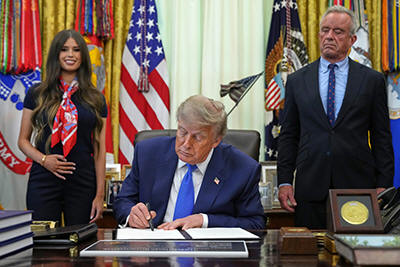
President Donald Trump signs an executive order about vaccines as
Jayme Franklin, left, and Health and Human Services Secretary Robert
F. Kennedy Jr. watch Monday, Aug. 10, 2026, in the Oval Office of
the White House in Washington. (AP Photo/Jacquelyn Martin)
 Dr. Andrew Racine, president of the
American Academy of Pediatrics, said the potential link between
childhood vaccines and autism has been studied in dozens of
well-designed studies around the globe and there is “unequivocally”
no link.
The fact Trump raised the issue, O’Shea said, “is really misguided
and unfair to families.”
Competing vaccine schedules raise confusion
Trump’s comments and his order also cause confusion about which
vaccines to give children and when, doctors said.
In the first year of Trump’s term, Kennedy set out to overhaul
immunization guidance, firing a 17-member vaccine advisory committee
and installing replacements who made the restrictive recommendations
halted by a federal judge. Those recommendations call for injections
against 11 diseases, with additional vaccines separately categorized
for at-risk children or as available through “shared
decision-making” with a doctor.
The pediatrics academy, meanwhile, continued to recommend vaccines
to protect against 18 diseases in its 2026 immunization schedule.
O’Shea said that schedule “has been very well designed, carefully
constructed and thoughtfully put together to provide safety and
protection just as the baby or young child’s immune system is ready
to accept it.”
Doctors said insurance coverage shouldn’t be an issue. Medicaid and
CHIP continue to cover the vaccines recommended before the current
Trump administration took office. Through 2027, private health
insurance plans generally will too, said Chris Regal of AHIP, the
national health insurers’ trade association.
Doctors say vaccine hesitancy, and dangers to kids, could grow
With confusion and fear rising, Racine said pediatricians expect to
answer more questions from parents.
But many doctors fear vaccine hesitancy may still keep increasing.
Federal data shows U.S. kindergarten vaccination rates have been
dropping, with the share of children with exemptions hitting an
all-time high in the 2024-25 school year.
Experts said they worry about families skipping necessary vaccines
for their children or spacing out shots, since a vaccine-preventable
disease could strike between doctor visits.
“Parents deserve clear, evidence-based guidance about how to protect
their children, not competing recommendations issued through
political processes,” said Michael Osterholm, a University of
Minnesota expert on infectious diseases. “When families receive
conflicting messages, confidence in vaccination suffers, and
children ultimately bear the consequences.”
___
Medical writer Mike Stobbe and video journalist Mary Conlon
contributed.
All contents © copyright 2026 Associated Press. All rights reserved |