Trump’s ‘energy emergency’ could fast-track massive expansion of
Plaquemines LNG export terminal
[August 13, 2026] By
TRISTAN BAURICK/Verite News
Less than two years after opening, a liquefied natural gas terminal near
New Orleans is seeking a multi-billion-dollar expansion under a new
Trump administration “emergency” permitting process that shortens
environmental review and may weaken protections for surrounding wetlands
and waterways.
The U.S. Army Corps of Engineers granted Plaquemines LNG, on the
Mississippi River between Myrtle Grove and Port Sulphur, fast-tracked
permitting under a “ national energy emergency ” President Donald Trump
declared last year.
The agency cut the public comment period from the typical 30 days to
just 10, ending July 2, and is expected to move quickly to approve the
expansion, which would allow the terminal to more than double in size,
growing from nearly 590 acres to about 1,220.
That would make the facility the largest LNG export terminal in North
America, according to its owner, Virginia-based Venture Global.
Environmentalists warn that the terminal’s expedited review could reduce
scrutiny of dredging, in-water construction, and the filling of
marshlands in a region suffering from rapid land loss. By the Army
Corps’ estimates, the $18 billion expansion could damage up to 470 acres
of wetlands and water bottoms in central Plaquemines Parish, about 25
miles south of New Orleans.
“Louisiana is already dealing with a coastal crisis,” said Matt Rota, a
senior policy director with Healthy Gulf, a New Orleans-based
environmental group. “Destroying 400 more acres in Plaquemines Parish is
ridiculous. I don’t know how many acres they have left, but it’s not
that much.”

Plaquemines has lost more than 250 square miles of land over the past 60
years to subsidence, sea level rise and erosion. The state’s Coastal
Protection and Restoration Authority projects another 300 square miles —
about half the parish’s remaining land — could disappear over the next
50 years. Much of Louisiana’s coast faces a similar threat. Since the
early 1900s, nearly 2,000 square miles of the state have vanished, an
area roughly the size of Delaware.
The Army Corps and Venture Global did not respond to requests for
comment.
Hundreds of other energy projects could receive expedited permitting
under the emergency declaration, which Trump said was necessary to
maintain a “reliable, diversified, and affordable supply of energy” for
the U.S. military and economy. Last year, the Army Corps identified more
than 600 projects that could speed through the normal review process
required by the Clean Water Act.
Streamlined permitting will likely accelerate the growth of an already
booming LNG industry. More than 30 LNG export terminals are under
construction or proposed in the U.S. Plaquemines LNG is the newest of
four terminals in Louisiana, including Sabine Pass, Cameron LNG and
Calcasieu Pass LNG, which is also owned by Venture.
LNG is natural gas chilled into a liquid for easier shipment overseas,
where demand has surged as countries seek alternatives to coal and
Russian gas.
The industry’s critics say shipping natural gas abroad conflicts with
Trump’s stated rationale for declaring an energy emergency: boosting
what he described as the “nation’s inadequate energy supply.”
[to top of second column] |
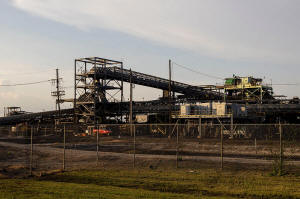
The Plaquemines LNG export terminal in Port Sulphur, La., Tuesday,
July 28, 2026. (Christiana Botic/Verite News and Catchlight
Local/Report for America via AP)
 “It’s hard to see how expanding an
LNG export terminal is going to help domestic energy independence
and reliability,” said Griffin Bird, a research analyst with the
Environmental Integrity Project.
“This has nothing to do with energy security,” Rota said. “It
sacrifices the Louisiana coast to enrich billionaires.”
Of the 833 billion cubic feet of gas exported from Plaquemines LNG
last year, most went to Europe, with Germany receiving the largest
share, at 19%, according to the U.S. Energy Information
Administration.
The terminal is one of Louisiana’s largest industrial facilities,
with 1.3 miles of river frontage, three ship berths, two gas-fired
power plants, and nearly 30 miles of natural gas pipeline.
It’s also one of the state’s biggest polluters. Plaquemines LNG is
permitted to release about 8.1 million tons of carbon dioxide and
other greenhouse gases per year, according to company records.
That’s equivalent to the annual greenhouse gas emissions of 1.7
million gas-powered vehicles.
The only industrial facility in Louisiana that emits more than
Plaquemines LNG is CF Industries, an ammonia producer in
Donaldsonville that released about 10.4 million tons of greenhouse
gases in 2023, the latest year available in the Environmental
Protection Agency’s greenhouse gas emissions inventory.
Those emissions, along with the carbon dioxide released when the LNG
is burned for energy overseas, contribute to climate change, which
is accelerating sea level rise and intensifying the storms that
drive land loss in Plaquemines, Rota said.
“Burning more natural gas means we lose Plaquemines Parish even
faster,” he said.
The terminal’s expansion would increase its production capacity from
about 1.4 trillion cubic feet of gas per year to around 2.3
trillion.
It’s unclear how the expansion will affect emissions, but federal
filings indicate the larger facility could produce at least 9
million tons of greenhouse gases per year. Venture plans to use
carbon capture and sequestration technology to inject a portion of
the terminal’s carbon dioxide underground.

Some Louisiana leaders welcome the expansion, saying it will spur
economic activity and create jobs.
U.S. House Majority Leader Steve Scalise, a Jefferson Parish
Republican, celebrated the rapid development of the Plaquemines
site.
“This was a cow pasture four or five years ago,” he told reporters
during a tour of the facility in April. “Now it’s the most modern,
the most efficient, the largest LNG export facility in the world,
and they’re building another one just like it next door.”
All contents © copyright 2026 Associated Press. All rights reserved |