Congo’s Ebola outbreak is on track to surpass the deadliest one in
history, WHO chief says
[August 13, 2026]
By STEFANIE DAZIO and MARK BANCHEREAU
The ongoing Ebola outbreak in Congo is on track to surpass the deadliest
one in history, which erupted over a decade ago and killed over 11,000
people, the head of the World Health Organization said Wednesday.
“At its current pace, it's on track to eclipse the West African Ebola
outbreak of 2014 to 2016,” Tedros Adhanom Ghebreyesus told reporters.
That outbreak horrified the world and jolted efforts to develop a
vaccine.
The outbreak in eastern Congo, considered the fastest-growing one yet,
has killed over 2,000 people out of more than 4,300 cases. The outbreak
was declared on May 15, but health authorities now say sequencing showed
it began months earlier, in February.
It is unlike recent Ebola outbreaks because the rare Bundibugyo virus
responsible for it has no approved vaccines or treatments, though
efforts to address that are underway.
WHO says this outbreak ‘had a big head start’
Experts say this outbreak is moving faster than efforts to track and
manage it in a remote part of eastern Congo facing ongoing conflict,
near the borders with South Sudan, Uganda and Rwanda.
Most new cases and deaths are being reported in communities outside the
reach of health workers in a region of poor infrastructure and
ill-equipped health centers. Some workers have gone on strike over lack
of pay. Misinformation about the virus circulates in communities where
some are wary of outsiders, keeping some people from clinics.

“The outbreak had a big head start, still way ahead of us, and we’re
playing catch-up,” Tedros said.
Dr. Abdirahman Mahamud, WHO's director for health emergency alert and
response operations, said the agency expects the peak of the outbreak to
be reached in six months.
“But ... that’s the moderate scenario,” Mahamud said. “There is a
one-case scenario where this outbreak may last nine months to 12
months.”
This Ebola outbreak has killed more people at a faster rate than any
other, including the 2014-2016 outbreak that had at least 28,000 cases.
That one took about eight months to reach 1,000 deaths.
[to top of second column]
|
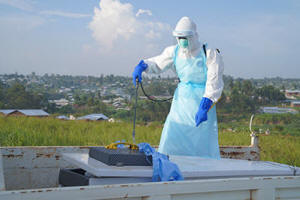
A health worker sprays the coffin containing the remains of Jacques
Lobo Dhena, who died of Ebola, during a burial service in Bunia,
Ituri province, eastern Congo, Wednesday, Aug. 12, 2026. (AP Photo/Dieudonne
Dirole)
 Two vaccines for this type are
being tested
Ebola is rare but highly contagious and can be contracted from
bodily fluids such as vomit, blood or semen, and from contaminated
surfaces and materials such as bedding and clothing. The disease it
causes is severe and often fatal.
Clinical trials of two possible treatments for this type of Ebola
began last month in Ituri, the most affected of the five provinces
in Congo where cases have been reported.
Two vaccines developed specifically for the Bundibugyo virus are now
being tested in people for the first time, Tedros said Wednesday.
WHO also plans to test whether an existing Ebola vaccine could
protect people against the virus after studies in animals showed
promising results.
The origins of the outbreak are becoming increasingly clear.
A study published in Nature Medicine on Monday added evidence that
the outbreak began when the virus jumped from an infected animal to
a person, rather than stemming from earlier outbreaks. Researchers
found the virus is genetically different from versions seen in
Bundibugyo Ebola outbreaks in 2007 and 2012.
___
Dazio reported from Berlin and Banchereau from Dakar, Senegal.
Associated Press writer Mike Stobbe in New York contributed to this
report.
All contents © copyright 2026 Associated Press. All rights reserved
 |