Kids keep getting hurt and killed on e-bikes. Should parents be held
responsible?
[August 14, 2026]
By PHILIP MARCELO
NEW YORK (AP) — As traumatic injuries and deaths surge among children
involved in crashes on e-bikes and other electrified vehicles, one
California prosecutor is cracking down by pursuing criminal charges
against some of the young riders' parents.
It is just one way officials across the country are trying to tackle the
growing issue, while families navigate a patchwork of local laws and
guidance on what kind of souped-up cycles and scooters are safe or even
legal for their kids to ride.
New York City’s mayor recently sent cease-and-desist notices to dozens
of online retailers for selling products marketed as “e-bikes” that
aren’t street legal after a 17-year-old died in a crash on an illicit
vehicle. In neighboring New Jersey, new regulations require e-bike
riders to be at least 15 and obtain a license and vehicle registration.
But do the measures hit the mark? Cycling advocates worry regulations
might be too broad — demonizing low-powered e-bikes instead of speedier
motos — while some parents question whether localized, piecemeal
strategies are enough.
Monica Stafford, a San Francisco-area mother whose teen daughter
fractured her skull falling off an e-bike, said officials are “missing
the mark” if they’re seeking to lay the blame solely on parents. The San
Rafael resident said a unified, national set of rules is needed.
“We’re in a total Wild West of laws,” Stafford said. “Being for common
sense laws doesn’t mean that you’re against e-bikes, just like you can
be for cars but not think that it’s safe to put keys in the hands of a
10-year-old.”

E-bike injuries disproportionately impact children, experts say
The two-wheeled machines have become nearly ubiquitous in recent years,
from packs of teens zipping around California beach towns to the army of
delivery drivers dodging traffic on the congested streets of Manhattan.
Hospital visits for injuries from e-bike, e-scooter and other motorized
rides have, as expected, soared as they have grown in popularity, study
after study has shown. But researchers stress that the more concerning
trends are the severity of the injuries and the fact that they’re
especially pronounced among children.
“The big takeaway is that people are generally more severely injured
than they would be if they were on a traditional, pedal bicycle,” said
Dr. John Austin, a doctor at the University of California San Diego
School of Medicine who led a recently published statewide study.
“Overall, these patients tend to be younger, they tend to be unhelmeted
and, in turn, be more severely injured.”
Recent youth deaths prompt officials to take action
Most e-bikes are classified as nonmotorized vehicles akin to traditional
bicycles under federal law, meaning riders don’t need a license,
insurance or to even wear a helmet. Most states, though, have enacted
additional requirements for higher powered machines, including minimum
age and helmet requirements.
In New York City, the death of 17-year-old just steps from City Hall has
spurred renewed debate about the bikes. Gabriel Nacato had been riding a
vehicle advertised as an “e-bike” but wasn't legal on city streets.
Earlier this month, Mayor Zohran Mamdani warned more than 40 online
retailers, including Amazon, Walmart and Target, that they could face
fines of up to $2,000 for each sale of an e-bike that exceeds city
regulations.
New York state requires riders of all forms of e-bikes to be at least
16, and New York City imposes additional restrictions, including a 15
mph (24 kph) speed limit. California, in contrast, has no statewide
minimum age for lower-powered bikes, though riders must be at least 16
to use e-bikes that can go up to 28 mph (45 kph).
New Jersey and Illinois are among the states that have enacted statewide
regulations recently, and Massachusetts is weighing measures. Meanwhile,
Florida Gov. Ron DeSantis in June vetoed a 10 mph (16 kph) speed limit
and other e-bike regulations, saying the measures would lead to
“enhanced surveillance” of citizens.
[to top of second column]
|
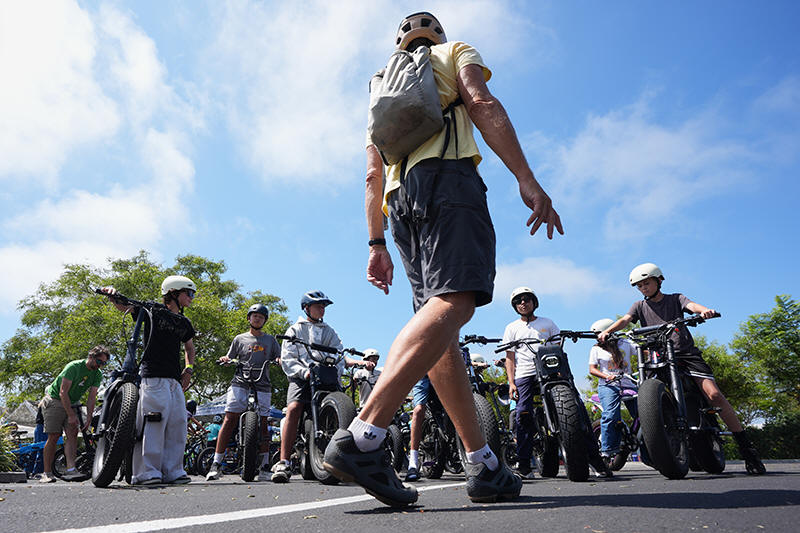
A group of riders listen to an instructor during an e-bike safety
and training class Saturday, Aug. 8, 2026, in San Diego. (AP
Photo/Gregory Bull)
 Other jurisdictions seek to hold
parents accountable
In Southern California, Orange County District Attorney Todd Spitzer
says his office has more than two dozen open investigations against
parents after launching a new unit focused on e-bike and
e-motorcycles cases involving children.
The office has already brought charges against four, including the
mother of a 14-year-old boy accused of killing an elderly pedestrian
while riding an e-motorcycle.
That mother’s attorney declined to comment, but Mitchell Krems, the
lawyer for another parent, dismissed the charges against his client
as “absurd,” suggesting his client was being made a “scapegoat.”
Richard Eyssallenne pleaded not guilty to child endangerment charges
after prosecutors say he bought his 12-year-old son an e-motorcycle
and helped him illegally modify it to make it go faster. The boy ran
through a red light and was injured by a car.
Other jurisdictions have also taken steps to hold parents liable. In
Ohio, a Columbus suburb recently issued new e-bike rules making it
clear that parents who knowingly allow their children to break the
rules are subject to the same penalties as the rider.
Cycling advocates blame electronic motorcycles
PeopleForBikes, a national bicycle advocacy group that tracks state
e-bike regulations, stressed that many of the problematic vehicles
are actually electronic motorcycles with heavy frames, sturdy tires
and sizable motors that are falsely marketed as e-bikes.
Lower-powered and pedal-assisted e-bikes have been used safely for
decades on U.S. streets and are key to reducing society's reliance
on cars, advocates argue.
“Many of the dangerous behaviors people cite — running red lights,
riding on sidewalks, not wearing helmets — are already illegal,”
added Chloé Lauer, executive director of the San Diego County Bike
Coalition. “We’d rather see those laws enforced than add new
restrictions that limit mobility for kids who are riding
responsibly.”

Anya Dalal, a San Francisco-area high school senior who has been
advocating for better safety measures, believes the problem requires
multiple solutions, including setting age limits.
“It should be a mix of parental accountability, accountability from
the manufacturers and retailers and also education for kids to
understand e-bike laws and road rules,” said the 17-year-old
Hillsborough resident.
Sharon Franke, a San Diego-area mother, agreed, though she said the
first step starts at home, with parents doing their research,
accompanying their children on rides and reinforcing safety once
they set off on their own.
“We want them to have fun, but we also want them to come back safe
and we don’t want them to hurt anybody,” she said as her 15- and
12-year-old sons prepared to attend a safety training last weekend.
“How do you balance all of it? It’s just overwhelming right now.”
__
Associated Press reporters Amy Taxin and Christopher Weber in
California and Anthony Izaguirre in New York contributed to this
story.
All contents © copyright 2026 Associated Press. All rights reserved |