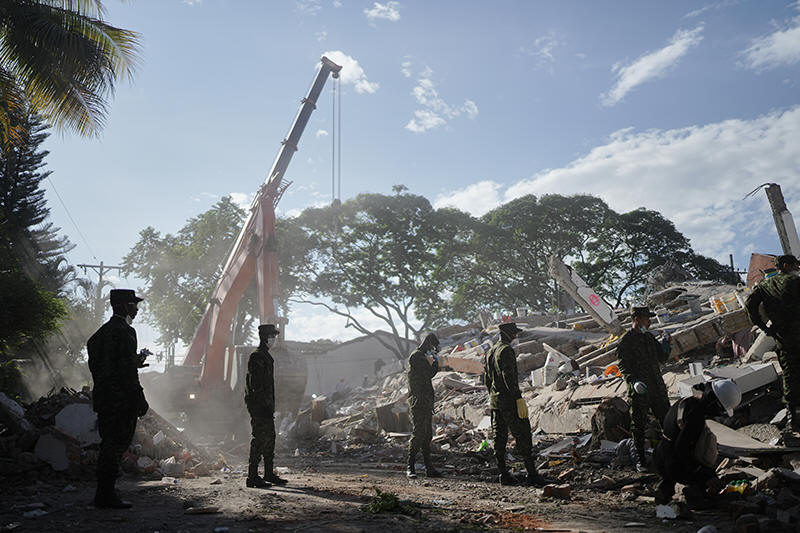
Rescuers call for silence around earthquake rubble as window for
survival narrows in Colombia
[August 14, 2026]
By ASTRID SUÁREZ, MARKO ÁLVAREZ and NAYARA BATSCHKE
CALI, Colombia (AP) — With arms raised and fists clenched, rescuers in
Colombia called for silence Thursday as they listened for signs of life
in the rubble of a deadly earthquake and raced to pull more survivors
from the debris before time runs out.
The call for quiet was part of last-ditch efforts to find anyone else
alive in the aftermath of the 7.4 magnitude quake that struck the South
American country Monday, killing more than 280 people and leaving
hundreds more missing.
“Unfortunately, we are reaching a point where the probability of finding
survivors is dwindling,” said David Santiago Tamayo, director of the
National Unit for Disaster Risk Management, in a press conference
Thursday night. “But the mission is to never stop searching and find all
those reported missing.”
Aid agencies consider the first two to three days after a quake to be
the prime window for retrieving survivors. People trapped in debris can
live longer if they have access to food and water.
The death toll rose Thursday to 281, authorities said, with another 348
people rescued.
As time runs out, rescuers, families and volunteers across the country
continue to hold on to hope.
“There might be two more people alive here, and I’m hopeful,” rescuer
Daiana Rojas told The Associated Press. “We have been hearing sounds
since 2:30 a.m., so our hope remains.”
Rojas and her family were unharmed by the quake, the most powerful to
hit Colombia in this century. She has been volunteering to help search
for survivors in Cali, one of the most heavily damaged cities, along
with Pereira, Manizales and Quibdó.

“I thought that was going to be my last moment alive,” she said,
recalling the terror of the quake. “Seeing this situation in my city
breaks my heart.”
Rojas has witnessed two people being pulled alive from the debris, as
well as the recovery of bodies.
“They are not a relative or a friend of mine, but it feels as they
were,” she said of the survivors who have been found. “Whenever rescuers
ask for silence, everyone stays still and tries not to move, speak or
whisper. But when signs of life are found, all the teams start to
applaud.”
Critical hours
The devastation has tested Colombia’s new President Abelardo de la
Espriella and his government as they scramble to respond while aid
groups seek to help the hardest-hit communities.
“The situation is complex, but we are using all our capacity and the
capacity that has come from other countries,” de la Espriella said.
The president added nearly 400 people remain missing, though
civilian-run databases put the number at more than 4,200. More than
3,900 people were reported injured, while nearly 10,600 homes were
destroyed and more than 65,800 damaged. In total, more than 44,900
families have been affected, he said.
Authorities recognize that the rescue effort has entered a grim phase as
search teams begin shifting toward recovering bodies. But as the
government moves forward with plans to help those affected and rebuild
the country, finding potential survivors remains a priority. “Our
priority is saving lives,” de la Espriella said. “These are human beings
who are trapped under the rubble.”
In other developments, a 4.2 magnitude aftershock struck Thursday in San
José del Palmar, in the Chocó region — the epicenter of the earthquake.
More than 160 aftershocks have rocked the country, according to the
Colombian Geological Survey.

[to top of second column]
|
Soldiers clear debris three days after an earthquake struck Cali,
Colombia, Thursday, Aug. 13, 2026. (AP Photo/Ivan Valencia)

“We’re pretty shaken up, but we’re in good spirits. We can see
everyone working hard to get through this very complex situation,”
volunteer helper Jairo Galán said in Cali, where food and donation
centers were set up.
Colombia, with a population of 54 million people, experiences an
average of 2,500 earthquakes each month, most of them small. That's
equivalent to about 80 tremors per day, according to the geological
survey.
More international aid arrives
Meanwhile, international aid continues to arrive.
Speaking to reporters in Quibdó, in the Chocó region, Colombian Vice
President José Manuel Restrepo said rescuers had concluded the
search for survivors and bodies in the area and would now shift
their focus to the “humanitarian phase.”
The region has received some 7 tons of humanitarian aid, with
another 10 tons expected to arrive late Thursday night. An
additional 20 tons of supplies are expected to arrive on Friday.
“That’s almost 40 tons of humanitarian aid, containing everything
people will need at this moment,” Restrepo said.
Earlier today, a group of rescuers from the Los Angeles County Fire
Department arrived to help with search efforts and structural
engineering assessments. Other countries, including Peru, El
Salvador, Mexico and Brazil, have also offered assistance.
De la Espriella announced on X that Colombia will receive a $10
million donation from the United Arab Emirates.
The Chinese ambassador to Colombia said China will provide $1
million in financial aid and more than $2 million in humanitarian
assistance.
The South American Football Confederation and the Colombian Football
Federation also jointly announced a $1 million donation to support
reconstruction efforts.
“Soccer transcends the pitch and remains close to its people,
especially in the most difficult times,” they said in a statement.
The Colombia disaster unfolded less than two months after
neighboring Venezuela endured back-to-back earthquakes. The contrast
between the two countries' responses was stark.

In Venezuela, acting President Delcy Rodríguez waited nearly four
hours before addressing the nation. In Colombia, de la Espriella
announced an emergency command post to oversee rescue efforts barely
an hour after the earthquake. For weeks, Venezuelan civilians were
clawing through rubble by hand. Hours after the earthquake in
Colombia, rescue teams were searching for survivors with cranes and
excavators.
The contrast was a reminder of the differences between the nations —
their political systems, resources and the strength of their
institutions — and a demonstration of how those can take on
life-or-death importance.
___
Suarez reported from Bogota, Colombia. Batschke reported from
Santiago, Chile.
All contents © copyright 2026 Associated Press. All rights reserved |