With US-Iran talks stalled, diplomatic efforts expand to unlikely
European players
[August 15, 2026]
By MATTHEW LEE and FARNOUSH AMIRI
WASHINGTON (AP) — Faced with an increasingly bellicose Iran as talks to
end the war have stalled, the Trump administration appears to be
reaching out to a broader swath of countries that might be able to help
pressure Tehran or ease its hardline position where traditional
mediators have not succeeded so far.
While discussions between Iran and Oman, as well as between Iran and
Pakistan, Turkey and Qatar, persist at an uneven and unpredictable pace,
the U.S. administration quietly has expanded its outreach to include
perhaps unlikely interlocutors in Europe.
Just this week, Secretary of State Marco Rubio met in person in
Washington with the foreign minister of Austria on Tuesday and held a
call with the foreign minister of Greece on Wednesday.
Those interactions were not notable beyond the normal course of
relations between the U.S. and two close European allies. The official
State Department readouts of the discussions were bland and vague and
did not mention Iran by name as a topic of conversation.
But it then emerged that both foreign ministers — almost immediately
after their talks with Rubio — spoke Thursday with Iranian Foreign
Minister Abbas Araghchi.
The apparent new tack to break the negotiation logjam comes as the U.S.
and Iran are both pushing for control of the Strait of Hormuz, the
crucial oil shipping corridor. President Donald Trump faces little
wiggle room in his next steps as the economic fallout from the war and
dwindling stockpiles of key weapons pose political problems for
Republicans ahead of November’s midterm congressional elections.

A desperate push is on to break the diplomatic logjam between the US
and Iran
The entry by Austria and Greece is likely less of a formal mediation
attempt, analysts say, and more reflective of a desperate push to halt
the conflict because of the impact it has on an increasing number of
countries, beyond those in the Middle East.
“Everyone is just urging both sides to stop this reckless game of
chicken,” said Ali Vaez, Iran project director at the International
Crisis Group.
It also shows how much Iran's effective closure of the Strait of Hormuz
has forced countries, which otherwise were neutral bystanders to the
larger conflict, to exercise any diplomatic sway they may have on their
Iranian and American counterparts to kick-start a lasting resolution.
Mona Yacoubian, director of the Middle East Program at the Center for
Strategic and International Studies, warned that any efforts by Greece,
Austria or any other non-mediating country could prove to be futile.
“While the calls to both sides may entail encouraging both Iran and the
U.S. back to the negotiating table, such efforts fall short of
mediation, which is a very complex endeavor and requires trust to be
built by the mediator with both sides," Yacoubian said.
She added that it’s not something that any country can “just jump into.”
Rubio discussed Iran with his Austrian and Greek counterparts
The State Department said Friday that it could not comment on the timing
of calls by other countries' foreign ministers and maintained that Rubio
had made no requests of either to get in touch with Iran or pass
messages to Araghchi.
One European diplomat, who was briefed on the matter and spoke on
condition of anonymity to detail sensitive diplomatic conversations,
said the timing of the calls was not an accident.
The State Department did allow, however, that Iran had been a topic of
conversation in Rubio's discussions, which occurred as Trump is facing
serious political headwinds over a war for which he has offered shifting
objectives.
[to top of second column]
|
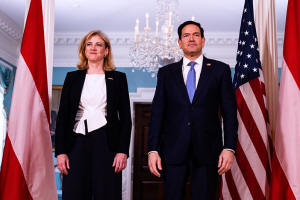
Secretary of State Marco Rubio arrives with Austrian Foreign
Minister Beate Meinl-Reisinger, to the Treaty Room at the State
Department, Tuesday, Aug. 11, 2026, in Washington. (AP Photo/Tierney
L. Cross)

No longer purely about making Iran incapable of producing a nuclear
weapon, the immediate goal has become reopening the Strait of
Hormuz, where a fifth of the world's oil usually passes through and
which was open before the U.S. and Israel launched attacks on Iran
on Feb. 28.
“That’s goal number one: keep oil and gas cheap for Americans all
over our country,” Vice President JD Vance said in an interview
Thursday on Fox News Channel. But he did not say anything about the
strait being open and toll-free for transiting ships, as he had in
the past.
The second goal, Vance said, is to ensure that Iran will never get a
nuclear weapon.
The two European countries have key connections to the war's
fallout
Austria and Greece may not be obvious choices to assist on the Iran
portfolio, but Vienna is home to the International Atomic Energy
Agency, which will play a key role in any resolution to the Iran’s
nuclear program, and hosted the final negotiations that resulted in
the 2015 Iran nuclear deal. Greece is a major maritime nation in the
Mediterranean and has significant shipping interests in the Strait
of Hormuz and the Red Sea.
In statements from the Austrian, Greek and Iranian foreign
ministries, it was clear that Iran had been a top topic in all of
the conversations this week.
The Greek foreign ministry said Foreign Minister George Gerapetritis
had been briefed by Araghchi on “regional developments, and in
particular on the ongoing talks regarding the Strait of Hormuz.” It
said Gerapetritis “underlined the importance of freedom of
navigation and maritime security.”
The Austrian foreign ministry offered Austria’s services as a venue
for further potential talks with Iran and said Foreign Minister
Beate Meinl-Reisinger had stressed to Araghchi “the urgency of
restoring stability in the region through serious diplomatic
efforts.”
“There can be no military solution,” it said. “A diplomatic solution
remains possible. Our priority is to safeguard freedom of navigation
through the Strait of Hormuz.”
Iran’s foreign ministry, expectedly, took a different tack in
explaining the calls.

It said Friday that in Araghchi’s calls with his European
counterparts they discussed “mechanisms for the future management of
the Strait of Hormuz,” which he said had been disrupted by the
“unlawful aggression by the United States and the Israeli regime
against Iran.”
In both calls, he accused the U.S. of violating the interim deal
signed by both sides in June to end the immediate hostilities and
begin broader talks to end the war.
___
Amiri reported from New York. Associated Press writers Derek
Gatopolous in Athens and Claudia Ciobanu in Warsaw, Poland,
contributed to this report.
All contents © copyright 2026 Associated Press. All rights reserved |