Democrats' early 2028 primary calendar set to prioritize Black and
Latino voters, organized labor
[August 15, 2026]
By MIKE CATALINI and BILL BARROW
AUSTIN, Texas (AP) — Democrats' process for picking a 2028 presidential
nominee will likely kick off in states where candidates will need to
appeal to key supporters such as Black and Latino voters and union
members.
It also may require fewer parkas for the winters in Iowa, which is out
of the top spot of the proposed calendar, and learning to pronounce
Nevada the way the locals do (it's Ne-VAD-ah).
The Democratic National Committee is scheduled to approve the calendar
Saturday at a meeting in Texas.
South Carolina’s primary would be first on Jan. 22, followed by Nevada
on Feb. 1. New Hampshire, New Mexico, Michigan and Virginia would round
out the early states, throughout February.
“It shouldn’t surprise anyone as a result of it being the largest and
most diverse committee that we got the most diverse calendar in our
party’s history,” DNC Chairman Ken Martin, who has championed the
calendar, told a gathering of the party’s Black Caucus this week.
Democrats' 2028 presidential primary is expected to draw a large group
of candidates. Already, some potential candidates have been making stops
in states expected to vote early, such as South Carolina. Party leaders
have widely praised the plan as giving its candidates the best shot at
replacing President Donald Trump.
“They have to show that they can go to the South and talk to Black
voters and rural voters, as well as out west, talking ranching and
mining issues, to a border state, to union members,” said party
strategist Karen Finney, who has worked on multiple winning and losing
presidential campaigns. “Whoever survives will be battle tested.”
Former presidential candidate Howard Dean recalled his time as national
party chairman, when Democrats solidified Nevada and South Carolina as
early states behind Iowa and New Hampshire. The latest change is even
better, he said.

“These states look more like the country,” as a whole, he said, “whereas
Iowa and New Hampshire don’t.”
Nonwhite voters claim top billing
As the first-in-the-South primary, South Carolina was more decisive than
Iowa and New Hampshire for nominees Barack Obama in 2008, Hillary
Clinton in 2016 and Joe Biden in 2020. All three dominated among South
Carolina’s large Black population, which can yield more than half the
state’s Democratic primary electorate.
With Nevada and New Mexico following, that will likely require that
candidates also court more Latino voters long before voting starts.
Shifting from Iowa and New Hampshire does not mean little-known
candidates can't catch fire like Pete Buttigieg did in Iowa and New
Hampshire in 2020, when he was a 37-year-old former mayor. They just
won’t be able to do it with an almost entirely white audience.
“If you can’t go to every part of this country and make your case, you
should not be running for president,” Finney said.
The progressive vs. establishment dynamics may shift
There’s disagreement over how Democrats’ split between progressives and
mainstream liberals may — or may not — surface in the calendar.
“I think our primary voters up north are probably a little different
than primary voters in South Carolina,” said Boyd Brown, a former DNC
member from South Carolina. “It’s not the woke ideologies that we just
can’t get away from” in other places.
Nina Smith, a former Buttigieg adviser who now works closely with
progressive causes, disagreed. Smith agreed that Black South
Carolinians, especially, have gravitated to more moderate candidates —
twice rejecting Vermont Sen. Bernie Sanders in favor of Clinton and
Biden.
But, she said, “Southern Black voters are more progressive than they’re
given credit for” on policy but also “realists” about what’s possible.
“Living through Jim Crow and other oppressive structures will force you
to take that approach,” she said.

[to top of second column]
|
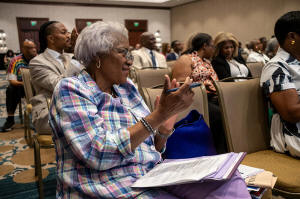
Democratic National Committee member Donna Brazile attends a Black
Caucus meeting as part of the DNC Summer Meeting, Thursday, Aug. 13,
2026, in Austin, Texas. (AP Photo/Joel Angel Juarez)

Smith said that South Carolina leading off — with many Southern
states following on Super Tuesday soon after the early slate
concludes — means that progressives will have to take the time to
listen and then tailor their messages.
“A lot of Black voters don’t necessarily see themselves in the ideas
and arguments that progressives put forward,” she said.
Unions get a spotlight
The slate covers three major organized labor buckets.
Nevada has the service industry unions because of Las Vegas;
Michigan has the auto industry and associated manufacturing support
industries; Virginia is home to more federal workers than any other
state.
“Labor is still so important,” Dean said.
Beyond seeking members' votes, campaigns and the party look to
organized labor for help in spreading Democrats' message to voters
and getting people to the polls.
More scheduling efficiency for candidates
Campaigns struggle to balance many demands: meeting voters on the
ground, raising money and travel logistics. As a result, some
places, such as Nevada, have gotten short shrift in the past because
candidates, most from the eastern half of the country, have
concluded the time investment isn’t worth it.
An expanded calendar offers more clustering opportunities.
A Western swing could hit two early states — Nevada and New Mexico —
plus a fundraising stop in California, which is rich with Democratic
donors. A South Carolina trip could mean fundraisers and public
appearances in Atlanta, Charlotte and Raleigh. Virginia offers
proximity to donors and national TV studios in Washington; the same
options are available by adding a New York City stop on the way to
New Hampshire.
Bre Maxwell is a DNC member from South Carolina who said the state’s
smaller size and lower media costs are a financial equalizer,
allowing not only the best-funded candidates to have an impact.
“They can campaign from the top to the bottom in a day,” Maxwell
said.

It’s about primaries — with a clear look to November
Of the six states, all but South Carolina are competitive general
election states. That means that even before Super Tuesday,
Democrats — including the eventual nominee — will have spent
significant time and resources in battlegrounds worth a combined 43
Electoral College votes. That’s not insignificant on the way to the
270 needed to win.
TV ads and news coverage can spill over, as well. Markets targeting
parts of South Carolina also reach portions of North Carolina and
Georgia.
After all, Brown said, the point is to put a Democrat in the White
House.
“This is not a social or a debate club. It is a political party,” he
said.
___
Barrow reported from Atlanta. Associated Press reporter Meg Kinnard
in Columbia, South Carolina, also contributed.
All contents © copyright 2026 Associated Press. All rights reserved |