'No serious dispute' that Comey's seashell post could be read as a Trump
threat, prosecutors say
[August 20, 2026]
By ERIC TUCKER
WASHINGTON (AP) — The Department of Justice is defending its prosecution
of former FBI Director James Comey, saying “there is no serious dispute"
that a social media post of seashells he made last year could be
understood as a threat against President Donald Trump.
Prosecutors also called into question Comey's account that he had found
the seashells in the numerical arrangement of “86 47” while walking on a
beach in North Carolina and suggested that his May 2025 post on
Instagram was an effort to generate attention for a forthcoming novel
about a social media personality whose words inspire his fans to attack
his foes.
The arguments in motions late Tuesday represent the government's most
detailed explanation of its indictment and were filed in response to
wide-ranging defense efforts to dismiss the case on grounds including
that it constitutes a vindictive prosecution and that Comey's post did
not amount to a true threat. Comey's lawyers contend that investigators
in the case misled judges, submitted documents containing false
statements, withheld key facts and repeatedly came up empty in their
efforts to prove that Comey intended a physical threat or knew that the
number 86 could suggest violence.
The entry for “86” from Merriam-Webster, the dictionary used by The
Associated Press, says its meaning is “to throw out,” “to get rid of” or
“to refuse service to.” Trump, a Republican, is the 47th president.
The Justice Department maintains that the post constituted a real
threat
Federal prosecutors maintain that the photo of the seashells, which
Comey said he found on the beach, constituted a threat against Trump.
Comey deleted the post shortly after he put it up, saying he did not
know that anyone interpreted the numbers as a call to violence. His
lawyers have said that the slogan has long meant to “get rid of” or
“eject” and has been featured on thousands of items sold online and
regularly displayed at protests.

But the department sought in its filings to place the post against the
backdrop of assassination plots or attempts against Trump in the months
before and after Comey's post. Prosecutors say that two minutes before
the post was made, Comey's wife texted him a screenshot of a definition
of “86” that said "to get rid of or refuse service.”
"There is no serious dispute that an objective viewer of Comey’s post
could read it to mean ‘Kill President Trump,’” prosecutors wrote.
The photo was posted days before Comey was set to release a novel he
wrote titled “FDR Drive,” in which a prosecutor pursues a far-right
social media personality who has called out his adversaries by name and
inspired violence against them by his fans, the department said.
After the Instagram post provoked an outcry, according to the
government's filings, Comey's publishing agent observed in a text
message to him that he had “gone viral.” Comey responded that that was
“not my intention, but I’ll be OK if it sells books.” The agent replied,
”Music to an agent's ears."
Prosecutors also asserted there was “reason to doubt” Comey’s account of
having come upon the seashells while on a walk, saying they were located
4 miles (6 kilometers) “down from the beach from beachfront property
where Comey was staying, in an area separated from the ocean by a sand
dune.” They said there was "no evidence that anyone else arranged,
photographed, or even saw the shells.”
[to top of second column]
|
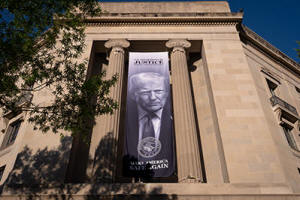
A portrait of President Donald Trump is displayed at the Justice
Department building in Washington, June 2, 2026. (AP Photo/J. Scott
Applewhite, File)

Comey has called the case vindictive, but prosecutors deny that
Comey's lawyers have called the indictment, which was filed months
after an earlier and unrelated case against him was dismissed, part
of a Trump retribution campaign targeting one of the president’s
vocal critics. Trump fired Comey as head of the FBI in 2017 as Comey
was overseeing an investigation into potential ties between Trump's
2016 presidential campaign and Russia. Trump since then has called
for him and other perceived adversaries to be jailed.
But the Justice Department denied allegations of vindictiveness,
saying the decision to indict Comey was made by the U.S. attorney in
the area and did not stem from a directive from the president or the
attorney general.
To bolster their claims that Comey was unjustly targeted, the
defense team argued that investigators struggled to develop
compelling evidence from witnesses that Comey had intended the post
as a threat, but they concealed that from federal magistrates as
they applied for warrants to search digital accounts associated with
Comey and his wife
For instance, defense lawyers have said that the FBI searched an
internal database of information about open and closed
investigations for any indication of an association between Comey
and the term “86” but found inconclusive results. An FBI agent also
requested a review of the FBI file for the case against reputed
mobster John Gambino, which Comey worked on as a young prosecutor,
but found no references to the term “86.”
Investigators also interviewed a key government cooperator in the
case, Salvatore “Sammy the Bull” Gravano, who said he did not recall
ever discussing the term “86” with Comey or hearing it in connection
with the trial.
The latest filings made clear that the administration was standing
behind the premise of the case.
“No Government theory was disproved at that time, or now. No
intentionally false omission exists, much less one made with
reckless disregard for the truth,” prosecutors wrote.
“The evidence still supports that Defendant acted at least
recklessly by consciously disregarding a substantial risk that his
coded message of ‘8647’ that he sent to his 200,000 or so Instagram
followers, and the millions of secondary social media users who
would view this as threatening violence against the President of the
United States," they added.
All contents © copyright 2026 Associated Press. All rights reserved
 |