China investigates comedian after he altered a revolutionary song lyric
onstage
[August 22, 2026]
By FU TING
One of China’s best-known comedians is under investigation and several
of his shows have been canceled after he changed the lyrics of a
revolutionary song during a performance.
Guo Degang, the country’s most prominent performer of traditional
xiangsheng, a form of Chinese comedic dialogue, is under investigation
by local authorities in the city of Wuhan in central China, local media
reported. Guo's show on Friday in the northwestern city of Xi’an was
canceled due to “venue issues," a statement on ticketing platform Damai
released by his promotion company showed.
The company offered refunds for tickets as well as travel and hotel
expenses. The exhibition center hosting the performance in Xi’an, which
also cited “venue issues” on Wednesday, said the show had been
“postponed,” without giving a new date.
Local media reports said several of Guo’s shows scheduled in August
across cities were canceled.
The investigation highlights China’s stricter controls and censorship of
the entertainment and arts industries, where performers and artists have
to navigate an environment where “red lines” are often unclear and
shifting.

Guo was reported to Wuhan's culture and tourism authorities after he
changed a lyric from “it is quiet along Weishan Lake” to “it is quiet in
the Forbidden City” while performing at a show in the city last month,
according to local media reports and videos shown on social media
platforms.
The Forbidden City, once home to China’s emperors for hundreds of years,
is now a museum that attracts over 10 million visitors each year.
Neither Guo nor his show promotor immediately responded to the AP’s
emails seeking for comment on Saturday.
Guo’s performance had been approved in advance by local authorities in
Wuhan, but the lyric change had not, which may have violated regulations
governing commercial performances according to The Paper, a
Shanghai-based news outlet.
[to top of second column]
|
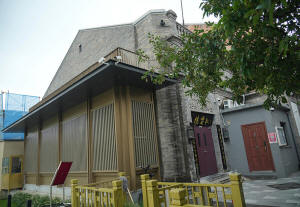
A Deyunshe theater, part of the comedy group founded by Guo Degang,
is seen in Beijing, Saturday, Aug. 22, 2026. (AP Photo/Achmad
Ibrahim)
 The lyrics are from “Playing My
Beloved Pipa,” a song from Railway Guerrilla, a well-known 1950s
film about Communist-led guerrillas fighting Japanese forces during
World War II. Pipa is a traditional Chinese stringed instrument,
similar to a lute.
It is a popular song among the public. It was once played at CCTV
Spring Festival gala in 1998, and was also selected in 2019 by the
Chinese Communist Party’s Publicity Department as one of 100 songs
recommended to mark the 70th anniversary of the founding of the
People’s Republic of China.
Guo is widely considered as the one who brought xiangsheng closer to
the younger generation in China. The traditional art form was more
regional and more popular among the older audience.
This is not the first time that performers facing consequences over
their work on stage. In 2023, comedian Li Haoshi, known by his stage
name House, sparked controversy after describing dogs chasing
squirrels with a military slogan. Xiaoguo Culture Media, the company
he worked for, was later fined 14.7 million yuan ($2.13 million),
and Li has not appeared in public performances in mainland China
since.
All contents © copyright 2026 Associated Press. All rights reserved
 |