Florida, hard-hit by Obamacare drop-off, feels the squeeze of rising
healthcare costs
[August 26, 2026]
By ALI SWENSON and JACQUELYN MARTIN
ST. CLOUD, Fla. (AP) — Florida chef Elijah Button was chopping onions in
June when his knife slipped and sliced his middle finger to the bone.
It was his worst kitchen accident to date. But having given up his
Affordable Care Act health insurance plan in January because of a $100
monthly premium hike he couldn’t afford, the 21-year-old in St. Cloud
didn’t have the money for emergency care.
“Going to the hospital for it wasn’t even an option,” he said, gesturing
toward his finger before preparing a pot roast for his aunt and uncle in
their suburban home. “My first thought was, ‘how am I going to fix
this?’”
After Republicans in Congress let enhanced federal subsidies for
Affordable Care Act health plans expire in January, millions of
Americans including Button had to decide whether to keep insurance that
often doubled or tripled in cost — or risk going without it.
Months later, with no action from lawmakers to replace the lost funds,
they’re facing the consequences. Some are dealing with strained budgets
and exorbitant medical bills, while others avoid the doctor in fear of
the cost.
Florida, whose large population of gig workers, entrepreneurs and small
business owners relies heavily on the federal health insurance
marketplace, has become one of the nation’s most visible epicenters of
that impact.
Figures first reported by The Associated Press showed that about 440,000
Floridians dropped their Affordable Care Act plans this year — more than
in any other state. Thousands more who kept coverage are struggling to
get by, as prices of necessities like groceries and gasoline remain
steep, and health insurers project another year of double-digit premium
hikes.
While Florida had the most affected residents, its struggles are
reflective of broader nationwide concerns over rising healthcare costs
and a lack of meaningful policy to address them.

In the deep-red state where congressional districts were recently
redrawn to strongly favor Republicans, the cost of healthcare is a major
campaign issue. Republican midterm candidates have been promoting fraud
crackdowns to protect federal health programs, while Democrats have been
urging voters to help Congress change hands so they can restore
subsidies.
Button, who is estranged from his parents, asked his uncle for help with
his bloodied finger. With a butterfly bandage, splint and daily
cleanings and dressings, it healed. But the scar still gnaws at Button
as a symbol of what else could go wrong.
“It just feels like I’m living in a house of cards,” he said.
Florida’s population and politics make it ground zero for ACA fallout
Last fall, debate over the expiring subsidies consumed Congress,
resulting in a record 43-day government shutdown as Democrats insisted
on extending the COVID-era assistance and most Republicans refused.
Fast forward almost a year and lawmakers rarely reference the topic
anymore. The administration says it is addressing affordability with
fraud-busting efforts and deals with drug companies, but Congress hasn't
passed any significant legislation to lower health costs.
In part due to its large number of construction, hospitality and small
business workers — and also because its Republican-led legislature never
expanded the Medicaid safety-net health program — Florida has the
largest Affordable Care Act enrollment in the country. At just over 3.8
million enrollees, it represents about a fifth of the nation’s total
enrolled population.
Of the roughly 443,000 Floridians who left the marketplace, most are
likely going without insurance, according to Cynthia Cox, a vice
president at the healthcare research nonprofit KFF. She said that’s
because it is typically a “place of last resort” to get coverage.
The data doesn’t tell the stories of those who kept insurance. Tracy
Rand, a licensed mental health counselor in Leesburg, Florida, is one of
them.
Ever since getting her ovaries removed last year due to benign but
painful tumors, she has had severe menopause symptoms that require
medication, including an overactive bladder and hot flashes that cause
piercing headaches.
She uses clear plastic containers to organize the more than 30 medicines
and supplements she takes daily, their bottles crammed into a
living-room drawer and a tray on her kitchen counter.
The 51-year-old’s Affordable Care Act plan was going to surge in price
this year from $55 a month to $1,100 a month, so she downgraded. Her new
plan, with higher deductibles and copays, costs $160 a month.

[to top of second column]
|
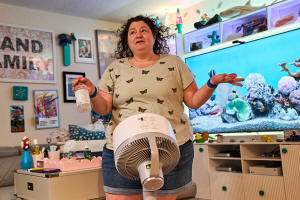
Tracy Rand uses a fan to help with her severe menopause symptoms,
brought on after a surgery to remove her ovaries, at her home in
Leesburg, Fla., Friday, Aug. 14, 2026. (AP Photo/Jacquelyn Martin)
 To make that work in her budget,
Rand quit a doctoral program she was working toward, started buying
groceries at cheaper stores, gave up once-monthly dinners out with
her husband and stopped meeting friends regularly at a
paint-your-own pottery studio.
It’s been a difficult adjustment, but a necessary one for her
health.
Rand said the prospect of insurers raising rates again fills her
with dread.
“I don’t know what else we can get rid of,” she said, covering her
face with her hands. “I don’t know if we’re going to have to file
bankruptcy.″
Clinics for the uninsured are a saving grace — but they can’t
take everyone
In Orlando's leafy, brick-paved neighborhood of Colonialtown South,
Tarsha Watson found her lifeline. A clinic there called Grace
Medical Home provides low-income, uninsured Floridians with
comprehensive care for a $5 per-visit fee.
Watson, 54, has a master’s degree in business administration, but
she hasn’t been able to find work since losing her job two years
ago. That means she doesn't have health insurance. When she explored
Affordable Care Act coverage, she was quoted $600 per month, far out
of her reach.
At Grace, Watson learned her blood sugar is high and that she needed
to lose weight. Now, she walks laps around her backyard pool and
does Tai Chi YouTube tutorials to focus on fitness. She said she
wishes everyone could have her experience.
“It's very hard out here,” she said. “It's not enough.”
At the clinic, patients cycle in and out of a wide hallway lined
with appointment rooms as doctors scan supply shelves for
complimentary over-the-counter medications. The expansive building
has separate areas for dental, mental health, vision and pediatric
care.
CEO Stephanie Garris said it’s one of 110 free or charitable clinics
in Florida, but that’s not enough to handle demand. To treat more
people in response to the Affordable Care Act changes, it recently
started hosting a mobile acute care clinic for walk-in patients.
Garris said Grace Medical Home treated about 1,350 people last year.
Every year, they take about 350 new patients.
“Would I love to double that, triple that? Of course,” Garris said.
“I just think in the reality, with the huge number of uninsured that
we have, it’s just not possible.”

Health costs become an issue in midterm campaigns
For U.S. Rep. Darren Soto, a Democrat defending his seat in a
sprawling — and now much redder — redrawn district south of Orlando,
health costs are a campaign focal point.
He said his district, which is near various theme parks, had the
second-largest Affordable Care Act enrollment in the nation, in part
because many small tourism businesses can’t offer employees health
insurance.
“I just hear it everywhere I go,” he said. His Republican opponent,
Navy veteran and former Trump administration official Dan Green, did
not answer emailed questions about the subsidies but has emphasized
affordability of groceries and property insurance as campaign
priorities.
Soto voted with Democrats and some Republicans — including a few
from Florida — to save the subsidies last year. The Republican
majority declined and suggested other ideas, including funding
Americans' health savings accounts. No law along those lines has
passed yet.
Button, a Democrat in Soto’s district, said he is open to different
reforms for health costs, but said politicians aren't acting fast
enough.
“They keep trying to make excuse after excuse,” he said. “I don’t
have six months to a year to wait for you guys to pass this through
the hoops that you need to.”
All contents © copyright 2026 Associated Press. All rights reserved |