Regional powers seek off-ramp from Iran war, and other Middle East
developments
[August 27, 2026]
JERUSALEM (AP) — Regional powers sought an off-ramp from
the war with Iran as another tanker attack was reported in the Strait of
Hormuz and Tehran dismissed Washington's latest sanctions.
Elsewhere in the Middle East, a Jerusalem court acquitted a man accused
of beating a Catholic nun but ordered him to undergo years of
psychiatric hospitalization over the attack that drew global
condemnation.
Israel's strikes in Gaza drew a sharp rebuke from the top diplomat
overseeing the U.S.-brokered ceasefire in the territory.
Here’s a look at the latest developments in the Iran war and the wider
Middle East. Full coverage can be found here.
Court orders psychiatric hospitalization for man indicted in nun attack
A Jerusalem Magistrate’s Court judge acquitted a man accused of
attacking a Catholic nun based on his insanity defense and ordered him
committed to psychiatric hospitalization for up to six years.
The violent assault in April on a nun walking in her habit in
Jerusalem’s Old City sent shockwaves across Israel – and its many
Christian communities, which have reported an increase in harassment.
Religious Freedom Data Center, an Israeli volunteer organization that
tracks incidents like verbal abuse and spitting in the direction of
visibly Christian people in Jerusalem, said they’re happening almost
daily and virtually all are committed by Jewish religious nationalists.

Jerusalem’s Old City contains some of the holiest sites of Christianity,
Islam and Judaism.
Tanker was attacked in the Strait of Hormuz
The United Kingdom Maritime Trade Organization said Thursday that it had
received a report of an oil tanker hit in the strategic waterway that's
been at the center of the evolving diplomacy in the Iran war.
The monitoring agency, run by the British military, said local
authorities reported that the vessel was hit by an unknown projectile
Tuesday in the waters between Oman and Iran, causing it to catch on
fire.
The crew was reported safe and there have been no reports of
environmental damage, the UKMTO said.
The attack underscores the ongoing dangers for vessels attempting to
transit the key waterway while it’s firmly under Iranian control, even
as Oman and Iran are reportedly in the final stages of talks on a plan
to manage shipping traffic through the strait.
Iran periodically fires at vessels attempting to transit the strait to
enforce its control of the waterway, though there was no immediate claim
for Tuesday’s attack. The U.S. has also fired on vessels while imposing
a blockade of Iranian ports.
Faltering diplomatic efforts to end Iran war continue
Pakistan said Thursday it was continuing diplomatic efforts to help
resolve the crisis between the United States and Iran and reopen the
Strait of Hormuz.
Foreign Ministry spokesperson Tahir Andrabi said at a news briefing that
Field Marshal Asim Munir’s recent visit to Tehran was aimed at reviving
the June memorandum of understanding to reopen the strait.
Pakistan’s Foreign Minister Ishaq Dar has also continued diplomatic
outreach during Munir’s visit, speaking with his Turkish, Egyptian, and
other regional counterparts, Andrabi said.
Sheikh Mohammed bin Abdulrahman Al Thani is expected in Tehran on
Thursday for talks with Iranian officials on “ways to de-escalate
tensions & create the conditions conducive to dialogue,” Qatar’s Foreign
Ministry said on X.

[to top of second column]
|
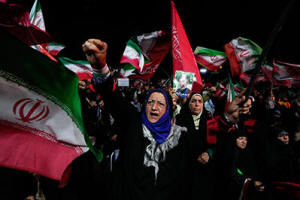
A pro-government demonstrator chants slogan during a gathering in a
square in Tehran, Wednesday, Aug. 26, 2026. (AP Photo/Vahid Salemi)

The discussions, confirmed by Tehran, will also address “freedom of
navigation” in the Strait of Hormuz and the need to return to the
prewar status quo, according to Majed Al Ansari, an agency
spokesperson.
But U.S. President Donald Trump told Al Jazeera by phone Wednesday
that he has “no time schedule” to wrap up the conflict that will
reach the six-month mark on Friday. Trump told the Qatar-based
broadcaster that he believes the United States is “winning very
big.”
Iran’s Foreign Ministry calls US sanctions “pure parody”
Esmail Baghaei, Iran’s foreign ministry spokesman, wrote late
Wednesday in a social media post that the U.S. had made a coalition
with Bahrain, calling it a country with “virtually no meaningful
economic exchange with Iran.”
In another social media post on Wednesday, Iran’s top negotiator and
parliamentary speaker Mohammad Bagher Qalibaf thanked China for
rejecting the U.S. “economic D-Day” policies against Iran.
“We welcome China’s principled statement rejecting illegal sanctions
against Iran," Qalibaf said.
Earlier this week, Tehran had warned that it would respond harshly
to expanded U.S. sanctions, including measures against countries it
sees as cooperating with Washington. Iran has repeatedly targeted
Bahrain and other Gulf countries with missiles and drones since the
U.S. and Israel launched the war on Feb. 28.
Israel's Gaza strikes get rebuke from peace board chief
Nickolay Mladenov, head of Trump’s Board of Peace, told the U.N.
Security Council on Wednesday that the gap between what has been
agreed by both sides and what is happening on the ground is the
biggest risk to the peace process in Gaza.
“Israeli strikes have continued since the road map was accepted, and
Palestinian civilians are still being killed,” Mladenov said.
An Israeli strike on a tent for displaced people Wednesday in
southern Gaza killed one person and wounded at least four, the
territory’s Health Ministry said. The Israeli military said that it
struck a “military operative,” without elaborating.

Palestinians in the Gaza Strip have reported a surge in deadly
Israeli strikes despite a fragile ceasefire in the nearly three-year
Israel-Hamas war. Israel has said that it targets Hamas and other
militants.
Israel’s deputy U.N. ambassador Noa Furman told the Security Council
on Wednesday that Israel is committed to Trump’s peace plan, but
that Hamas’ “disarmament must come first” before Gaza’s
reconstruction can begin.
The war in Gaza was triggered by the Hamas-led Oct. 7, 2023 attack
in southern Israel; some 1,200 people, mostly civilians, were killed
and 251 others abducted. Israel’s retaliatory offensive killed more
than 73,400 people in Gaza, according to Gaza's Health Ministry.
The ministry, part of the Hamas-controlled government, is staffed by
medical professionals and maintains detailed records viewed as
generally reliable by United Nations agencies and independent
experts. It does not distinguish between civilians and militants,
and says women and children make up around half of all fatalities.
All contents © copyright 2026 Associated Press. All rights reserved |