Tropical Storms Karina and Lowell form in the Pacific Ocean as Dolly
churns in the Atlantic
[August 28, 2026]
MIAMI (AP) — Tropical Storms Karina and Lowell formed Thursday in the
Pacific Ocean, both of which were expected to become hurricanes in the
next few days, the National Hurricane Center said.
Tropical Storm Karina was located about 825 miles (1,330 kilometers)
south of the southern tip of Baja California, with maximum sustained
winds of around 45 mph (75 kph), according to an advisory from the
Miami-based hurricane center. Tropical Storm Lowell was about 1,765
miles (2,840 kilometers) west-southwest of the tip of Baja California,
with maximum sustained winds of around 40 mph (65 kph).
There were no coastal watches or warnings in effect for either storm,
though the hurricane center warned swells from Karina could bring
life-threatening surf and rip currents to portions of southwest Mexico
and the Baja California Peninsula over the weekend.
Earlier Thursday, Tropical Storm Dolly formed in the Atlantic Ocean far
from land, and forecasters said it could bring heavy rain to portions of
the Caribbean.
The storm was about 1,555 miles (2,500 kilometers) east of the Leeward
Islands and had maximum sustained winds of 40 mph (64 kph), the U.S.
National Hurricane Center in Miami said. Dolly was moving west.
The storm and its name had no connection to Dolly Parton’s death
Tuesday.

Storm systems are named by procedures set by the World Meteorological
Organization, and the lists of names are reused every six years. For the
Atlantic region, the lists are alphabetical and alternate male and
female names.
Dolly was the fourth named storm for the 2026 Atlantic hurricane season.
There were no coastal watches or warnings in effect, but the center said
the Leeward Islands could get heavy rain Saturday and Sunday. The Virgin
Islands, Puerto Rico and Hispaniola could see heavy rain Sunday and
Monday.
[to top of second column]
|
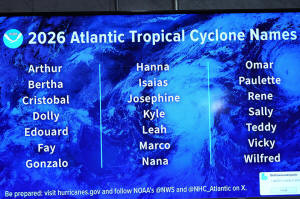
The 2026 Atlantic Tropical Cyclone Names are displayed at the
National Hurricane Center on the first day of hurricane season, June
1, 2026, in Miami. (AP Photo/Lynne Sladky, File)

Little change in strength is forecast during the coming days, the center
said, but flash flooding could occur.
The Atlantic hurricane season started with Tropical Storm Arthur coming
ashore on the U.S. Gulf Coast in June, and Tropical Storm Bertha dumped
rain in Louisiana and Texas in July. Tropical Storm Cristobal formed and
quickly dissipated in the Atlantic earlier in August.
The National Oceanic and Atmospheric Administration has forecast a
below-average Atlantic hurricane season due to El Nino. It forecast
eight to 14 named storms, with three to six of them reaching hurricane
strength and one to three of those intensifying to major hurricanes.
The NHC and other weather agencies name storms to easily communicate
warnings about them to people and to avoid confusion. The WMO says names
are chosen to be short, easy to pronounce and familiar to the regions of
the world where the storm names are used. It meets regularly to evaluate
potential names, and some names are retired for reasons of sensitivity,
particularly for deadly or destructive storms.
One name from the 2025 season was retired, Melissa, which was a Category
5 hurricane that brought devastation to the Caribbean.
All contents © copyright 2026 Associated Press. All rights reserved
 |