Israeli strikes kill 5 in Gaza and 3 in West Bank, and other news in the
Middle East
[August 29, 2026]
Israeli airstrikes killed five people in Gaza and three in the West Bank
on Friday, despite a fragile ceasefire brokered by the United States.
Meanwhile, thousands of sailors remain stranded in the Persian Gulf by
the Iran war, while Iran is touting an energy deal with Russia and the
U.S. has imposed restrictions on a major Egyptian bank for its ties with
Iran.
Here’s a look at the latest developments in the Iran war and the wider
Middle East. Full coverage can be found here.
Israeli strikes in Gaza kill 5
Israeli strikes in Gaza have killed five people, local hospital
officials said Friday.
Two brothers and another relative died in a strike on the family’s home
outside Khan Younis, officials at Nasser Hospital said. Two separate
Israeli strikes killed one person each in Gaza City, according to health
officials at Shifa hospital.
Israel’s military confirmed the Gaza strikes but said it was not aware
of the one in Khan Younis.
The five deaths are among more than 1,300 Palestinians killed in
airstrikes since an October ceasefire deal, Gaza health officials say.
Attack kills 3 in Jenin
Israel's military said it killed three Palestinians in an airstrike in
the West Bank city of Jenin on Friday, describing one of the dead as a
Hamas operative and the two others as accomplices.

The military identified one of the targets as Qais Bitawi who was
alleged to be “involved in advancing significant terrorist activity.”
The Palestinian Ministry of Health confirmed Bitawi had been killed,
along with two others. Hamas condemned the strike as a “heinous crime.”
Violence has escalated in the West Bank, where at least 87 Palestinians
have been killed in attacks while three Israelis have been killed by
Palestinians in 2026.
Iranian leader bans actions undermining national unity
Iran’s leader, Mojtaba Khamenei, on Friday declared that actions
undermining national unity in the political, security, cultural, social
or economic spheres are prohibited.
He warned that even measures with some support could ultimately be
harmful if their broader social consequences are ignored.
“Any statement that creates despair or weakens national and public
motivation,” as well as what Khamenei called false divisions such as
“war or negotiations,” “consensus or radicalism” and “compromise or
warmongering,” could damage the country.
US diplomats return to Mideast embassies
American diplomats and some of their family members are beginning to
return to U.S. embassies in the Middle East after many were ordered to
leave their posts during the early days of the war with Iran.
On Friday, the embassies in Doha, Qatar; Kuwait City, Kuwait; and
Manama, Bahrain announced they would allow some family members of
diplomats to return.
Similar measures were implemented earlier this week to all family
members of U.S. government employees in Israel as well as those who are
over 21 to Beirut, Lebanon.
Iran's president says negotiations between Iran and US needed
Iranian President Masoud Pezeshkian said Friday that neither Tehran nor
Washington can achieve all of its demands and that negotiations are
needed to bring stability and calm, state television reported.
Pezeshkian said Iran would remain committed to the Islamabad memorandum
if the United States upheld its own commitments under the agreement,
adding that negotiations could then continue toward a broader
resolution.
He also criticized hard-liners inside Iran who oppose an agreement,
favor continuing the war and argue that sanctions have had little effect
on the country.
Thousands of sailors stranded by Iran war
The U.N.’s maritime agency said Friday that 19 seafarers have been
killed and at least 6,000 remain stranded on hundreds of ships unable to
leave the region since the start of the Iran war on Feb. 28.
There have been at least 70 attacks on international shipping in the
Persian Gulf, according to the International Maritime Organization.
About 20% of the world’s traded oil and natural gas passed through the
vital commercial waterway at the mouth of the Persian Gulf before the
war.

[to top of second column]
|
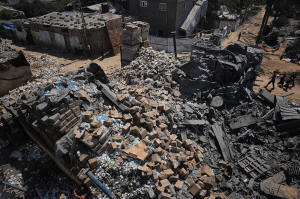
Palestinians walk past a food-aid warehouse damaged in an Israeli
airstrike that targeted a nearby house in Deir al-Balah, central
Gaza Strip, Wednesday, Aug. 26, 2026. (AP Photo/Abdel Kareem Hana)

Iran and Russia look to revive energy deal
Iran’s ambassador to Russia on Friday said the two countries are
seeking to deepen links between their energy grids by reviving a
plan that dates to 2022, according to Iranian state media.
Umud Shokri, a fellow at George Mason University, said the plan
calls for piping 55 billion cubic meters of Russian gas annually
into Iran, via Azerbaijan.
He said that would help Iran weather U.S. economic pressure by
alleviating seasonal shortages of gas, though there are significant
hurdles, as building out the infrastructure would be expensive and
time-consuming.
US imposes restrictions on Egyptian bank
The Trump administration is taking steps to limit an Egyptian bank’s
operations in the United Arab Emirates.
Banque Misr, Egypt’s second-largest bank, is accused of serving as
an economic lifeline to Iran's leadership. But under a new rule
proposed by the U.S. Treasury, the bank's Emirati branches would be
severed from access to the U.S. financial system.
The Central Bank of Egypt said the restrictions are limited to
Banque Misr's branches in the UAE and relate to dollar transfers
only. No other Egyptian bank is affected.
Iran objects to US economic pressure
Iran’s Foreign Ministry on Friday condemned a new round of U.S.
economic measures against the country, calling them “economic
terrorism” and saying Tehran would use all available means to
counter them.
The ministry said the sanctions violated international law and
called on other countries to refrain from implementing them.
Earlier this week, U.S. Treasury Secretary Scott Bessent vowed to
fully sever Iran from the global economy and threatened countries
that continue to do business with Iran with secondary sanctions.
‘Strong support’ among some at UN to extend peacekeeping in south
Lebanon, 2 diplomats say
The U.N. Security Council met behind closed doors Friday and
discussed a request by Lebanon’s government to extend the mandate of
the 8,100-member peacekeeping force, slated to end Dec. 31, two
diplomats with knowledge of the discussion said.

There was “strong support” among the 15 council members to extend
the mandate of the force known as UNIFIL, especially amid concern
over the volatile situation in Lebanon. But support wasn’t
unanimous, the diplomats said, speaking on condition of anonymity
because the meeting was closed.
Israel has pressed for the closure of UNIFIL for years, and last
year the United States, its closest ally, succeeded in forcing its
closure on Dec. 31. But that was before the latest Israel-Hezbollah
war, which erupted on March 2. Despite a June 20 truce, airstrikes
and clashes have continued.
The two diplomats said U.S. Ambassador Mike Waltz attended Friday’s
council meeting, listened to the members, and didn’t say yes or no
to a limited extension of UNIFIL.
By Edith M. Lederer
US revokes visa of former Iraqi finance minister who won 2022
‘International Women of Courage’ award
The Trump administration has revoked the U.S. visa of a former Iraqi
finance minister who was honored in 2022 with an “International
Women of Courage” award by the State Department.
The department said Friday it had revoked the visa of Taif Sami
Mohammed Al Shakarchi, who served as Iraq’s finance minister from
2022 until July and earlier this month when she was implicated by
Iraqi authorities in a possible corruption scheme.
The department said her visa was revoked after the FBI added her to
its “terrorism watchlist.” It was not clear why she had been added
to the watchlist but officials said she had left the United States
before her visa was revoked.
All contents © copyright 2026 Associated Press. All rights reserved |