Africa's male midwives are rare but increasing in the fight against
pregnancy deaths
[August 31, 2026]
By MOGOMOTSI MAGOME
MOHALE'S HOEK, Lesotho (AP) — On a cold morning, Ntlhane Sehloho grabbed
his backpack containing medical equipment and embarked on a three-hour
journey, navigating the curving gravel roads leading to a clinic nestled
in a valley of mountainous Lesotho.
Sehloho has an almost unheard-of role in this part of the world: male
midwife.
His arrival at the Mpharane Health Center in the southern African
kingdom is met with a sigh of relief from several women, some of them
pregnant. Others carry crying babies on their backs.
Midwifery has been traditionally viewed as women’s work in Lesotho, but
a growing number of men are joining the profession as the country tries
to bring down its high rate of deaths around childbirth. For every
100,000 live births, about 530 women die, the United Nations says.
That's far above the global average of about 200.
___
This is part of a series on maternal mortality in sub-Saharan Africa,
which has the world’s fastest-growing population and accounts for 70% of
global maternal deaths. Around 180,000 pregnancy deaths are recorded
every year across the continent.
___
Lesotho, like many African nations, is a society with largely
conservative views. The idea of a man who isn’t a doctor dealing with a
woman so intimately still can make many hesitant, if not uncomfortable.
World Health Organization figures estimate that men make up less than 1%
of all midwives around the world. Organizations like the WHO and UNICEF
have called for more people, male and female, to become midwives and
address shortages in childbirth responders.

He wanted to be a nurse and was steered into this job
Sehloho is one of about 300 male midwives in Lesotho and has been doing
the work for two decades. The exact number of male midwives is not
available as the government does not keep the data according to gender.
Talkative and ready with a joke, he seeks to put women at ease from the
first of their prenatal visits.
He had good grades in school and wanted to become a nurse to help
address the difficulties he had witnessed for pregnant women in his
rural community.
“Our village was far away from the health facility, so most women who
would be pregnant, some were delivering at home. We were still young, we
were not supposed to see that, as some were dying,” he said. He didn’t
understand how far they had to travel for care.
Health authorities later encouraged him and other male nurses to train
as midwives to help address deaths around childbirth in a country with
poorly staffed rural health posts and a population of just over 2
million people.
Now, after efforts to bring care closer to rural communities, UNICEF
data show that 92% of births in Lesotho are now attended by a trained
health care provider.
[to top of second column]
|
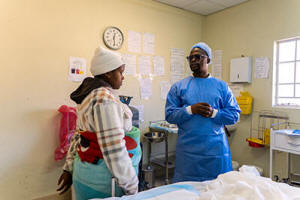
Male midwife Sehloho Ntlhane consults with expectant mother Bonolo
Tebelo during an prenatal appointment at Mpharane Health Centre in
Mohale's Hoek district, Lesotho, Friday, July 10, 2026. (AP Photo/Kayleen
Morgan)
 The government says gender
shouldn’t matter
“I think the system and the community is starting to slowly accept
that gender should not matter when it comes to this issue of
delivery,” said Dr. Llang Maama, acting director of health services
at Lesotho’s Ministry of Health.
There are still a small number of cases where the mother says she
isn’t comfortable with a male midwife, she said. “But the system
allows them to register their discomfort and get treated by a
woman.” In the urgency of childbirth, however, there isn’t always
time to choose.
Sehloho acknowledged that it is a matter of gaining women’s trust.
He tries to put them at ease by explaining how he has delivered
babies for years and how he grew up in similar rural circumstances.
“We are a very cultural and traditional African society,” he said.
There are usually mixed reactions to male midwives, said Blandina
Motaung, a representative of the United National Population Fund,
which works extensively with midwives in Lesotho.
The positive remarks include praise for how the men appear to be
more gentle and less strict when working with pregnant women. During
consultations, Sehloho checked women’s blood pressure and measured
their progress, asking from time to time whether they were
comfortable.
Most female midwives have given birth themselves, “but for the men,
because they have not been through the process, they become more
vigilant and more attentive to the nitty gritties, and that in
itself improves the quality of care that they provide,” Motaung
said.
Pregnant women are learning to adapt
One of the clinic’s patients, Mpolokeng Mafereka, 21, said she was
more comfortable being treated by a woman, but sometimes a male
midwife is the one available.
“I’m used to being treated by women,” she said.
But another patient, 21-year-old Bonolo Tebello, said she has never
had a problem being treated by a male midwife.
“I’m happy to be treated by a male because they still provide the
same level of care,” she said.
“Even when one arrives late for a check-up, they just treat you like
any other person who arrived on time,” she added.
All contents © copyright 2026 Associated Press. All rights reserved
 |