US futures and world shares slip as worries over Trump's Fed chief pick
and AI weigh on markets
[February 02, 2026] By
ELAINE KURTENBACH
U.S. futures and world shares skidded on Monday as worries over
President Donald Trump’s nominee to be the next Federal Reserve chair
amplified jitters over a possible bubble in the artificial intelligence
boom.
South Korea’s exchange, which is heavily influenced by tech-related
developments, briefly suspended trading as its benchmark Kospi bounced,
closing 5.3% lower at 4,949.67. Samsung Electronics gave up 6.3%, while
chip maker SK Hynix sank 8.7%.
The Kospi has been forging records for weeks as big tech companies
piggybacked on the AI craze with deals with major players like chip
maker Nvidia and OpenAI.
In early European trading, Germany's DAX edged less than 0.1% lower to
24,528.57. The CAC 40 in Paris shed 0.2% to 8,108.56, while Britain's
FTSE 100 declined 0.3% to 10,195.88.
The future for the S&P 500 sank 0.7%, while that for the Dow Jones
Industrial Average fell 0.4%.
Markets took a hit as investors considered how Kevin Warsh, Trump’s
nominee to lead the Federal Reserve after Fed Chair Jerome Powell's term
ends in May might handle interest rates.
Warsh’s nomination requires Senate approval. But financial markets fear
the Fed may lose some of its independence because of Trump, who has
pushed hard for more and faster rate cuts. That fear has helped catapult
skyward the price of gold and weaken the U.S. dollar’s value over the
last year.
“People do not get handed the keys to the most powerful central bank on
earth because they plan to drive in the opposite direction of the people
who gave them the keys,” Stephen Innes of SPI Asset Management said in a
commentary.

Early Monday, the price of gold fell 1.9%, while silver bounced back
slightly, gaining 0.2%. Both plunged Friday as record runs in precious
metals markets ground to a halt.
On Friday, the price of gold dropped 11.4%, suddenly losing momentum
after a tremendous rally where it roughly doubled over 12 months. It
topped $5,000 for the first time on Jan. 26 and was around $5,600 at one
point on Thursday.
Silver, which had been on a similar, jaw-dropping tear, plunged 31.4%.
U.S. benchmark crude oil lost $3.46 to $61.75 per barrel, while Brent
crude, the international standard, fell $3.47 to $65.85 per barrel.

[to top of second column] |
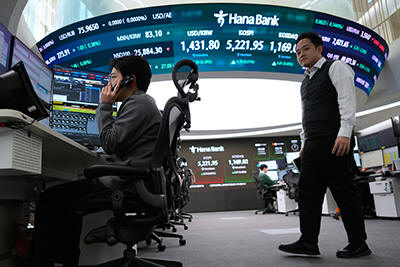
A currency trader talks on the phone near a screen showing the Korea
Composite Stock Price Index (KOSPI), top center, and the foreign
exchange rate between U.S. dollar and South Korean won, top center
left, at the foreign exchange dealing room of the Hana Bank
headquarters in Seoul, South Korea, Friday, Jan. 30, 2026. (AP
Photo/Ahn Young-joon)
 Speaking to reporters during the
weekend, Trump said Iran should negotiate a “satisfactory” deal to
prevent the Middle Eastern country from getting any nuclear weapons.
“I don’t know that they will. But they are talking to us. Seriously
talking to us,” he said.
That comment apparently assuaged some worries over potential
disruptions to oil supplies that had pushed prices higher, analysts
said.
In Tokyo, the Nikkei 225 gave up early gains, sinking 1.3% to
52,655.18.
Hong Kong's Hang Seng dropped 2.2% to 26,775.57, while the Shanghai
Composite index sank 2.5% to 4,015.75.
In Australia, the S&P/ASX 200 fell 1% to 8,778.60.
Taiwan's Taiex lost 1.4%.
On Friday, the S&P 500 dropped 0.4% and the Dow lost 0.4%. The
Nasdaq composite lost 0.9%.
The Fed chair has a big influence on the economy and markets
worldwide by helping to dictate where the U.S. central bank moves
interest rates. That affects prices for all kinds of investments, as
the Fed tries to keep the U.S. job market humming without letting
inflation get out of control.
A report released Friday showed U.S. inflation at the wholesale
level was hotter last month than economists expected. That could put
pressure on the Fed to keep interest rates steady for a while
instead of cutting them, as it did late last year.
The longtime assumption has been that the Fed should operate
separately from the rest of Washington so that it can make moves
that are painful in the short term but necessary for the long term.
To get inflation down to the Fed’s goal of 2%, for example, may
require the unpopular choice to keep interest rates high and grind
down on the economy for a while.
In other action early Monday, the dollar fell to 154.88 Japanese yen
from 154.94 yen. The euro was unchanged at $1.1853.
All contents © copyright 2026 Associated Press. All rights reserved |