A crisis emerges across the US as ‘forever chemicals’ quietly
contaminate drinking water wells
[February 03, 2026]
By MICHAEL PHILLIS and HELEN WIEFFERING
STELLA, Wis. (AP) — Kristen Hanneman made a small decision in 2022 that
would upend life for her entire town.
State scientists were checking private drinking water wells across
Wisconsin for a widely used family of harmful chemicals called PFAS.
They mailed an offer to test the well outside her tidy farmhouse
surrounded by potato farms cut out of dense forest. Without much
thought, she accepted.
Months later, Hanneman found herself on the phone with a state
toxicologist who told her to stop drinking the water — now. The well her
three kids grew up on had levels thousands of times higher than federal
drinking water limits for what are commonly known as forever chemicals.
Hanneman’s well was hardly the only one with a problem. And the
chemicals were everywhere. Pristine lakes and superb hunting made Stella
a sportsman’s dream. Now officials say the fish and deer should be eaten
sparingly or not at all.
Many residents here have known their neighbors for decades. If they want
to move away from all this, it’s hard to sell their property – who,
after all, would want to buy?
“Had I just thrown that survey in the garbage,” Hanneman said, “would
any of this be where it is today?”
Stella is far from the only community near industrial sites and military
bases nationwide where enormous amounts of PFAS have contaminated the
landscape, posing a particular threat to nearby well owners.

Forever chemicals get their name because they resist breaking down,
whether in well water or the environment. In the human body, they
accumulate in the liver, kidneys and blood. Research has linked them to
an increased risk of certain cancers and developmental delays in
children.
Government estimates suggest as much as half of U.S. households have
some level of PFAS in their water — whether it comes from a private well
or a tap. But while federal officials have put strict limits on water
provided by utilities, those rules don’t apply to the roughly 40 million
people in the United States who rely on private drinking water wells.
Short of a random test, as in Stella, few may learn their water is
tainted with the odorless, colorless chemicals.
At least 20 states do not test private wells for PFAS outside of areas
where problems are already suspected, according to a survey of state
agencies by The Associated Press. Even in states that do, residents
often wait years for help and receive far fewer resources than people
tied into municipal tap water.
PFAS are so common because they are so useful. Uniquely able to repel
moisture and withstand extreme temperatures, the chemicals have been
critical to making waterproof shoes, nonstick cookware and foam that
could extinguish the hottest fires.
When the chemicals reach soil or water, as they have near factories and
waste sites, they are extremely difficult to remove. North Carolina saw
an early example, with well owners downstream from a PFAS manufacturing
plant still dealing with tainted water years later. In rural northwest
Georgia, communities are reckoning with widespread contamination from
PFAS that major carpet manufacturers applied for stain resistance.
Robert Bilott, an environmental attorney who pursued one of the first
major lawsuits against a PFAS manufacturer in the late 1990s, said many
states don’t have the money to help.
“The well owners — the victims of the contamination — shouldn’t have to
be paying,” he said. “But where’s this money going to come from?”
Well owners often the last to know about contamination
The alarming results from Hanneman’s well triggered a rush of testing,
beginning with the wells of nearby neighbors and later expanding miles
away.

How the chemicals infiltrated water beneath Stella’s sandy soil was
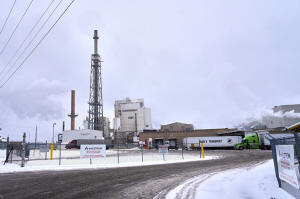
initially a mystery. State officials eventually suspected the paper mill
in the small city of Rhinelander, a 10-mile (16-kilometer) drive from
town. The mill had specialized in making paper for microwave popcorn
bags — a product that was greaseproof thanks in part to PFAS.
The mill’s manufacturing process also produced a waste sludge which
could be used as a fertilizer. By 1996, and for decades after with state
approval, the mill spread millions of pounds on farm fields in and
around Stella. Wisconsin officials now believe the PFAS it contained
seeped into the subterranean reserves of groundwater that feed lakes,
streams and many residential wells.
In September, the state sent initial letters assigning cleanup and
investigation responsibilities to current and former owners of the mill.
These companies point out that the state permitted their sludge
spreading, starting long before the dangers of PFAS were widely
understood.
The problem in Stella remained hidden because well owners don’t have a
utility testing their water.
Rhinelander’s water utility first tested for PFAS in 2013 to comply with
federal rules. By 2019, the city shut down two utility-owned public
wells to protect customers. In Stella, meanwhile, some well owners found
out only last year that their water is unsafe.
The Hanneman family moved into their home when their oldest son was
nearly two. He’s 19 now. His parents worry about all those years of
exposure, and have joined an effort to sue the paper mill’s owners and
PFAS manufacturers.
Several plaintiffs in the growing lawsuit allege property damage and
that their cholesterol, thyroid and kidney diseases are linked to
contaminated groundwater. The companies have denied responsibility.
Very tiny amounts of PFAS consumed regularly over years can be
dangerous. As scientists better understood those risks, federal advice
for water utilities slowly followed and tightened. The current limit is
just 4 parts per trillion, or less than a drop diluted in an
Olympic-size swimming pool.

The Environmental Protection Agency recommends private wells be tested
for bacteria and a limited number of commonly found chemicals, but not
PFAS unless it is a known local problem. Experts say testing mandates
would be deeply unpopular. Many well owners value their freedom from
government oversight and a monthly bill, and take pride in the taste of
their water.
PFAS has turned some of those freedoms into liabilities. The chemicals
can only be removed from water with costly filters that must be
regularly monitored and replaced. Some well owners opt instead to drill
deeper or even connect to city water pipes. Facing expensive and
uncertain options, many resort to bottled water.
In Stella, residents are grappling with the chemicals’ unpredictable
underground path. Though Tom LaDue’s backyard extends to the edge of a
highly contaminated lake, testing found barely any PFAS in his family’s
well.
Somehow, a neighbor farther back from the lake found 1,500 parts per
trillion of PFAS in her shallower well — magnitudes above the federal
limits for tap water. The mother of three in that house says she is
regularly tired, which she blames on thyroid issues, wondering if the
water is to blame.
In one picture from a few years ago, LaDue is baiting a hook as his
grandson dangles a fishing pole over the side of their boat. The sun
shines bright.
“It’s a nice lake and we fished in here,” he said. “Now they tell us we
can’t eat the fish anymore.”
House by house
While utilities can rely on centralized treatment facilities, restoring
safe water for well owners must be done household by household. Some
well owners get left out as regulators, lawyers and companies strike
deals over who gets help.
The treatment of residents in the lakeside town of Peshtigo, Wisconsin,
depends on the street where they live.
The town faced a crisis nearly a decade ago when PFAS were detected in
wells downstream from a fire technology plant owned by Tyco and parent
company Johnson Controls, which manufactured firefighting foam.
Wisconsin officials said the company was responsible for cleaning up the
plant and must sample wells in a broad area to see where the pollution
spread. Johnson Controls told state regulators it studied the area’s
hydrology and geology and concluded it would pay for tests and drill new
wells in a smaller section of town for which it maintains it is
responsible.

Kayla Furton, a high school teacher who grew up in Peshtigo, lives in a
home inside this area.
Had she lived two houses away, Furton would have had to pay out of
pocket to treat the PFAS in her water.
Furton’s worries over what would happen to her neighbors beyond that
line, including her sister, motivated her to run for the town’s board.
During her time in office, Peshtigo leadership split over which fixes to
pursue, and some well owners are still waiting on a long-term solution.
“Groundwater does not follow lines drawn on a map,” Furton said.
“There’s nothing to say that, OK, the PFAS stops there.”
In a statement, Johnson Controls said it has taken full responsibility
for the area it contaminated. The company said it has restored more than
300 million gallons of clean water to the environment and installed 139
new wells.
The state of Wisconsin says the company has not fully investigated the
extent of the contamination, and filed a lawsuit in 2022. Johnson
Controls said in December the parties were close to reaching an
agreement; the Wisconsin Department of Justice said it does not comment
on pending litigation.
Residents along the Cape Fear River in North Carolina have seen just how
far forever chemicals can spread. In 2017, the Wilmington StarNews
revealed that PFAS from a Chemours chemical plant in Fayetteville were
washing into the river and contaminating the water supply. After being
sued, the billion-dollar company agreed to test nearby wells and treat
those with polluted water. It did not admit to any wrongdoing.
As in Stella, the company tested in a slowly expanding radius that grew
by quarter-mile segments from its plant. Chemours agreed to keep testing
wells until it reached the edge of the polluted area — a process it
expected to take 18 months.

[to top of second column]
|
The Ahlstrom paper mill in Rhinelander, Wis., on Friday, Dec. 5,
2025 (AP Photo/Morry Gash)
 Seven years and some 23,000 wells
later, testing is ongoing, with the contamination stretching far
beyond what state regulators first imagined. Forever chemicals have
been found in drinking water along nearly 100 miles (160 kilometers)
of the river, from inland Fayetteville to the Atlantic coast.
According to an AP analysis of data submitted to the state’s
Department of Environmental Quality, Chemours discovered high levels
of PFAS in more than 150 new wells in 2025.
Many well owners “thought they were fine,” said Emily Donovan, an
organizer and cofounder of the group Clean Cape Fear. “And now
they’re finding out so late that they were also contaminated.”
In a statement, Chemours said its timeline for testing wells depends
on factors outside its control, including whether residents allow
it, and that of the roughly 1,250 wells it sampled last year, 12%
had PFAS. Chemours said it continues to contact eligible homes, and
that a sample is typically taken within a week of residents’
responding.
States leave well owners behind
In the absence of federal rules, responsibility falls to the states.
But many states don't look for contamination in private wells — and
when those that do find it, many struggle to fund a fix.
One proactive state is Michigan, where millions rely on private
wells. Officials there have tested groundwater and offered free
tests to well owners near PFAS hot spots which, at hundreds of
dollars per test, many owners are reluctant or unable to buy. The
state provided more than $29 million in grants to clean up forever
chemicals in its 2022 fiscal year, including hooking up nearly a
thousand well owners to public water.
One of the biggest challenges is helping well owners understand why
they should take the threat seriously.
“We are very lucky to get 50% of the people to say, ‘Yes, come test
my well for free,’ let alone willing to put on a filter,” said
Abigail Hendershott, executive director of Michigan’s multiagency
team that responds to PFAS contamination.
New Hampshire, which dealt with an early PFAS crisis in Merrimack,
has tested over 15,000 wells, more than half of which had levels
exceeding federal standards. It provides generous rebates for
homeowners to access clean water.

Elsewhere, millions of households are left on their own.
In northwest Georgia, some of the world’s largest carpet companies
began applying PFAS for stain resistance in the 1970s. The companies
continued using the chemicals, which entered the environment through
manufacturing wastewater, for years, even after scientific studies
and regulators warned of their accumulation in human blood and
possible health effects, according to an investigation by The
Atlanta Journal-Constitution, The Associated Press, The Post and
Courier and AL.com. The companies say that they followed all
required regulations and that they stopped using PFAS on carpets in
2019.
The chemicals have tainted much of the landscape, including the
drinking water in cities and the waterways that crisscross the
Conasauga River watershed, home to tens of thousands of people. But
only well owners near the small city of Calhoun have been offered
free tests, and then only under a court agreement. The contaminated
river flows into Alabama, where state officials do not typically
test private wells for PFAS.
Financial limitations are an oft-cited reason why states aren’t
doing more.
Wisconsin, which relied on federal funds for its initial survey of
wells, has scraped together resources to investigate PFAS in Stella.
The state’s environmental agency has no budget for sampling or
treatment and is pulling money and staff time from other programs,
according to the head of the drinking and groundwater program.
Supplying bottled water to impacted homes — once a rare expense —
now requires the state to set aside $900,000 annually.
Meanwhile, enormous amounts of money that could help have been stuck
in a bank account, collecting interest. Though state lawmakers voted
in 2023 to provide $125 million for PFAS cleanup, the funding has
been mired by a separate debate over whether to shield certain
property owners from liability. In January, key legislators said
they were getting closer to a deal that would release the money.
The EPA has allocated billions to states for PFAS treatment and
testing, but much of that money goes to public utilities.

Federal officials are evaluating Stella for inclusion in the
Superfund program, a large-scale decontamination process that would
take years. They also partnered with Wisconsin officials to expand
well sampling in July.
At an October public meeting in Stella, several residents asked if
they should be worried about their well water.
There is a risk, state employees said, but they could not offer
unlimited free tests to rule it out. Those who wanted one
immediately would have to pay for it.
“We’re doing the best that we can with the funding that we have
available," said Mark Pauli, a drinking and groundwater supervisor.
In a statement, a spokesperson for the Wisconsin Department of
Natural Resources said it had offered cost-free PFAS sampling for
well owners within three miles of Stella and to many beyond that
distance. The state said it provides owners of contaminated wells
with guidance on treating their water and accessing financial help.
Nobody is accepting blame in Stella and finger pointing is circular.
While the state is investigating, the current and former mill owners
point to the state’s permit as exonerating and say they followed all
state rules.
Ahlstrom, the Finnish company that has owned the mill since 2018,
said in a statement it hasn’t used two of the most common types of
PFAS found in Stella wells in its manufacturing process, and that it
phased out all other types of PFAS in 2023. In late January, the
company announced its own free bottled water program for residents.
Former owner Wausau Paper and its parent company Essity said they
were cooperating with state officials and that the waste sludge they
spread was tested for various contaminants, but not PFAS because it
wasn’t required.
Wisconsin officials say the threat of PFAS in the sludge wasn’t well
understood when they approved its use as fertilizer, and that the
state will continue to require those who caused contamination to
address its impacts.
That leaves residents, who did not contaminate their own wells,
stuck hiring lawyers who argue these companies and PFAS
manufacturers knew — or should have known — the risks.

A new normal in Stella
The crisis in Stella sparked by the test of her own well drove
Kristen Hanneman to run for a town leadership role.
She spent months learning about the dangers of PFAS, then relaying
that knowledge. It’s a town so small that she said talking to a few
of the right people would spread word to just about everyone.
It’s been more than three years since Hanneman learned her well had
PFAS levels near 11,500 parts per trillion. Federal limits are in
the single digits. Her water supply is just as contaminated now as
it was then. The family currently drinks and cooks with bottled
water provided by the state.
Though some Stella residents have been able to access grant funding
to drill deeper wells to reach clean water, the help was limited by
household income, with some families disqualified if they made more
than $65,000. Typically, the most a family could receive was $16,000
— about half of what it may cost for a replacement well.
Stories circulate in Stella about people who paid for a new well
only for their water still to be contaminated. Wisconsin state
officials confirmed that at least three households faced this
dilemma.
“Do we spend $20,000 to $40,000 on a new well for it to still be a
problem?” Hanneman said.
One couple said replacing their well cleaned out much of their
savings. Many are concerned about how much their home values have
dropped.
A grant did help Cindy Deere, who worries about how 25 years of
drinking the water in Stella may affect her health. She replaced her
well and a test confirmed the new one was PFAS-free. Still, she has
a hard time trusting the water.
“It’s a constant worry,” she said. “Is it going to turn bad?”
The paper mill is still permitted to spread sludge in the county
that includes Stella. Its PFAS levels have recently tested well
within new state guidelines.
Experts said sludge from industry and manufacturers is most likely
to contain PFAS. Wisconsin developed testing guidelines for those
sources for that reason, officials said.

But the state doesn’t require another type of sludge — treated waste
from septic systems, which capture household sewage — to be tested
for PFAS. A local septic company has been spreading it in Stella —
in 2024 alone, it applied hundreds of thousands of gallons to farms
and elsewhere, state records show. The company did not respond to
multiple requests for comment.
Dianne Kopec, who has researched PFAS in wastewater at the
University of Maine, said that without testing, officials can’t know
if the practice recycles the chemicals back onto the soil in Stella.
“Given what we know today, continuing to spread sludge on
agricultural fields is ludicrous,” Kopec said. “When you find
yourself in a hole, it is best to stop digging.”
___
Associated Press writers Todd Richmond in Madison, Wis., Jason
Dearen in Los Angeles and M.K. Wildeman in Hartford, Conn.,
contributed. Dylan Jackson and Justin Price of The Atlanta
Journal-Constitution contributed from Atlanta.
All contents © copyright 2026 Associated Press. All rights reserved |