2-month-olds see the world in a more complex way than scientists
thought, study suggests
[February 03, 2026]
By LAURA UNGAR
A new study suggests that babies are able to distinguish between the
different objects they see around them at 2 months old, which is earlier
than scientists previously thought.
The findings, published Monday in Nature Neuroscience, may help doctors
and researchers better understand cognitive development in infancy.
“It really tells us that infants are interacting with the world in a lot
more complex of a way than we might imagine,” said lead author Cliona
O’Doherty. “Looking at a 2-month-old, we maybe wouldn’t think that
they’re understanding the world to that level.”
The study looked at data from 130 2-month-olds who underwent brain scans
while awake. The babies viewed images from a dozen categories commonly
seen in the first year of life, such as trees and animals. When babies
looked at an image like a cat, their brains might “fire” a certain way
that researchers could record, O'Doherty said. If they looked at an
inanimate object, their brains would fire differently.
The technique — known as functional magnetic resonance imaging, or fMRI
— allowed scientists to examine visual function more precisely than in
the past. Many previous studies relied on how long an infant looked at
an object, which can be difficult to assess at younger ages. Some of
those past studies suggested that infants as young as 3 to 4 months
could distinguish between categories such as animals and furniture.
“What we’re showing is that they really already have this ability to
group together categories at two months,” O'Doherty said. “So it’s
something much more complex than we would’ve thought before.”

[to top of second column]
|
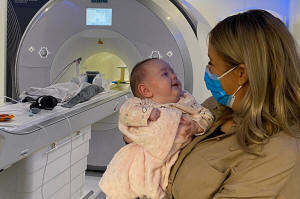
In this undated photo, baby Sadie attends her 2-month Foundcog scan
with her mother Donna at Trinity College Institute of Neuroscience
in Dublin, Ireland. (Cusack Lab via AP)
 In the new study, many of the babies
returned at 9 months, and researchers successfully collected data
from 66 of them. In the 9-month-olds, the brain was able to
distinguish living things from inanimate objects much more strongly
than in the 2-month-olds, O'Doherty said.
Someday, researchers said, scientists may be able to connect such
brain imaging to cognitive outcomes later in life.
Liuba Papeo, a neuroscientist at the National Center for Scientific
Research in France, said the number of babies in the study is one
thing that makes the work “impressive and unique.” Brain imaging
with very young infants presents challenges.
“One — perhaps the most obvious — is that the infant needs to (lie)
comfortably in the fMRI scanner while awake without moving," she
said in an email.
O’Doherty, who did the work at Trinity College Dublin in Ireland,
said the key was making the experience as comfortable as possible
for the babies. Inside the scanner, they reclined on a bean bag so
they were snug.
The images “appear really big above them while they’re lying down,”
she said. "It's like IMAX for babies.”
All contents © copyright 2026 Associated Press. All rights reserved |