Palestinians allowed in to Gaza and patients are evacuated to Egypt as
the Rafah crossing reopens
[February 03, 2026]
By SAMY MAGDY and JOSEF FEDERMAN
CAIRO (AP) — A dozen Palestinian returnees were allowed into Gaza from
Egypt late Monday after the long-awaited reopening of the Rafah border
crossing was marred by delays. Their arrival came hours after a small
group of medical evacuees was ferried from the territory into Egypt.
The reopening of the crossing marked a key step in the Israel-Hamas
ceasefire but mostly a symbolic one, with few people allowed to travel
and no goods allowed to pass through. The limitations were apparent
Monday as crossings fell well short of the 50 people officials had said
would be allowed to move in each direction.
About 20,000 Palestinian children and adults needing medical care hope
to leave the devastated territory via the crossing, according to Gaza
health officials. Thousands of other Palestinians outside the territory
hope to enter and return home.
The crossing had been closed since Israeli troops seized it in May 2024.
The number of travelers is expected to increase over time if the system
is successful. Israel has said it and Egypt will vet people for exit and
entry.
Ambulances queued for hours at the border before ferrying patients into
Egypt, the state-run Al-Qahera News satellite television channel showed.
Just before midnight, a bus arrived in Gaza carrying Palestinian
returnees who had fled the fighting early in the war. As the vehicle
entered the compound of a hospital in Khan Younis, a girl wearing
barrettes and an older woman stood just inside the front door, waving to
relatives anxious for their return.
Before the war, Rafah was the main crossing for people moving in and out
of Gaza. The territory’s handful of other crossings are all shared with
Israel. Under the terms of the ceasefire, which went into effect in
October, Israel’s military controls the area between the Rafah crossing
and the zone where most Palestinians live.

Violence continued across the coastal territory Monday. Gaza hospital
officials said an Israeli navy ship had fired on a tent camp, killing a
3-year-old Palestinian boy. Israel’s military said it was looking into
the incident.
Egypt prepares to receive the wounded
Rajaa Abu Mustafa stood outside a Gaza hospital where her 17-year-old
son Mohamed awaited evacuation. He was blinded by a shot to the eye last
year as he joined desperate Palestinians seeking food from aid trucks
outside the southern city of Khan Younis.
“The health ministry called and told us that we will travel to Egypt for
(his) treatment,” she said.
About 150 hospitals across Egypt are ready to receive patients evacuated
from Gaza through Rafah, authorities said. But the isolated crossing is
separated from Cairo by a six-hour drive. The Egyptian Red Crescent said
it has readied “safe spaces” on the Egyptian side of the border to
support those evacuated.
More than 10,000 patients have been evacuated from Gaza since the war
began, according to the World Health Organization. But Israel’s seizure
of the Rafah crossing brought the pace of evacuations to a crawl, with
an average of 17 patients a week leaving for most of the time since.
Israel has banned sending patients to hospitals in the Israeli-occupied
West Bank and east Jerusalem since the war began, cutting off what was
previously the main outlet for Palestinians needing medical treatment
unavailable in Gaza.
U.N. officials on Monday called on other countries to take in more
patients from Gaza “so that everyone receives the treatment they need.”
With the crossing reopened, Gaza residents looked forward to the return
of family members who fled earlier in the war.

[to top of second column]
|
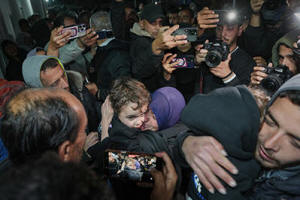
Najat Rubaie, center right, embraces one of her grandsons after they
arrive with their mother as part of a group of about a dozen
Palestinian returnees allowed into Gaza following the long-awaited
reopening of the Rafah border crossing, at Nasser Hospital in Khan
Younis, southern Gaza Strip, early Tuesday, Feb. 3, 2026. (AP
Photo/Abdel Kareem Hana)

“This time it's real,” said Iman Rashwan, anticipating the arrival
of her mother and sister. They left Gaza a year ago when her
mother's heart condition worsened and she was referred for treatment
in Egypt.
“They called us yesterday and said they received news that they will
leave,” Rashwan said. “We have been waiting for it for too long.”
The Rafah crossing will be supervised by European Union border
patrol agents with a small Palestinian presence. Historically,
Israel and Egypt have vetted Palestinians applying to cross. Fearing
that Israel could use the crossing to push Palestinians out of the
enclave, Egypt has repeatedly said it must be open for them to enter
and exit Gaza.
Palestinian toddler killed by Israeli fire
A 3-year-old Palestinian was killed when Israel's navy hit tents
sheltering displaced people in Khan Younis, Palestinian hospital
authorities said. According to Nasser hospital, which received the
body, the attack happened in Muwasi, a tent camp area on Gaza’s
coast.
Also on Monday, Israel's military said it killed four Palestinians
in northern Gaza who approached troops near the line marking
Israeli-controlled territory, “posing an imminent threat to them.”
More than 520 Palestinians have been killed by Israeli fire since
the ceasefire went into effect on Oct. 10, according to Gaza's
health ministry. They are among the over 71,800 Palestinians killed
since the start of the war, according to the ministry, which does
not say how many were fighters or civilians.
The ministry, part of Gaza's Hamas-led government, keeps detailed
casualty records that are seen as generally reliable by U.N.
agencies and independent experts.
Rafah's opening represents ceasefire progress
Israel had said seizing the Rafah crossing in May 2024 was part of
efforts to combat arms-smuggling by the Hamas militant group. The
crossing was briefly opened for the evacuation of medical patients
during a ceasefire in early 2025.
Israel had resisted reopening the Rafah crossing, but the recovery
of the remains of the last hostage in Gaza cleared the way to move
forward.

The reopening is seen as a key step as the U.S.-brokered ceasefire
agreement moves into its second phase.
The truce halted more than two years of war between Israel and Hamas
that began with the Hamas-led attack on southern Israel on Oct. 7,
2023. Its first phase called for the exchange of all hostages held
in Gaza for hundreds of Palestinians held by Israel, an increase in
badly needed humanitarian aid and a partial pullback of Israeli
troops.
The second phase of the ceasefire deal is more complicated. It calls
for installing the new Palestinian committee to govern Gaza,
deploying an international security force, disarming Hamas and
taking steps to begin rebuilding.
___
Federman reported from Jerusalem. Associated Press journalists Wafaa
Shurafa in Khan Younis, Gaza and Julia Frankel in Jerusalem
contributed to this report.
All contents © copyright 2026 Associated Press. All rights reserved |