Every Homeland Security officer in Minneapolis is now being issued a
body-worn camera, Noem says
[February 03, 2026]
By REBECCA SANTANA
WASHINGTON (AP) — Every Homeland Security officer on the ground in
Minneapolis, including those from Immigration and Customs Enforcement,
will be immediately issued body-worn cameras, Secretary Kristi Noem said
Monday, in the latest fallout after the shooting deaths of two U.S.
citizens at the hands of federal agents.
Noem said the body-worn camera program is being expanded nationwide as
funding becomes available.
“We will rapidly acquire and deploy body cameras to DHS law enforcement
across the country,” Noem said in a social media post on X.
The news of the body cameras comes as Minneapolis has been the site of
intense scrutiny over the conduct of federal officers after two U.S.
citizens protesting immigration enforcement activities in the city were
shot and killed.
It is the latest apparent effort by the Trump administration to ratchet
down tensions after the shootings triggered protests and widespread
criticism.
The shooting deaths sparked calls for accountability
In the immediate hours after ICU nurse Alex Pretti's death, Noem went on
the offensive, saying several times that Pretti “came with a weapon and
dozens of rounds of ammunition and attacked” officers, who took action
to “defend their lives.” Other administration officials painted a
similar picture.
Multiple videos that emerged of the shooting contradicted that claim,
showing Pretti had only his mobile phone in his hand as officers tackled
him to the ground, with one removing a handgun from the back of his
pants as another officer began firing shots into his back.

Homeland Security has said that at least four Customs and Border
Protection officers on the scene when Pretti was shot were wearing body
cameras. The body camera footage from Pretti’s shooting has not been
made public.
The department has not responded to repeated questions about whether any
of the ICE officers on the scene of the killing of 37-year-old mother of
three Renee Good earlier in January were wearing the cameras.
The shootings, and the narrative coming from some in the administration,
sparked demands for accountability, including among some Republicans.
President Donald Trump sent his border czar Tom Homan to Minneapolis to
take control of operations there, displacing Border Patrol commander
Gregory Bovino, who has become a lightning rod for criticism in the
various operations he's joined in cities like Chicago and Los Angeles.
The Justice Department has also opened a federal civil rights
investigation into Pretti's shooting, which it has not done in the case
of Good.
Critics have increasingly called for Homeland Security to require its
immigration enforcement officers to wear body cameras.
In response to Noem's announcement, Minnesota Gov. Tim Walz said on X
that body cameras should have been worn "long before (officers) killed
two Americans.”

[to top of second column]
|
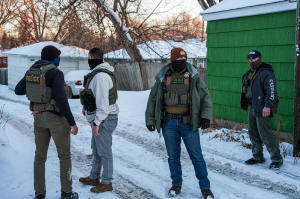
Federal agents conduct immigration enforcement operations in a
neighborhood on Monday, Feb. 2, 2026, in Minneapolis. (AP Photo/Ryan
Murphy)

Lawmakers consider restraints in DHS funding bill
Noem's announcement comes as the administration and Democrats are
locked in a congressional battle over funding for the Department of
Homeland Security.
Democrats have been demanding changes to rein in the Trump
administration's immigration enforcement operations. An additional
$20 million for body cameras was included in the bipartisan federal
funding package that was approved by the Senate late last week ahead
of a deadline to prevent a government shutdown.
But the House has yet to approve the package, launching a partial
government shutdown for certain agencies, including Homeland
Security, last Saturday. But because many Homeland Security
operations are deemed essential, they continue despite the federal
funding lapse.
Body cameras have become a flashpoint in previous immigration
enforcement operations under the Trump administration's mass
deportations agenda, including during a major operation in Chicago
last fall. A U.S. district judge ordered uniformed agents there to
wear cameras, if available, and turn them on when engaged in
arrests, frisks and building searches or when being deployed to
protests.
A 2022 executive order on police reform by President Joe Biden
directed federal law enforcement officers to wear body cameras.
Trump had rescinded that directive after starting his second term.
Trump backs body-worn cameras
Noem’s move comes after Trump over the weekend endorsed the idea of
body cameras for immigration officers.
After Noem's announcement Monday, Trump said the decision was up to
the secretary but said that he thought it was generally good for law
enforcement to wear cameras.
“They generally tend to be good for law enforcement because people
can’t lie about what’s happening,” he said in the Oval Office
Monday, adding, “If she wants to do the camera thing, that’s OK with
me.”

Aaron Reichlin-Melnick, a senior fellow with the American
Immigration Council, an advocacy group, said Noem didn't need to
wait for more money to enforce the new policy nationwide, pointing
to the massive immigration enforcement funding measure that Congress
passed last summer that gave ICE nearly $30 billion for “enforcement
and removal operations” including spending on information
technology.
“That buys a lot of body cameras," he said.
All contents © copyright 2026 Associated Press. All rights reserved |