House lawmaker raises new concerns over FDA's ultra-fast drug review
program
[February 04, 2026]
By MATTHEW PERRONE
WASHINGTON (AP) — A Democratic lawmaker raised new concerns about a Food
and Drug Administration program designed to drastically shorten the
review of certain drugs, including whether senior officials involved in
the effort are complying with federal ethics rules.
In a letter sent Tuesday, Rep. Jake Auchincloss of Massachusetts took
issue with the lack of transparency in FDA's handling of the program and
questioned its legal underpinnings, noting that Congress did not sign
off on the plan.
Under the Commissioner’s National Priority Voucher program, drugmakers
are promised expedited reviews of one to two months for new medicines
that support “ national interests.” It’s at the center of FDA
Commissioner Marty Makary’s stated goal of “cutting red tape” at the
agency.
But Auchincloss says details about the program have been “shrouded in
secrecy,” in part because the FDA has not responded to multiple
congressional inquiries.
“The public must have transparency about the ‘voucher’ program, under
which drug approvals have been made almost wholly and in an
unprecedented manner by the FDA’s political leadership,” states
Auchincloss, who is a member of a House subcommittee on health.
The new scrutiny came on the same day that the FDA held an employee town
hall on the program, according to three agency staffers who spoke to The
Associated Press on condition of anonymity to discuss confidential
agency matters. Much of the debate surrounding the program involves
concerns that drug decision-making is being taken away from agency
scientists.

But FDA leaders used Tuesday's event to stress that final approval
decisions continue to be made by drug center staffers, not political
appointees.
“The approval decision remains with the relevant product center, using
the center's normal processes,” stated a slide presented at the meeting
and shared with the AP.
In his letter, Auchincloss asserts that the FDA has failed to publish or
release financial disclosure forms for eight senior FDA officials who
vote on which drugs should receive priority vouchers. Membership of
group, which was first reported by Stat News, is mostly comprised of
officials closely aligned with Health Secretary Robert F. Kennedy Jr.,
including Deputy FDA Commissioner Dr. Sara Brenner, Dr. Vinay Prasad,
who oversees vaccines, and Dr. Tracy Beth Hoeg, FDA’s drug center
director.
[to top of second column]
|
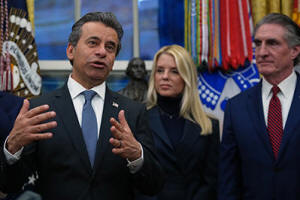
Dr. Marty Makary, commissioner of the Food and Drug Administration
speaks at an event on addiction recovery in the Oval Office of the
White House, Thursday, Jan. 29, 2026, in Washington, as Attorney
General Pam Bondi and Interior Secretary Doug Burgum listen. (AP
Photo/Allison Robbert)
 The forms, which are collected
annually by the Office of Government Ethics, list investments,
outside income and other financial details for senior government
officials and their spouses. Such disclosures are considered
critical to avoiding potential conflicts of interest at the FDA,
where staffers are often involved in regulating multibillion-dollar,
publicly traded companies.
A Department of Health and Human Services spokesperson didn't
immediately respond to AP's questions about the letter.
Elsewhere in his letter, Auchincloss questions whether the FDA had
the legal authority to establish the voucher program without action
from Congress, which typically legislates such programs into law.
His letter states that the FDA's legal office “was not consulted nor
provided findings to support the agency’s claim,” that it could
independently establish the program.
Several senior FDA staffers have declined to sign off on drug
approvals going through the program due to legal concerns, as
previously reported by the AP.
Auchincloss also notes that FDA officials did not respond to two
letters he sent last year requesting information. In the new letter,
the lawmaker instructs the agency to “affirm or refute,” his
findings.
In November, Sen. Bernie Sanders of Vermont and Rep. Frank Pallone
of New Jersey sent a letter seeking answers to 15 questions about
the FDA’s voucher program. Pallone is the top Democrat on the House
Energy and Commerce Committee, which oversees health agencies.
The agency did not respond to the letter, according to a committee
staffer.
___
The Associated Press Health and Science Department receives support
from the Howard Hughes Medical Institute’s Department of Science
Education and the Robert Wood Johnson Foundation. The AP is solely
responsible for all content.
All contents © copyright 2026 Associated Press. All rights reserved |