Hank and John Green's studio becomes a nonprofit as they aim to make
'trustworthy content' online
[February 05, 2026]
By JAMES POLLARD
NEW YORK (AP) — Author-vloggers Hank and John Green often end their
popular “Crash Course” videos with a donation appeal to keep the YouTube
show “free for everyone forever.” The multihyphenate brothers now hope
they've figured out a way to do just that — by changing their production
studio's tax status.
Their educational media company Complexly, which has garnered billions
of views through web series that explain just about every classroom
subject from animal biology to Latin American literature, will now
operate as a nonprofit.
The change is intended to ensure viewers have access to engaging,
fact-based content that can compete free of advertisers' interests in
the attention economy. It comes as artificial intelligence gives rise to
absurdist “ brain rot ” and distorted deepfake images while public media
struggles to make ends meet amid sudden cuts in federal funding.
“Part of what Complexly’s trying to do is create good information on the
internet,” Hank told the Associated Press. “Let’s actually just say that
this is our goal. Like, our goal isn’t to build a big company and sell
it someday.”
“There’s never been more information and yet there’s never been less
information that you feel you can trust," John added. "Our goal at
Complexly has always been to make trustworthy content. And making
Complexly a public good, for me, is the next step in that process.”

Strong audience and philanthropic support
Nonprofit status has been a consideration for several years, according
to Complexly CEO Julie Walsh Smith.
The studio already receives sizable philanthropic funding — including
$4.8 million last year. The nonprofit's initial supporters are led by
existing partners such as YouTube, PBS, and the Alfred P. Sloan
Foundation. Other funders such as Arizona State University and the
Howard Hughes Medical Institute underwrite a number of “Crash Course”
projects.
While about one-tenth of their revenue comes from a YouTube program that
gives creators a share of advertising earnings, strong audience support
made them confident in their ability to reach individual donors.
Complexly estimates that another tenth of their revenue comes from
Patreon, a platform where fans can contribute to their favorite online
creators often in exchange for bonus content. Monthly Patreon
subscribers tend to give $5 or $10 to help them make shows such as
“Crash Course.”
They also sell minted silver “Crash Course” coins every year that can
cost thousands of dollars. Hank said they have relationships with the
individuals who buy the most expensive versions of the coin — and that
most of those high-dollar supporters have said they want to increase
their support but maybe “felt a little weird” giving money to a
for-profit entity.
The small donors provide general funds that Hank said give them
flexibility to “invest in the ideas that we think are most likely to
deliver impact through reach.”
It is "hard to do the thing that we have to do where we compete with
MrBeast and cat videos and all of the very attention-grabbing dashcam
fights that YouTube has to offer," he said. “But we really take that
responsibility very seriously. We are not just here to make educational
video. We are here to make educational video that people choose to
watch. And so that's the fight that we are fighting."
New roles and new shows
The nonprofit transition requires Hank and John, best known for his
young adult novels “The Fault in Our Stars” and “Looking for Alaska,”
give up any equity they held in Complexly. While the
Montana-headquartered nonprofit expects to maintain its staff of roughly
80 employees, Smith says its growth means they no longer require the
founders’ “day-to-day leadership.”

[to top of second column]
|
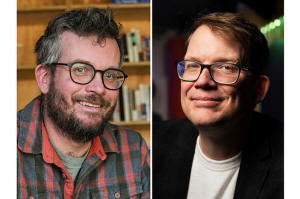
This combination of photos show brothers John Green, left, and Hank
Green. (AP Photo)
 John will move forward as “founder
emeritus” — he doesn’t know exactly what that means but says he is
“looking forward to finding out” — while Hank will join the
nonprofit’s board of directors and continue hosting some shows.
“The way I like to think about it is they’re going from leaders of
the organization to cheerleaders,” said Smith.
John promised that the viewing experience won't change much. If
anything, he said, there are potential new shows “that have long
been great ideas that weren't possible because they didn't make
sense from a business perspective."
Complexly is committing $8.5 million to new content that neither its
founders nor CEO would discuss yet. But Smith did say they are
seeking additional funding for an upcoming series that will go
behind the scenes at zoos and museums to spotlight the specimens
they don't display.
As far as new mediums such as TikTok go, Smith said they're focused
on YouTube while staying committed to being in the spaces “where
audiences are spending their time.”
Living in an 'advertising-funded internet'
The duo has long tried to crack the economics of the internet.
They founded the crowdfunding platform Subbable in 2013 to help
creators raise money for specific projects. There was even a point
where Hank tried to form a union for creators, whose livelihoods are
subject to the unpredictability of social media platforms'
algorithmic priorities and advertising share models.
This shift wasn't motivated by any doubts about their business'
health, they insisted, but rather other concerns.
“We've always worried about being overly reliant on advertising,”
John said. “I think that an advertising-funded internet is a
complicated place to live, as I've observed from the last 25 years
of my life.”
By leaning into philanthropic funding, John says the desire is for
Complexly to exist “for the good of the people who benefit from it”
and not “for anyone else's benefit."

“That’s not the same path a lot of digital media companies take,”
Smith said. “Often, they’ll put premium content behind paywalls or
behind a subscription service. And we’re just never gonna do that.”
No strangers to the nonprofit world
It's hardly their first foray into philanthropy.
The brothers say they have granted more than $17 million to dozens
of charities through their Foundation to Decrease World Suck. They
fund those donations with the profits from everyday purchases made
on the Good Store, their online retailer.
That familiarity has made them aware of the fact that many
nonprofits struggle with the nimbleness required of a digital
production studio. But they emphasized that there are many ways to
run a nonprofit. John noted that Partners in Health — one of the
Good Store's charitable partners — track tuberculosis in Lesotho
with an app that is “on par with anything being done in the private
sector.”
“It's perfectly possible for nonprofits to be innovative and fast
movers," John said. "It's just that you need to set that up from the
beginning."
“Can we signal to other people that there is no reason why you can't
do this and also model, as we go forward, that if that's a choice
that other people want to make then there's good ways to do it?"
Hank added.
All contents © copyright 2026 Associated Press. All rights reserved |