Iran and US agree to hold nuclear talks Friday in Oman as Trump delivers
blunt warning to Khamenei
[February 05, 2026]
By JON GAMBRELL
DUBAI, United Arab Emirates (AP) — Nuclear talks between Iran and the
United States will take place Friday in Oman, the Iranian foreign
minister said, as tensions between the countries remain high following
Tehran's bloody crackdown on nationwide protests last month.
The announcement Wednesday by Iranian Foreign Minister Abbas Araghchi
came after hours of indications that the anticipated talks were
faltering over changes in the format and content of the talks. U.S.
President Donald Trump, meanwhile, sent a blunt warning to Iran’s
Supreme Leader Ayatollah Ali Khamenei ahead of the talks.
“I would say he should be very worried,” Trump said of Khamenei in an
interview with NBC News.
Turkey had been working behind the scenes to host talks in Istanbul with
regional countries taking part and discussions focused on issues like
Iran's ballistic missile program and other concerns.
Early Wednesday, a regional official said Iran was seeking a “different”
type of meeting focused exclusively on the issue of Iran’s nuclear
program, with participation limited to Iran and the United States. The
official spoke on condition of anonymity because they were not
authorized to brief the media.
A similar series of talks had been hosted last year by Oman, a sultanate
on the eastern edge of the Arabian Peninsula that long as served as an
interlocutor between Iran and the West. Those talks ultimately broke
down in June as Israel launched what became a 12-day war on Iran that
included the U.S. bombing Iranian nuclear sites.

A White House official, who spoke on condition of anonymity as they were
not authorized to discuss the talks publicly, confirmed the talks would
happen in Oman. The official said several Arab and Muslim leaders urged
the Trump administration on Wednesday not to walk away from talks even
as Iranian officials pressed to narrow their scope.
The official added that the White House remains “very skeptical” that
the talks will be successful but has agreed to go along with the change
in plans out of respect for allies in the region.
Alan Eyre, a former U.S. diplomat once involved in past nuclear
negotiations with Tehran, similarly offered a skeptical opinion of talks
succeeding.
“Opting for indirect talks is the diplomatic equivalent of a surgeon
taking a hit of ether and then putting on gloves before a difficult
surgery,” Eyre wrote on X.
Rubio hopes talks will go beyond nuclear ones
Tensions between the countries spiked after Trump suggested the U.S.
might use force against Iran in response to the bloody crackdown on
nationwide protests last month that killed thousands of people or if
Iran conducted mass executions of detained demonstrators. The U.S.-based
Human Rights Activists News Agency reported Wednesday that over 50,000
people also had been arrested over the protests.
Trump also has been pushing Tehran for a deal to constrain its nuclear
program.
Iran’s reformist President Masoud Pezeshkian on Tuesday said he had
instructed the foreign minister to “pursue fair and equitable
negotiations” with the U.S., in the first clear sign from Tehran it
wants to try to negotiate. That signaled the move is supported by
Supreme Leader Ayatollah Ali Khamenei, who has the final say on all
matters of state and previously dismissed any negotiations.
U.S. Secretary of State Marco Rubio said the U.S. hoped to discuss a
number of concerns beyond the nuclear issue, including discussions on
Iran’s ballistic missiles, support for proxy networks across the region
and the “treatment of their own people.”

[to top of second column]
|
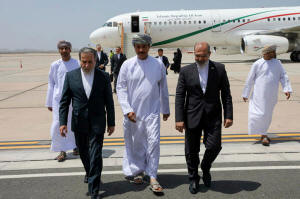
In this photo released by the Iranian Foreign Ministry, Iranian
Foreign Minister Abbas Araghchi, left, is welcomed by an
unidentified Omani official, center, upon his arrival at Muscat,
Oman, for negotiations with U.S. Mideast envoy Steve Witkoff, as
Iranian Ambassador to Oman Mousa Farhang walks at right, May 11,
2025. (Iranian Foreign Ministry via AP, File)

“The leadership of Iran at the clerical level does not reflect the
people of Iran. I know of no other country where there’s a bigger
difference between the people who lead the country and the people
who live there,” he told reporters.
Vice President JD Vance told “The Megyn Kelly Show” that diplomatic
talks with Iran are challenging because Khamenei oversees Tehran’s
political system and declines to speak directly with Trump, unlike
the leaders of China, North Korea or Russia.
Vance said Trump’s bottom line is that Iran cannot be allowed to
develop a nuclear weapon, asserting that other states in the region
would quickly do the same.
Iran long has insisted its nuclear program is peaceful. However,
Iranian officials in recent years have increasingly threatened to
pursue the bomb and had been enriching uranium up to 60% purity, a
short, technical step away from weapons-grade levels of 90%.
Vance said he believed Trump would work to “accomplish what he can
through non-military means. And if he feels like the military is the
only option, then he’s ultimately going to choose that option.”
Talks expected even after US shot down Iranian drone
On Tuesday, a U.S. Navy fighter jet shot down an Iranian drone that
approached an American aircraft carrier. Iranian fast boats from its
paramilitary Revolutionary Guard also tried to stop a U.S.-flagged
ship in the Strait of Hormuz, the narrow mouth of the Persian Gulf,
the Navy said.
Iran did not formally acknowledge either incident, which strained
but apparently did not derail hopes for talks with the U.S.
On Wednesday, Iranian military chiefs visited a missile base in an
attempt to highlight its military readiness after the 12-day war
devastated Iran’s air defenses. The base holds the Khorramshahr
missile, which has a range of more than 2,000 kilometers (1,250
miles) and was launched toward Israel during the war last year.

Turkey urges diplomacy
Also Wednesday, Turkish President Recep Tayyip Erdogan reiterated
Turkey’s opposition to foreign intervention in neighboring Iran,
calling for the resolution of issues through dialogue.
Turkey has been urgently working for the past week to bring the U.S.
and Iran to the negotiating table, and was previously expected to
host the talks.
“We believe that external interventions involving our neighbor Iran
would pose significant risks for the entire region,” Erdogan said
during a visit to Cairo. “Resolving issues with Iran, including the
nuclear file, through diplomatic means is the most appropriate
approach.”
___
Associated Press writers Suzan Fraser in Ankara, Turkey, Melanie
Lidman in Jerusalem, Farnoush Amiri in New York, and Aamer Madhani
and Moriah Balingit in Washington contributed to this report.
All contents © copyright 2026 Associated Press. All rights reserved |