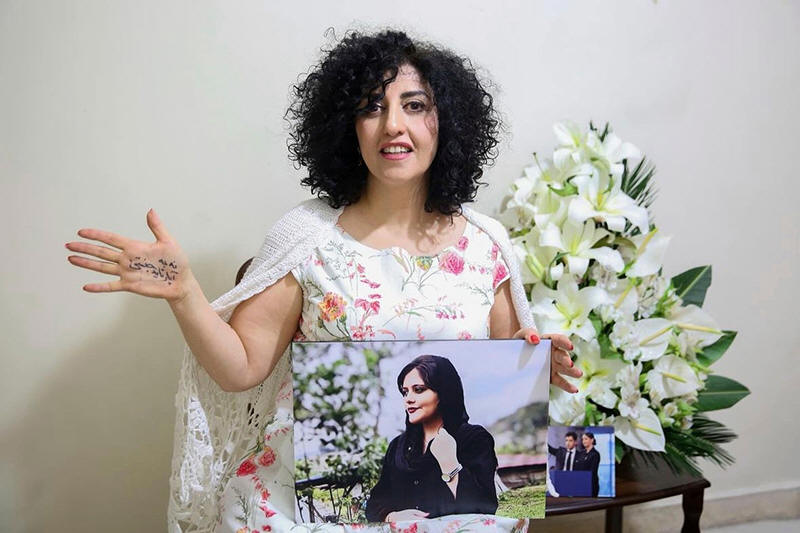
Iran sentences Nobel laureate Narges Mohammadi to 7 more years in prison
[February 09, 2026]
By JON GAMBRELL
DUBAI, United Arab Emirates (AP) — Iran sentenced Nobel Peace Prize
laureate Narges Mohammadi to over seven more years in prison after she
began a hunger strike, supporters said Sunday, as Tehran cracks down on
all dissent following nationwide protests and the deaths of thousands at
the hands of security forces.
The new convictions against Mohammadi come as Iran tries to negotiate
with the United States over its nuclear program to avert a threatened
military strike by U.S. President Donald Trump. Iran's top diplomat
insisted Sunday that Tehran's strength came from its ability to “say no
to the great powers," striking a maximalist position just after
negotiations in Oman with the U.S.
Mohammadi’s supporters cited her lawyer, who spoke to Mohammadi. The
lawyer, Mostafa Nili, confirmed the sentence on X, saying it had been
handed down Saturday by a Revolutionary Court in the city of Mashhad.
Such courts typically issue verdicts with little or no opportunity for
defendants to contest their charges.
“She has been sentenced to six years in prison for ‘gathering and
collusion’ and one and a half years for propaganda and two-year travel
ban,” he wrote. She received another two years of internal exile to the
city of Khosf, some 740 kilometers (460 miles) southeast of Tehran, the
capital, the lawyer added.
Agnes Callamard, the secretary-general of Amnesty International, wrote
on X that Mohammadi's sentence was “a reflection of the skyrocketing
lethal repression against dissent and protests waged by the
authorities.”
Iran did not acknowledge the sentence. Supporters say Mohammadi has been
on a hunger strike since Feb. 2 and ended it Sunday after her sentencing
over her worsening health. She had been arrested in December at a
ceremony honoring Khosrow Alikordi, a 46-year-old Iranian lawyer and
human rights advocate who had been based in Mashhad. Footage from the
demonstration showed her shouting, demanding justice for Alikordi and
others.

Mohammadi a symbol for Iranian activists
Supporters had warned for months before her December arrest that
Mohammadi, 53, was at risk of being put back into prison after she
received a furlough in December 2024 over medical concerns.
While that was to be only three weeks, Mohammadi’s time out of prison
lengthened, possibly as activists and Western powers pushed Iran to keep
her free. She remained out even during the 12-day war in June between
Iran and Israel.
Mohammadi still kept up her activism with public protests and
international media appearances, including even demonstrating at one
point in front of Tehran’s notorious Evin prison, where she had been
held.
Mohammadi had been serving 13 years and nine months on charges of
collusion against state security and propaganda against Iran’s
government. She also had backed the nationwide protests sparked by the
2022 death of Mahsa Amini, which have seen women openly defy the
government by not wearing the hijab.
Mohammadi suffered multiple heart attacks while imprisoned before
undergoing emergency surgery in 2022, her supporters say. Her lawyer in
late 2024 revealed doctors had found a bone lesion that they feared
could be cancerous that later was removed.
“Considering her illnesses, it is expected that she will be temporarily
released on bail so that she can receive treatment,” Nili wrote.
However, Iranian officials have been signaling a harder line against all
dissent since the demonstrations. Speaking on Sunday, Iranian judiciary
chief Gholamhossein Mohseni-Ejei made comments suggesting harsh prison
sentences awaited many.

[to top of second column]
|
In this photo released by the Narges Foundation Archive, Nobel
Peace Prize laureate Narges Mohammad is seen after being released on
a medical furlough in Tehran, Iran, Wednesday, Dec. 4, 2024. On her
hand written in Farsi is "End gender apartheid." (Narges Foundation
Archive via AP, File)

“Look at some individuals who once were with the revolution and
accompanied the revolution," he said. "Today, what they are saying,
what they are writing, what statements they issue, they are
unfortunate, they are forlorn (and) they will face damage.”
Foreign minister strikes hard-line tone
The news about Mohammadi came as Foreign Minister Abbas Araghchi,
speaking to diplomats at a summit in Tehran, signaled that Iran
would stick to its position that it must be able to enrich uranium —
a major point of contention with Trump, who bombed Iranian atomic
sites in June during the 12-day Iran-Israel war.
Israeli Prime Minister Benjamin Netanyahu is expected to travel to
Washington this week, with Iran expected to be the major subject of
discussion, his office said.
While Iranian President Masoud Pezeshkian praised the talks Friday
in Oman with the Americans as “a step forward,” Araghchi's remarks
show the challenge ahead. Already, the U.S. moved the aircraft
carrier USS Abraham Lincoln, ships and warplanes to the Middle East
to pressure Iran into an agreement and have the firepower necessary
to strike the Islamic Republic should Trump choose to do so.
“I believe the secret of the Islamic Republic of Iran’s power lies
in its ability to stand against bullying, domination and pressures
from others," Araghchi said. "They fear our atomic bomb, while we
are not pursuing an atomic bomb. Our atomic bomb is the power to say
no to the great powers. The secret of the Islamic Republic’s power
is in the power to say no to the powers.”
‘Atomic bomb’ as rhetorical device
Araghchi's choice to explicitly use an “atomic bomb” as a rhetorical
device likely wasn't accidental. While Iran has long maintained its
nuclear program is peaceful, the West and the International Atomic
Energy Agency say Tehran had an organized military program to seek
the bomb up until 2003.
Iran had been enriching uranium up to 60% purity, a short, technical
step to weapons-grade levels of 90%, the only nonweapons state to do
so. Iranian officials in recent years had also been increasingly
threatening that the Islamic Republic could seek the bomb, even
while its diplomats have pointed to Iranian Supreme Leader Ayatollah
Ali Khamenei’s preachings as a binding fatwa, or religious edict,
that Iran wouldn’t build one.

It remains unclear when and where, or if, there will be a second
round of nuclear talks. Trump, after the talks Friday, offered few
details but said: “Iran looks like they want to make a deal very
badly — as they should.”
Meanwhile, Iran issued a warning to pilots it planned “rocket
launches” Monday into Tuesday in an area over the country's Semnan
province, home to the Imam Khomeini Spaceport. Such launches have
corresponded in the past with Iran marking the anniversary of its
1979 Islamic Revolution.
All contents © copyright 2026 Associated Press. All rights reserved |