Russia says it will stick to New START's nuclear arms limits as long as
the US does
[February 12, 2026]
By VLADIMIR ISACHENKOV
MOSCOW (AP) — Moscow will observe the limits of the last nuclear arms
pact with the United States that expired last week as long as it sees
that Washington is doing the same, Russia's top diplomat said Wednesday.
The New START treaty expired Feb. 5, leaving no restrictions on the two
largest atomic arsenals for the first time in more than a half-century
and fueling fears of an unconstrained nuclear arms race.
Russian President Vladimir Putin last year declared his readiness to
stick to the treaty’s limits for another year if Washington followed
suit, but U.S. President Donald Trump has argued that he wants China to
be a part of a new pact — something Beijing has rejected.
Remarks to Russian lawmakers
Speaking Wednesday to the parliament's lower house, Russian Foreign
Minister Sergey Lavrov said that even though the U.S. hasn't responded
to Putin's offer, Russia will respect New START's caps for as long as it
sees that the U.S. observes them too.
“The moratorium declared by the president will remain as long as the
U.S. doesn't exceed these limits,” Lavrov told lawmakers. "We will act
in a responsible and balanced way on the basis of analysis of the U.S.
military policies.”
He added that “we have reason to believe that the United States is in no
hurry to abandon these limits and that they will be observed for the
foreseeable future.”
“We will closely monitor how things are actually unfolding," Lavrov
said. "If our American colleagues’ intention to maintain some kind of
cooperation on this is confirmed, we will work actively on a new
agreement and consider the issues that have remained outside strategic
stability agreements."

US-Russia talks in Abu Dhabi
Lavrov's statement followed a report by Axios claiming Russian and U.S.
negotiators discussed a possible informal deal to observe the pact’s
limits for at least six months during talks last week in Abu Dhabi.
Asked to comment on the report, Kremlin spokesman Dmitry Peskov said
Friday that any such extension could only be formal, adding that “it’s
hard to imagine any informal extension in this sphere.”
At the same time, Peskov confirmed that Russian and U.S. negotiators
discussed future nuclear arms control in Abu Dhabi where delegations
from Moscow, Kyiv and Washington held two days of talks on a peace
settlement in Ukraine.
“There is an understanding, and they talked about it in Abu Dhabi, that
both parties will take responsible positions and both parties realize
the need to start talks on the issue as soon as possible,” Peskov said.
The limits of the New START treaty
New START, signed in 2010 by then-President Barack Obama and his Russian
counterpart, Dmitry Medvedev, was the last of a long series of
agreements between Moscow and Washington to limit their nuclear
arsenals, starting with SALT I in 1972.
New START restricted each side to no more than 1,550 nuclear warheads on
no more than 700 missiles and bombers deployed and ready for use. It was
originally set to expire in 2021 but was extended for five years.
[to top of second column]
|
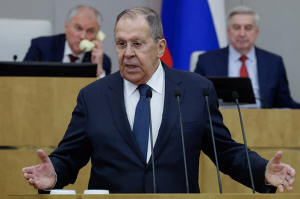
In this photo released by The State Duma, The Federal Assembly of
The Russian Federation Press Service, Russian Foreign Minister
Sergey Lavrov gestures as he delivers his speech at the State Duma,
the Lower House of the Russian Parliament in Moscow, on Wednesday,
Feb. 11, 2026. (The State Duma, The Federal Assembly of The Russian
Federation Press Service via AP)

The pact envisioned sweeping on-site inspections to verify
compliance, although they stopped in 2020 because of the COVID-19
pandemic and never resumed.
In February 2023, Putin suspended Moscow’s participation, saying
Russia couldn’t allow U.S. inspections of its nuclear sites at a
time when Washington and its NATO allies openly declared they wanted
Moscow’s defeat in Ukraine. But the Kremlin also emphasized it
wasn’t withdrawing from the pact altogether, pledging to respect its
caps on nuclear weapons.
In September, Putin offered to keep the New START’s limits for
another year to buy time for both sides to negotiate a successor
agreement.
Even as New START expired, the U.S. and Russia agreed on Feb. 5 to
reestablish high-level, military-to-military dialogue following a
meeting between senior officials from both sides in Abu Dhabi, the
U.S. military command in Europe said. The link was suspended in 2021
as relations grew increasingly strained before Russia sent troops
into Ukraine in February 2022.
Lavrov cites ‘excellent’ Trump-Putin relationship
Lavrov described personal relations between Putin and Trump as
“excellent,” saying that their “mutual sympathy and respect helped
create the atmosphere that allowed them to reach understanding" on
specific issues during their August summit in Anchorage, Alaska,
including Ukraine.
Asked by lawmakers about the U.S. bid to take control of Greenland,
Lavrov said it doesn't concern Russia, but he noted that “in case of
militarization of Greenland and the creation of military
capabilities there aimed against Russia, we will take relevant
countermeasures, including those of a military-technical character.”
He described the U.S. ban for Russia, China and Iran to make any
transactions with Venezuelan oil as “discriminatory,” noting that
Moscow expects Washington to develop relations on the basis of
“mutual respect.”

Lavrov emphasized that while the Kremlin hasn't yet launched a
“strategic dialogue” with the Trump administration, “we are always
open for such dialogue.”
___
The Associated Press receives support for nuclear security coverage
from the Carnegie Corporation of New York and Outrider Foundation.
The AP is solely responsible for all content.
All contents © copyright 2026 Associated Press. All rights reserved |