Buddhist monks draw thousands to Lincoln Memorial on final day of their
15-week journey from Texas
[February 12, 2026]
By DEEPA BHARATH and TIFFANY STANLEY
A group of Buddhist monks ended their 108-day Walk for Peace from Texas
to Washington with a ceremony Wednesday afternoon at the Lincoln
Memorial, where thousands gathered to hear them speak.
The 19 monks — led by the Venerable Bhikkhu Pannakara and joined by his
dog, Aloka — walked 2,300 miles (3,700 kilometers) across several
Southern states — sometimes in frigid conditions — drawing large crowds
in churchyards, city halls and town squares. The group, with its message
of peace, has captured hearts across the nation and globe, earning it
millions of online followers.
From the steps of the Lincoln Memorial, Pannakara urged everyone to
practice mindfulness and to always choose kindness, compassion, love,
harmony and hope.
“The Walk for Peace is not a protest, it is not to convert,” the monk
said, his words ringing out in pin-drop silence. “It's a reminder that
hope still exists when people are willing to care. Hope is the final
light that must never go out.”
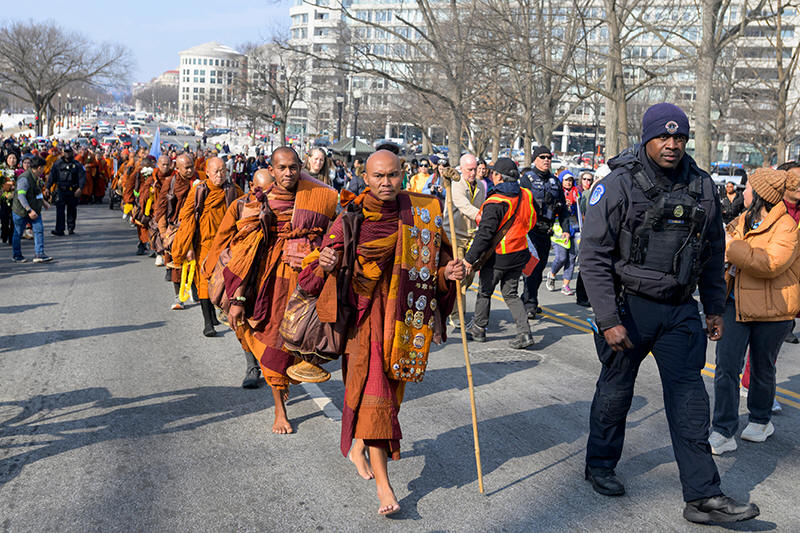
On Wednesday morning, the monks walked single file under bright blue
skies, on the warmest day since a snowstorm hit the region more than two
weeks ago. The group was followed by about 100 other monks and nuns who
had joined them in Washington.
Behind them was a sea of people marching silently, some carrying peace
signs. More than 21,000 people followed the livestream online from
around the globe, posting messages in Spanish, Hindi, Thai, Portuguese,
Sinhalese and many more.
Several monks representing Buddhists in Canada, Myanmar, Cambodia and
Thailand commended the monks' effort. The Venerable Ratanaguna, abbot of
the Fort Worth temple and Pannakara's teacher, said he was happy to see
the walk bring together such a diverse group of people in Washington.

Monks receive message from the Dalai Lama
Tencho Gyatso, niece of the 14th Dalai Lama and president of the
International Campaign for Tibet, read a commendation from the
90-year-old monk appreciating the monks' commitment to “promote national
healing, unity and compassion.”
“Their initiative illustrates how religious practitioners can contribute
in a constructive way to social harmony and public dialogue,” the Dalai
Lama said in the statement.
Crowds cheered and thanked the monks from sidewalks as they walked from
George Washington University, where they stopped for the night, to
Capitol Hill. The monks were greeted by House Democratic Leader Hakeem
Jeffries and Former House Speaker Nancy Pelosi as they walked near the
Peace Monument on Capitol Hill.
Pannakara walked barefoot on Wednesday, holding his staff in one hand
and a long-stemmed yellow rose in another. His robe was covered in pins
given by municipal and law enforcement officials the monks met and
interacted with along the way.
People crowded on sidewalks trying to capture a shot of the monks on
their cellphones. Many shouted out “thank you” and “we love you,” which
the monks acknowledged with smiles and waves.
[to top of second column]
|
Bhikkhu Pannakara, center, leads his fellow Buddhist monks on
Capitol Hill, during the Walk for Peace, in Washington, Wednesday,
Feb., 11, 2026. (AP Photo/Rod Lamkey, Jr.)

On Tuesday, they made stops at American University and the
Washington National Cathedral for an interfaith conversation where
thousands thronged to hear Pannakara speak about mindfulness and
loving kindness.
The group left from the Huong Dao Vipassana Bhavana Center, a
Buddhist temple in Fort Worth. Long Si Dong, a temple spokesperson,
said Wednesday that approaching the U.S. Capitol, he felt “deeply
humbled and grateful to witness the large crowd walking quietly
behind the monks.”
“Seeing so many people move together in respect, calm and shared
purpose was a powerful reminder that peace is not a solitary act —
it is something we create together,” he said.
Challenges on the walk to Washington
The monks' trek has had its perils. In November, outside Houston,
the group was walking on the side of a highway when their escort
vehicle was hit by a truck. Two monks were injured; Venerable Maha
Dam Phommasan had his leg amputated. Phommasan, abbot of a temple in
Snellville, Georgia, rejoined the monks near Washington and entered
American University’s arena in a wheelchair and joined the group on
their walk to the Capitol.
Pannakara gave Phommasan the floor before he spoke during
Wednesday's closing ceremony. Phommasan told the crowd he was
feeling cold, “but you all make my heart warm.” He said practicing
mindfulness made him face the difficult moments after the accident
and his amputation with equanimity.
He thanked Pannakara, who he said taught him to be strong.
“He walks like how I run,” Phommasan said as the crowd laughed.
“When we walked together, we were very tired, we were cold and we
were hot. But, we never gave up.”
Peace walks are a cherished tradition in Theravada Buddhism. Some of
the monks have walked barefoot or in socks during parts of the
journey to feel the ground directly and help them be present in the
moment.
The monks practice and teach Vipassana meditation, an ancient Indian
technique taught by the Buddha that focuses on breath and the
mind-body connection. Pannakara’s peace talks, given at stops along
the way, have urged listeners to put down their phones and find
peace within themselves.
Their return trip should be less arduous. After an appearance at the
Maryland State House, a bus will take them back to Texas, where they
expect to arrive in downtown Fort Worth early on Saturday.
From there, the monks will walk together again, traversing 6 miles
(9.6 kilometers) to the temple where their trip began.
All contents © copyright 2026 Associated Press. All rights reserved |