US homes sales fell sharply in January, even as mortgage rates continued
to ease
[February 13, 2026] By
ALEX VEIGA
Sales of previously occupied U.S. homes fell sharply in January as
higher home prices and possibly harsh winter weather kept many
prospective homebuyers on the sidelines despite easing mortgage rates.
Existing home sales sank 8.4% last month from December to a seasonally
adjusted annual rate of 3.91 million units, the National Association of
Realtors said Thursday. That’s the biggest monthly decline in nearly
four years and the slowest annualized sales pace in more than two years.
Sales fell 4.4% compared with January last year. The latest sales figure
fell short of the 4.105 million pace economists were expecting,
according to FactSet.
“The decrease in sales is disappointing," said Lawrence Yun, NAR’s chief
economist. "The below-normal temperatures and above-normal precipitation
this January make it harder than usual to assess the underlying driver
of the decrease and determine if this month’s numbers are an
aberration.”
Home sales slowed sharply across the Northeast, Midwest, South and West.
But sales had their biggest annual and monthly drop in the West, which
wasn't as affected by last month's winter storm as the other regions of
the country. Plus, there’s usually a month or two lag between a contract
signing and when the sale is finalized, so many of January's sales
reflect contracts signed late last year.
Despite the sharp drop in sales, home prices continued to climb last
month. The national median sales price increased 0.9% in January from a
year earlier to $396,800. Home prices have risen on an annual basis for
31 months in a row.

The U.S. housing market has been in a sales slump dating back to 2022,
when mortgage rates began to climb from pandemic-era lows. The
combination of higher mortgage rates, years of skyrocketing home prices
and a chronic shortage of homes nationally following more than a decade
of below-average home construction have left many aspiring homeowners
priced out of the market. Sales of previously occupied U.S. homes
remained stuck last year at 30-year lows.
Sales have been hovering close to a 4-million annual pace now going back
to 2023. That’s well short of the 5.2-million annual pace that’s
historically been the norm.
Still, mortgage rates have been trending lower for months, which helped
give home sales a boost in December and brightened the outlook for the
upcoming spring home-buying season — at least for home shoppers who can
afford to buy at current rates.
Many of the homes purchased last month likely went under contract in
November and December, when mortgage rates eased to their lowest levels
of the year.
[to top of second column] |

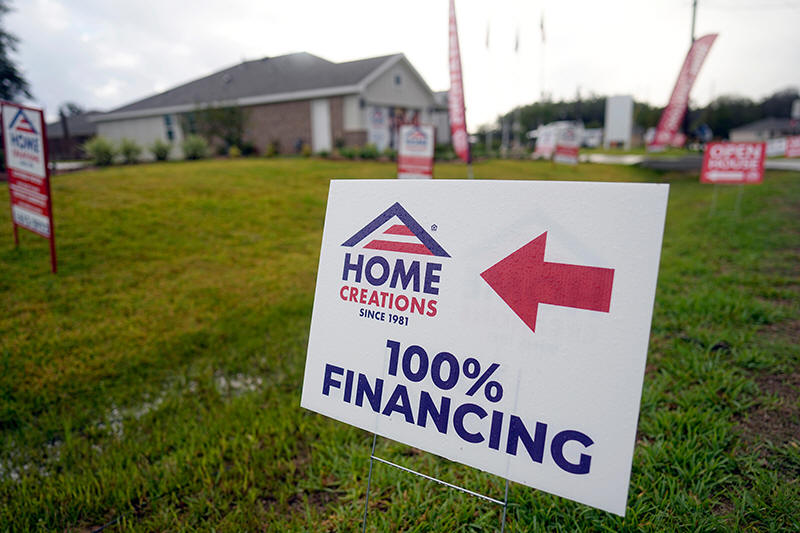
A sign promoting 100% financing is displayed outside a model home in
the Colony Ridge development in Cleveland, Tx., Oct. 3, 2023. (AP
Photo/David J. Phillip, File)
 The average rate on a 30-year
mortgage briefly dropped last month to 6.06%, the lowest level since
September 2022, according to mortgage buyer Freddie Mac. It has
since inched higher, remaining this week at just above 6%, but close
to a percentage point lower than a year ago.
Even so, affordability remains a challenge for many
aspiring homeowners, especially first-time buyers who don’t have
equity from an existing home to put toward a new home purchase. They
accounted for 31% of homes sales last month. Historically, they made
up 40% of home sales.
“Today we have minimal foreclosures, housing wealth continues to
build out, it's just that renters who want to become homeowners are
finding difficulty,” Yun said.
Uncertainty over the job market is also likely keeping many would-be
buyers on the sidelines.
While the economy has been registering solid growth, the labor
market has been sluggish for months. U.S. job openings fell in
December to the lowest level in more than five years. And while
hiring by U.S. employers was surprisingly strong in January,
government revisions reduced the number of jobs created last year to
the weakest total since 2020, when the pandemic began.
The sales slowdown means more homes are staying on the market
longer.
There were 1.22 million unsold homes at the end of January, down
0.8% from December and up 3.4% from January last year, NAR said.
That’s still well short of the roughly 2 million homes for sale that
was typical before the COVID-19 pandemic.
January’s month-end inventory translates to a 3.7-month supply at
the current sales pace. Traditionally, a 5- to 6-month supply is
considered a balanced market between buyers and sellers.
More homes traditionally go on the market ahead of the spring
home-buying season, which could give prospective buyers a wider
selection.
“Buyers will find a more favorable market as we head into spring,”
said Lisa Sturtevant, chief economist at Bright MLS. “More
inventory, lower rates and slower price growth will give buyers more
room for negotiation.”
All contents © copyright 2026 Associated Press. All rights reserved |