Scientific studies calculate climate change as health danger, while
Trump calls it a 'scam'
[February 13, 2026]
By SETH BORENSTEIN
The Trump administration on Thursday revoked a scientific finding that
climate change is a danger to public health, an idea that President
Donald Trump called “a scam.” But repeated scientific studies say it’s a
documented and quantifiable harm.
Again and again, research has found increasing disease and deaths —
thousands every year — in a warming world.
The Environmental Protection Agency finding in 2009, under the Obama
administration, has been the legal underpinning of nearly all
regulations fighting global warming.
“It boggles the mind that the administration is rescinding the
endangerment finding; it’s akin to insisting that the world is flat or
denying that gravity is a thing,” said Dr. Howard Frumkin, a physician
and professor emeritus of public health at the University of Washington.
Thousands of scientific studies have looked at climate change and its
effects on human health in the past five years and they predominantly
show climate change is increasingly dangerous to people.
Many conclude that in the United States, thousands of people have died
and even more were sickened because of climate change in the past few
decades.
For example, a study on “Trends in heat-related deaths in the U.S.,
1999-2023 ” in the prestigious JAMA journal shows the yearly
heat-related death count and rate have more than doubled in the past
quarter century from 1,069 in 1999 to a record high 2,325 in 2023.

A 2021 study in Nature Climate Change looked at 732 locations in 43
countries — including 210 in the United States — and determined that
more than a third of heat deaths are due to human-caused climate change.
That means more than 9,700 global deaths a year attributed to warming
from the burning of coal, oil and natural gas.
A new study published this week found that 2.2% of summer deaths in
Texas from 2010 to 2023 were heat related “as climate change brings more
frequent and intense heat to Texas.”
Research is booming on the topic
In the more than 15 years, since the government first determined climate
change to be a public health danger, there have been more than 29,000
peer-reviewed studies that looked at the intersection of climate and
health, with more than 5,000 looking specifically at the United States,
according to the National Library of Medicine's PubMed research
database.
More than 60% of those studies have been published in the past five
years.
“Study after study documents that climate change endangers health, for
one simple reason: It’s true,” said Frumkin, a former director of the
National Center for Environmental Health appointed by President George
W. Bush.
In a Thursday event at the White House, Trump disagreed, saying: “It has
nothing to do with public health. This is all a scam, a giant scam.”
Experts strongly disagree.
“Health risks are increasing because human-cause climate change is
already upon us. Take the 2021 heat dome for example, that killed (more
than) 600 people in the Northwest,'' said Dr. Jonathan Patz, a physician
who directs the Center for Health, Energy and Environmental Research at
the University of Wisconsin-Madison. "The new climate attribution
studies show that event was made 150-fold more likely due to climate
change.”

[to top of second column]
|
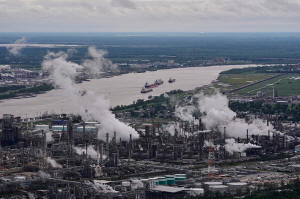
The Shell Norco oil refinery operates in Norco, La., April 7, 2025.
(AP Photo/Gerald Herbert, File)
 Patz and Frumkin both said the “vast
majority” of peer-reviewed studies show health harms from climate
change. Peer-reviewed studies are considered the gold standard of
science because other experts pore over the data, evidence and
methods, requiring changes, questioning techniques and conclusions.
More than just heat and deaths
The various studies look at different parts of health. Some looked
at deaths that wouldn't have happened without climate change. Others
looked at illnesses and injuries that didn't kill people. Because
researchers used different time periods, calculation methods and
specific aspects of health, the final numbers of their conclusions
don't completely match.
Studies also examined disparities among different peoples and
locations. A growing field in the research are attribution studies
that calculate what proportion of deaths or illness can be blamed on
human-caused climate change by comparing real-world mortality and
illness to what computer simulations show would happen in a world
without a spike in greenhouse gases.
Last year an international team of researchers looked at past
studies to try to come up with a yearly health cost of climate
change.
While many studies just look at heat deaths, this team tried to
bring in a variety of types of climate change deaths — heat waves,
extreme weather disasters such as 2017's Hurricane Harvey,
wildfires, air pollution, diseases spread by mosquitos such as
malaria — and found hundreds of thousands of climate change deaths
globally.
They then used the EPA's own statistic that puts a dollar value on
human life — $11.5 million in 2014 dollars — and calculated a global
annual cost “on the order of at least $10 billion.”
Studies also connect climate change to waterborne infections that
cause diarrhea, mental health issues and even nutrition problems,
Frumkin said.

“Public health is not only about prevention of diseases, death and
disability but also well-being. We are increasingly seeing people
displaced by rising seas, intensifying storms and fires,” said Dr.
Lynn Goldman, a physician and dean emeritus at the George Washington
University School of Public Health.
“We have only begun to understand the full consequences of a
changing climate in terms of health.”
Cold also kills and that's decreasing
The issue gets complicated when cold-related deaths are factored in.
Those deaths are decreasing, yet in the United States there are
still 13 times more deaths from cold exposure than heat exposure,
studies show.
Another study concludes that until the world warms another 2.7
degrees (1.5 degrees Celsius) from now, the number of
temperature-related deaths won't change much “due to offsetting
decreases in cold-related mortality and increases in heat-related
deaths.”
But that study said that after temperatures rise beyond that
threshold, and if society doesn't adapt to the increased heat,
“total mortality rises rapidly."
All contents © copyright 2026 Associated Press. All rights reserved |