Iranian security use dragnet spanning the entire country to arrest
protesters
[February 14, 2026]
By AMIR-HUSSEIN RADJY
CAIRO (AP) — The Iranian security agents came at 2 a.m., pulling up in a
half-dozen cars outside the home of the Nakhii family. They woke up the
sleeping sisters, Nyusha and Mona, and forced them to give the passwords
for their phones. Then they took the two away.
The women were accused of participating in the nationwide protests that
shook Iran a week earlier, a friend of the pair told The Associated
Press, speaking on condition of anonymity for her security as she
described the Jan. 16 arrests.
Such arrests have been happening for weeks following the government
crackdown last month that crushed the protests calling for the end of
the country’s theocratic rule. Reports of raids on homes and workplaces
have come from major cities and rural towns alike, revealing a dragnet
that has touched large swaths of Iranian society. University students,
doctors, lawyers, teachers, actors, business owners, athletes and
filmmakers have been swept up, as well as reformist figures close to
President Masoud Pezeshkian.
They are often held incommunicado for days or weeks and prevented from
contacting family members or lawyers, according to activists monitoring
the arrests. That has left desperate relatives searching for their loved
ones.
The U.S.-based Human Rights Activists News Agency has put the number of
arrests at more than 50,000. The AP has been unable to verify the
figure. Tracking the detainees has been difficult since Iranian
authorities imposed an internet blackout, and reports leak out only with
difficulty.
Other activist groups outside Iran have also been working to document
the sweeps.
“Authorities continue to identify people and detain them,” said Shiva
Nazarahari, an organizer with one of those groups, the Committee for
Monitoring the Status of Detained Protesters.
So far, the committee has verified the names of more than 2,200 people
who were arrested, using direct reports from families and a network of
contacts on the ground. The arrestees include 107 university students,
82 children as young as 13, as well as 19 lawyers and 106 doctors.
Nazarahari said authorities have been reviewing municipal street
cameras, store surveillance cameras and drone footage to track people
who participated in the protests to their homes or places of work, where
they are arrested.
Held for weeks with no contact
The protests began in late December, triggered by anger over spiraling
prices, and quickly spread across the country. They peaked on Jan. 8 and
9, when hundreds of thousands of people in more than 190 cities and
towns across the country took to the streets.
Security forces responded by unleashing unprecedented violence. The
Human Rights Activists News Agency has so far counted more than 7,000
dead and says the true number is far higher. Iran’s government offered
its only death toll on Jan. 21, saying 3,117 people were killed. The
theocracy has undercounted or not reported fatalities from past unrest.

Gholamhossein Mohseni Ejehi, a hard-line cleric who heads Iran’s
judiciary, became the face of the crackdown, labeling protesters
“terrorists” and calling for fast-tracked punishments.
Since then, “detentions have been very widespread because it’s like a
whole suffocation of society,” said one protester, reached by the AP in
Gohardasht, a middle-class area outside the Iranian capital. He said two
of his relatives and three of his brother’s friends were killed in the
first days of the crackdown, as well as several neighbors. The protester
spoke on condition of anonymity for fear of being targeted by
authorities.
The Nakhii sisters, 37-year-old Nyusha and 25-year-old Mona, were first
taken to Tehran’s notorious Evin prison, where they were allowed to
contact their parents, their friend said. Later, she said, they were
moved to Qarchak, a women’s prison on the outskirts of Tehran where
rights groups reported conditions that included overcrowding and lack of
hygiene even before the crackdown.
Other people whose arrests were documented by the detainees committee
have disappeared into the prisons. The family of Abolfazl Jazbi has not
heard from him since his Jan. 15 arrest at a factory in the southern
city of Isfahan. Jazbi suffers from a severe blood disorder that
requires medication, according to the committee.
Atila Sultanpour, 45, has not been heard from since he was taken from
his home in Tehran on Jan. 29 by security agents who beat him severely,
according to Dadban, a group of Iranian lawyers based abroad who are
also documenting detentions.
[to top of second column]
|
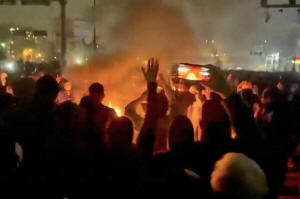
In this image from video circulating on social media,
protesters dance and cheer around a bonfire as they take to the
streets of Tehran, Iran, on Jan. 9, 2026. (UGC via AP, File)

Authorities have also moved to suspend bank accounts, block SIM
cards and confiscate the property of protesters' relatives or people
who publicly express support for them, said Musa Barzin, an attorney
with Dadban, citing reports from families.
In past crackdowns on protests, authorities sometimes adhered to a
veneer of due process and rule of law, but not this time, Barzin
said. Authorities are increasingly denying detainees access to legal
counsel and often holding them for days or weeks before allowing any
phone calls to family. Lawyers representing arrested protesters also
have faced court summons and detention, according to Dadban.
“The following of the law is in the worst situation it has ever
been,” Barzin said.
Signs of defiance continue
Despite the crackdown, many civic groups continue to issue defiant
statements.
The Writers’ Association of Iran, an independent group with a long
tradition of dissent, issued a statement describing the protests as
an uprising against “47 years of systemic corruption and
discrimination.”

It also announced that two of its members had been detained,
including a member of its secretariat.
A national council representing schoolteachers urged families to
speak out about detained children and students. “Do not fear the
threats of security forces. Refer to independent counsel. Make your
children’s names public,” it said in a statement.
A spokesman for the council said Sunday that it has documented the
deaths of at least 200 minors who were killed in the crackdown. That
figure is up several dozen from the count just days before.
“Every day we tell ourselves this is the last list,” Mohammad Habibi
wrote on X. “But the next morning, new names arrive again.”
Bar associations and medical groups have also spoken out, including
Iran’s state-sanctioned doctors council, which called on authorities
to stop harassing medical staff.
Anger over the bloodshed now adds to the bitterness over the
economy, which has been hollowed out by decades of sanctions,
corruption and mismanagement. The value of the currency has plunged,
and inflation has climbed to record levels.
The Iranian government has announced gestures such as launching a
new coupon program for essential goods. Labor and trade groups,
including a national retirees syndicate, have issued statements
condemning the economic and political crisis.
Meanwhile, U.S. President Donald Trump has moved an aircraft carrier
and other military assets to the Persian Gulf and suggested the U.S.
could attack Iran over the killing of peaceful demonstrators or if
Tehran launches mass executions over the protests. A second American
aircraft carrier is on its way to the Mideast.
Iran’s theocracy has faced down protests and U.S. threats in the
past, and the crackdown showed the iron grip it holds over the
country. This week, authorities organized pro-government rallies
with hundreds of thousands of people to mark the anniversary of the
1979 Islamic Revolution.
Still, Barzin said, he sees the ferocity of the crackdown as a sign
that Iran’s leadership “for the first time is afraid of being
overthrown.”
___
Associated Press Writer Kareem Chehayeb in Beirut contributed to
this report.
All contents © copyright 2026 Associated Press. All rights reserved
 |