Penny shortage causes headaches for retailers in the Land of Lincoln
[February 16, 2026]
By Erika Tulfo and Medill Illinois News Bureau
SPRINGFIELD — At the Abraham Lincoln Presidential Library and Museum in
Springfield, visitors can shop for sweatshirts, pillows, jewelry and
chocolates using coins bearing the face of perhaps the most-famous
Illinoisian, Abraham Lincoln.
But even here, pennies are growing scarce at the cash register.
The museum gift shop, like the rest of the country, is grappling with a
penny shortage after the United States Mint halted production of the
coin in November, citing the rising cost of producing them.
The lack of fixed guidance from the state and federal governments about
how to cope with the shortage of new pennies has left some business
owners scrambling to come up with ways to address it.
Many retailers are just rounding up or down to the nearest 0- or 5-cent
mark in their prices to make change. They will accept the one-cent
coins, but can’t always pay them out.
“The retailer faces frustration on behalf of the consumer,” said Rob
Karr, president of the Illinois Retail Merchants Association. “Most
retailers are rounding in the consumer’s favor, which doesn’t make the
consumer mad, but it also takes profits out of the retailer and puts
them at the narrowest end of the net profit margin. So every penny
matters there. I think the absence of clear guidance at the moment is
difficult.”
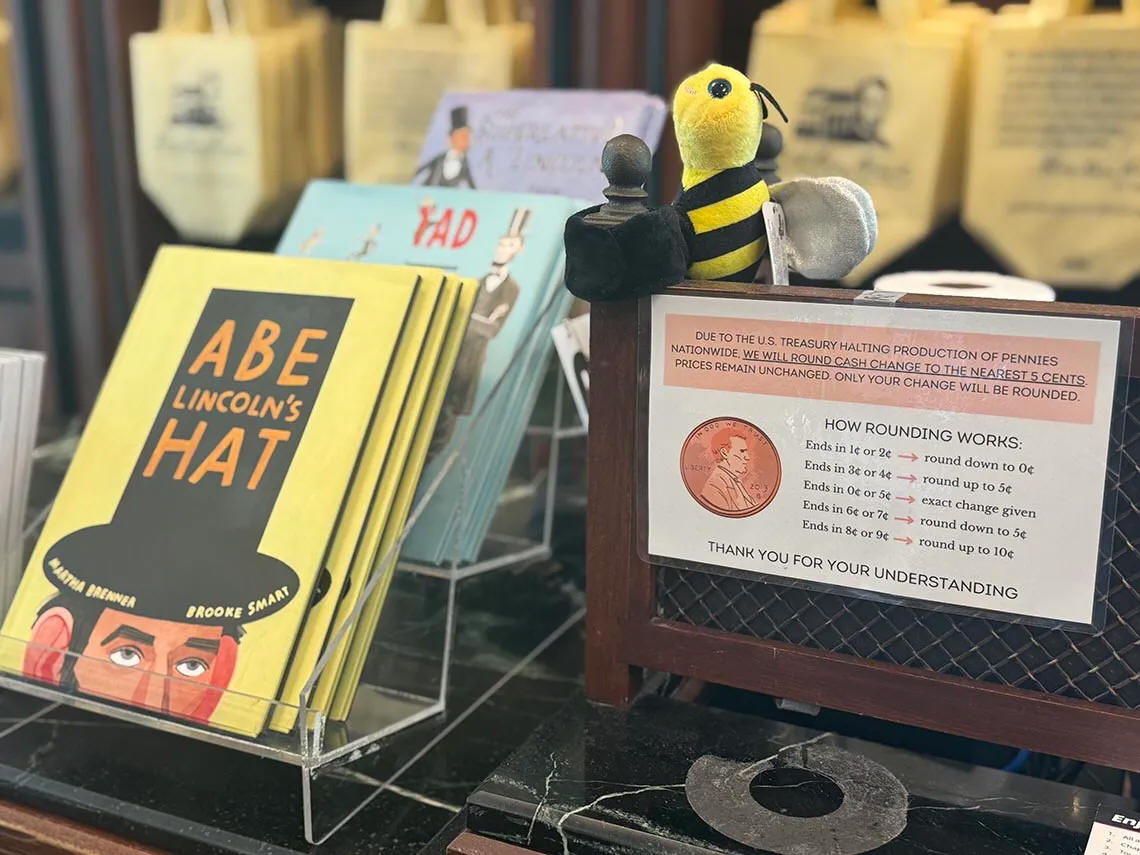
Some businesses, like the Lincoln Museum gift shop, display a guide on
how its rounding system works. The museum, for example, rounds amounts
ending in 1 or 2 cents down to 0. It rounds amounts ending in 3 or 4
cents up to 5 cents, and amounts ending in 6 or 7 cents down to 5 cents.
However, other business owners say this kind of multi-tiered rounding
system can be inconvenient and confusing for customers.

For many Illinoisans, there is a sad, end-of-an-era feeling watching the
slow disappearance of the one-cent coin, which was one of the first
coins made by the U.S. Mint after its establishment in 1792. President
Lincoln’s profile has been on the “heads” side since 1909, and that
change made him the first president featured on U.S. coins in honor of
his 100th birthday.
Mary Disseler has been working as a volunteer at the Lincoln Museum for
over 20 years since its founding in 2005. As a die-hard fan of Lincoln,
she sees the decision to stop penny production as a sad but sensible
decision.
“It kind of breaks my heart. I think it’s a nice tribute to Mr. Lincoln,
but I understand that it’s costing four cents to make a penny, so
there’s a part of us that has to be practical, too,” she said.
Keith Wetherell, executive director of the Illinois Beverage
Association, which represents a handful of small, cash-reliant or
cash-exclusive businesses, has practical concerns, too. He worries that
the inconvenience posed by complicated rules around rounding could
affect customers’ sentiments.
“The one thing that we would really lobby against was any type of
bouncing around from city to city where you have all these different
rules and stuff; we want to just minimize the confusion,” he said. “We
just like to make everything as good and as easy as possible for the
customer. Small businesses are struggling as it is. We don’t want any
operational challenges. When (customers) have challenges, they take it
out on us by not buying them as much.”
Julie Johnson, who owns Daisy Jane’s, a boutique in downtown
Springfield, said she rounded up cash change to the benefit of the
customer when necessary, but would rather use pennies to give them exact
amounts.
“My jar is pretty low on coins. I’m gonna have to figure out what (the
state) wants us to do with pennies,” she said. “There has to be a plan
for that. When you calculate tax on something, it’s almost always going
to have pennies as part of the equation.”
How will lawmakers respond?
Illinois lawmakers say the penny shortage is not an issue at the top of
the agenda because of factors like the popularity of cashless payment
methods and the fact that there are still billions of pennies in
circulation.
[to top of second column]
|
The gift shop at the Abraham Lincoln Presidential Museum has a
printed guide for customers explaining how its penny rounding system
works. (Medill Illinois News Bureau photo by Erika Tulfo)

Sen. Dave Syverson, R-Cherry Valley, wrote a note on his website in
November applauding the U.S. Treasury’s decision to halt production,
saying it was “more of an inconvenience than a useful part of the
economy.” He said no steps were currently being taken to address the
shortage at the state level and that he would await guidance from the
federal level.
“It’ll be something that they’ll obviously start working on addressing
more and more as the pennies become less in circulation,” he told
Capitol News Illinois. “It doesn’t look like people have to worry about
it at all for 2026. I’m guessing that the soonest there’d be any
guidance would be ’27, when they would maybe set some rules about
requiring businesses to accept whatever rounding decision that gets
made.”
But Karr, head of the retail merchants association, said he wasn’t
satisfied with Springfield playing the waiting game and leaving the
decision up to the U.S. Treasury.
“While the federal government makes currency decisions, the states make
sales tax decisions. So it’s a shared responsibility,” he said. “While
there’s clarity that the federal government needs to provide, there’s
also clarity that the state needs to provide. That clarity, it helps in
terms of lawsuits as well, because there are lawyers out there who can
sue if they don’t think you’ve done something correctly. And without
that guidance, it leaves the retailers certainly exposed.”
Gordon Davis, founder of the Springfield tea store Whimsy Tea, said he
hasn’t had issues with the penny shortage yet, but that it was
“looming.” He said that while 72% of his customers opted to pay with
cards, more than one-quarter still chose to pay with cash.
Instead of rounding prices, Davis made prices tax-inclusive in his
store’s point of sale system, which he says saves him the trouble of
facing legal complications with rounding.
“Rounding, as I understand, can run you afoul of federal law because you
have to treat all currencies, all payment methods the same. If you’re
rounding for cash but not rounding for card, you’re breaking the law,”
he said.
Still, experts say that beyond minor adjustment costs on the retailers’
end, the penny shortage won’t pose a major issue in terms of price
increases simply because its value is low.
“Inflation-wise, it’s not creating a problem,” said Shihan Xie, an
assistant professor of monetary economics at the University of Illinois
Urbana-Champaign. “The value of the penny has diminished. It’s at a
point where the value is so small that it’s not going to affect daily
life much, or that it becomes crazy.”

But for some citizens of the Land of Lincoln, the penny shortage is an
issue that has more to do with sentiment. Lincoln Museum volunteer
Disseler she understands the economics no longer support the beloved
one-cent piece.
“We’ll still have the $5 bill,” she said. “Even though they’re phasing
(the penny) out, we’ll keep his memory alive forever.”
Erika Tulfo is a graduate student in journalism with
Northwestern University’s Medill School of Journalism, Media and
Integrated Marketing Communications, and is a fellow in its Medill
Illinois News Bureau working in partnership with Capitol News
Illinois.
Capitol News Illinois is
a nonprofit, nonpartisan news service that distributes state
government coverage to hundreds of news outlets statewide. It is
funded primarily by the Illinois Press Foundation and the Robert R.
McCormick Foundation. |