Trump administration ordered to restore George Washington slavery
exhibit it removed in Philadelphia
[February 17, 2026]
By HANNAH SCHOENBAUM
An exhibit about nine people enslaved by George Washington must be
restored at his former home in Philadelphia after President Donald
Trump’s administration took it down last month, a federal judge ruled on
Presidents Day, the federal holiday honoring Washington's legacy.
The city of Philadelphia sued in January after the National Park Service
removed the explanatory panels from Independence National Historical
Park, the site where George and Martha Washington lived with nine of
their slaves in the 1790s, when Philadelphia was briefly the nation’s
capital.
The removal came in response to a Trump executive order “restoring truth
and sanity to American history” at the nation’s museums, parks and
landmarks. It directed the Interior Department to ensure those sites do
not display elements that “inappropriately disparage Americans past or
living.”
U.S. District Judge Cynthia Rufe ruled Monday that all materials must be
restored in their original condition while a lawsuit challenging the
removal's legality plays out. She prohibited Trump officials from
installing replacements that explain the history differently.
Rufe, an appointee of Republican President George W. Bush, began her
written order with a quote from George Orwell’s dystopian novel “1984”
and compared the Trump administration to the book's totalitarian regime
called the Ministry of Truth, which revised historical records to align
with its own narrative.

“As if the Ministry of Truth in George Orwell’s 1984 now existed, with
its motto ‘Ignorance is Strength,’ this Court is now asked to determine
whether the federal government has the power it claims — to dissemble
and disassemble historical truths when it has some domain over
historical facts," Rufe wrote. “It does not.”
She had warned Justice Department lawyers during a January hearing that
they were making “dangerous” and “horrifying” statements when they said
Trump officials can choose which parts of U.S. history to display at
National Park Service sites.
The Interior Department did not immediately respond to a request for
comment on the ruling, which came while government offices were closed
for the federal holiday.
The judge did not provide a timeline for when the exhibit must be
restored. Federal officials can appeal the ruling.
The historical site is among several where the administration has
quietly removed content about the history of enslaved people, LGBTQ+
people and Native Americans.
Signage that has disappeared from Grand Canyon National Park said
settlers pushed Native American tribes “off their land” for the park to
be established and “exploited” the landscape for mining and grazing.
[to top of second column]
|
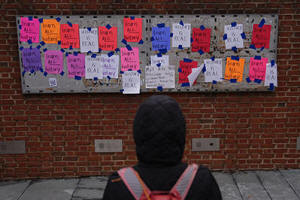
A person views posted signs on the locations of the now removed
explanatory panels that were part of an exhibit on slavery at
President's House Site in Philadelphia, Jan. 23, 2026. (AP
Photo/Matt Rourke, file)

Last week, a rainbow flag was taken down at the Stonewall National
Monument, where bar patrons rebelled against a police raid and
catalyzed the modern LGBTQ+ rights movement. The administration has
also removed references to transgender people from its webpage about
the monument, despite several trans women of color being key figures
in the uprising.
The Philadelphia exhibit, created two decades ago in a partnership
between the city and federal officials, included biographical
details about each of the nine people enslaved by the Washingtons at
the home, including two who escaped.
Among them was Oney Judge, who was born into slavery at the family’s
plantation in Mount Vernon, Virginia, and later escaped from their
Philadelphia house in 1796. Judge fled north to New Hampshire, a
free state, while Washington had her declared a fugitive and
published advertisements seeking her return.
Because Judge had escaped from the Philadelphia house, the National
Park Service in 2022 added it to a national network of Underground
Railroad sites where the agency pledged to “honor, preserve and
promote the history of resistance to enslavement through escape and
flight."
Rufe said the removal of materials about Judge “conceals crucial
information linking the site" to the network.
Only the names of Judge and the other eight enslaved people —
Austin, Paris, Hercules, Richmond, Giles, Moll and Joe, who each had
a single name, and Christopher Sheels — remained engraved in a
cement wall after federal employees took a crowbar to the plaques on
Jan. 22.
Hercules also escaped in 1797 after he was brought to Mount Vernon,
where the Washingtons had many other slaves. He reached New York
City despite being declared a fugitive slave and lived under the
name Hercules Posey.
Several local politicians and Black community leaders celebrated the
ruling, which came while many were out rallying at the site for its
restoration.

State Rep. Malcolm Kenyatta, a Philadelphia Democrat, said the
community prevailed against an attempt by the Trump administration
to “whitewash our history.”
“Philadelphians fought back, and I could not be more proud of how we
stood together,” he said.
All contents © copyright 2026 Associated Press. All rights reserved |