US stocks edge higher after swinging through worries about AI and the
economy
[February 18, 2026] By
STAN CHOE
NEW YORK (AP) — A quiet finish for the U.S. stock market on Tuesday
masked big swings underneath the surface as companies talked about how
discouraged their customers are feeling and some tech stocks continued
to feel the downside of the artificial-intelligence boom.
The S&P 500 rose 0.1% after flipping earlier between a gain of 0.5% and
a loss of nearly 1%. The Dow Jones Industrial Average added 32 points,
or 0.1%, and the Nasdaq composite gained 0.1%.
Paramount Skydance helped lead the market and rose 4.9% after Warner
Bros. Discovery said it would allow Paramount a chance to give its “best
and final” bid to buy the entertainment company. Paramount is trying to
top an offer from Netflix.
Warner Bros. Discovery rose 2.7%, and Netflix added 0.2%.
On the losing end of Wall Street was General Mills, which sank 7% after
warning that its customers are feeling uneasy. The company behind the
Cheerios, Nature Valley and Pillsbury brands cut its forecast for an
underlying measure of profit for 2026, saying declines would likely be
sharper than it earlier expected.
Several surveys have recently shown weak confidence among U.S.
households, which are struggling with inflation that remains higher than
anyone would like, a job market coming off a weak year of growth and
worries about tariffs.
Genuine Parts, which sells auto and industrial replacement parts, said
it’s also “navigating a dynamic environment” while reporting weaker
results for the latest quarter than analysts expected.

It plans to split into two separate, publicly traded companies in early
2027, with one focusing on auto parts and the other on industrial parts.
Genuine Parts’ stock fell 14.6%
Drops for some Big Tech stocks were the heaviest weights on the market
Tuesday, including a 1.2% fall for Alphabet.
The moves were tentative, though, and Nvidia swung between being one of
the market’s heaviest weights and one of its biggest strengths.
Markets need such Big Tech companies to stabilize and “need to see less
sell first/ask questions later behavior from investors,” according to
Sameer Samana, head of global equities and real assets at Wells Fargo
Investment Institute.
Last week, Wall Street shook when stocks of software and other companies
tumbled as investors hunted for companies that could be potential losers
if AI ends up remaking the world and their industries.
“Overall, the market is still close to records highs, but it may not
feel that way to some investors because of the sharp sell-offs that seem
to derail upswings almost as soon as they begin,” according to Chris
Larkin, managing director, trading and investing, at E-Trade from Morgan
Stanley.
[to top of second column] |
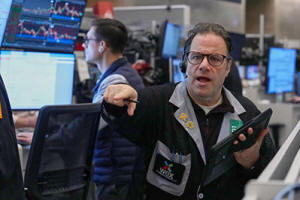
Options trader Anthony Spina works on the floor of the New York
Stock Exchange, Friday, Feb. 13, 2026, in New York. (AP
Photo/Richard Drew)
 The market has seen a sharp
turnaround from prior years, when the promise of AI helped drive
U.S. stock indexes to record after record. Now, companies in
industries as varied as software and legal services and trucking
have seen investors suddenly turn against them when worries flare
that AI-powered competitors could steal their customers.
The companies spending big on AI are feeling their own pressure,
too.
Global fund managers say they’re worried about the risk that
companies are pouring too many dollars into AI data centers and
chips. Those companies will need to see tremendous profits and
productivity to make their investments worth it. Alphabet, for
example, said its spending on AI and other investments could double
this year to roughly $180 billion.
A survey of global fund managers by Bank of America found a record
percentage is saying that companies are “overinvesting.” That could
mean an eventual pullback in spending on chips from Nvidia and other
companies.
All told, the S&P 500 added 7.05 points to 6,843.22. The Dow Jones
Industrial Average rose 32.26 to 49,553.19, and the Nasdaq composite
gained 31.71 to 22,578.38.
In the bond market, Treasury yields held relatively steady.
The yield on the 10-year Treasury edged up to 4.05% from 4.04% late
Friday.
In stock markets abroad, indexes rose in Europe following a quiet
day in Asia, where most markets were closed for Lunar New Year
holidays.
Japan’s Nikkei 225 slipped 0.4%. Weak economic data for Japan
appeared to weigh on the market, and a 5.1% decline for tech giant
SoftBank Group also pulled shares lower. The decline followed a big
rally after a Feb. 8 general election appeared to clear the way for
Prime Minister Sanae Takaichi’s ruling party to push through
policies to help the economy.
___
AP Business Writers Yuri Kageyama and Matt Ott contributed.
All contents © copyright 2026 Associated Press. All rights reserved
 |