Trump administration backs Kalshi, Polymarket as states move to ban
prediction markets
[February 18, 2026] By
KEN SWEET
NEW YORK (AP) — The Trump administration is throwing its support behind
the prediction market operators Kalshi and Polymarket in a critical
legal battle between the growing prediction market industry and states
that wish to ban these platforms.
The move by Michael Selig, the recently appointed chairman of the
Commodity Futures Trading Commission, could have enormous implications
for how sports betting is regulated in the country and, if Kalshi and
Polymarket were to prevail, could erode the ability for states to
effectively regulate gambling.
Any friendly decision the CFTC makes on this industry could end up
financially benefiting the president's family as well. President Trump’s
son, Donald Trump Jr., has invested in Polymarket through his venture
capital firm and is a strategic advisor for Kalshi.
The CFTC currently regulates prediction markets, and that federal
oversight allows Kalshi and others to operate in all 50 states, even
those where gambling is illegal. Several states have sued Polymarket and
Kalshi, alleging that the companies effectively operate casino or
gambling operations in violation of state gambling laws, and have
ordered them to shut down or stop operating in their states.
In an opinion piece in the The Wall Street Journal, Selig wrote, “The
CFTC will no longer sit idly by while overzealous state governments
undermine the agency’s exclusive jurisdiction over these markets by
seeking to establish statewide prohibitions on these exciting products.”

Polymarket and Kalshi and other prediction markets allow participants to
buy and sell contracts tied to the probable outcome of an event.
Customers can wager on everything from whether it will rain in Los
Angeles tomorrow to who will in the NBA championship to whether the U.S.
and Iran will go to war. The contracts are typically priced between one
cent and 99 cents, which roughly translates into what percentage of
those customers believe that event will happen.
While customers can bet on anything, roughly 90% of Kalshi’s trading
volume goes toward wagers on sports, while roughly half of Polymarket’s
trading is tied to sports. Kalshi said it saw more than $1 billion in
volume trade on the Superbowl.
The biggest of the lawsuits comes from Nevada, where the Nevada Gaming
Control Board sued or issued enforcement actions against Kalshi and
Polymarket, saying they are operating unlicensed sports betting
operations in the state. A federal judge agreed with the NGCB and issued
a temporary restraining order against Kalshi from operating in the
state.
In response, Kalshi has appealed the case to the U.S. Court of Appeals
for the 9th Circuit, which is why the CFTC is weighing in through what
is known as a “friend of the court” briefing.
As the regulator of commodities, futures and derivatives, the CFTC has
historically overseen markets like oil futures, agricultural products,
gold, and other financial products. At roughly 700 employees, the CFTC
is much smaller than the Securities and Exchange Commission, with
roughly 5,000 employees. But as the CFTC has become the favored
regulator of cryptocurrency companies and prediction markets proponents,
it has taken on a much larger role in financial markets in the last five
years.
[to top of second column] |

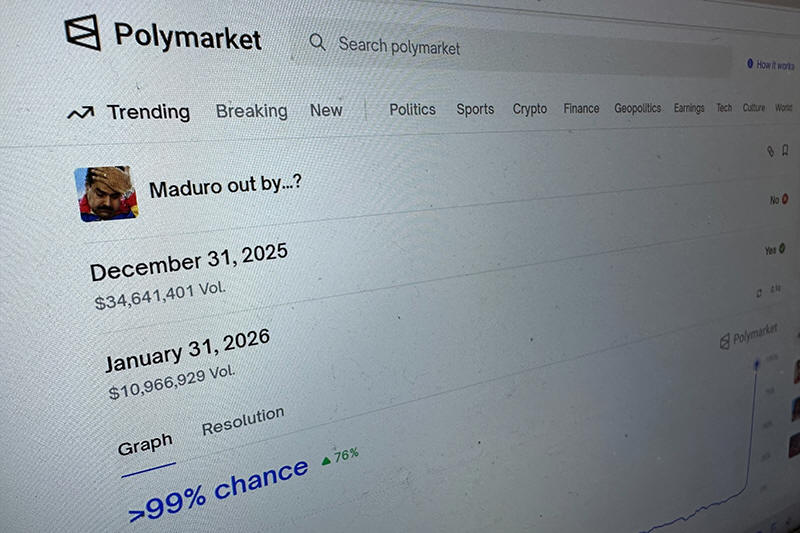
The Polymarket prediction market website is displayed on a computer
screen, Jan. 11, 2026, in New York. (AP Photo/Wyatte
Grantham-Philips, File)
 By stepping into the lawsuit, the
Trump administration is taking an unusually broad definition of
commodities and futures. Selig has shifted his position from what he
told Senators at his confirmation hearing, where he said that it
would be best for the CFTC to defer to the courts on the core legal
issue facing Kalshi and Polymarket.
Last week Selig announced the the regulator would create an
“Innovation Advisory Committee” to help the CFTC draft regulations
on issues such as cryptocurrencies and prediction markets. The
35-member panel includes the CEOs of Polymarket, Kalshi, Coinbase,
Robinhood, FanDuel and DraftKings. While there's some representation
from traditional finance, the panel has no representation from
consumer advocates or public interest groups.
Selig now says that prediction markets effectively do the same thing
as other futures contracts, where customers can hedge against bad
weather or changes in energy prices, and they are not betting
against the house, which is what happens with sports book companies.
The states that have taken legal action against Kalshi and
Polymarket argue that while these companies do offer customers the
ability to bet on future events, the vast majority of their business
is sports betting. Further, most prediction markets allow customers
18 years or older to use their platforms, while state gambling is
limited to those 21 years or older.
Selig now says states cannot preempt federal regulators.
“To those who seek to challenge our authority in this space, let me
be clear, we will see you in court,” Selig said in a video
statement.
Some members of the GOP pushed back on Selig's announcement,
including the Governor of Utah, which has some of the strictest
gambling laws in the country.
“Mike, I appreciate you attempting this with a straight face, but I
don’t remember the CFTC having authority over the “derivative
market” of LeBron James rebounds,” said Gov. Spencer Cox, in a
statement on Twitter. “These prediction markets you are breathlessly
defending are gambling — pure and simple.”
All contents © copyright 2026 Associated Press. All rights reserved
 |