Michigan wants schools ready for cardiac emergencies, fails to provide
funds
[February 18, 2026]
By ELI NEWMAN/Bridge Michigan
Emily Orta was a seemingly healthy 14-year-old soccer player in Adrian
when her life changed in seconds. In the middle of a shooting drill, her
heart stopped. She wasn’t breathing.
“It was a complete shock,” Orta, now 26, told Bridge Michigan. She’d
later discover she was living with a rare heart defect from birth —
anomalous left coronary artery from the pulmonary artery, or ALCAPA.
“We had no idea that there was any issues.”
Orta said she “wouldn’t be here today” if it weren’t for the quick work
of her coaches, who started emergency CPR on the field to keep her heart
pumping. Another person entered a nearby building to grab an automated
external defibrillator — an AED. The portable device delivers an
electric shock to restore normal heart rhythm and kept the young teen
stable before she was transferred to a hospital.
“I was at the right place at the right time,” Orta said. “And everybody
that was around me and had their hands on me that day, they were also in
the right place at the right time.”
But for many Michigan students, those resources may be more out of
reach. A 2024 state law required schools to adopt a cardiac emergency
response plan for the current school year — if the Legislature
appropriates “sufficient funds.”
No dedicated money was included in the current state education budget’s
$321 million school safety fund. A Senate proposal to include $25
million for “visitor management programs, low-level behavior software,
panic alerts, and AED devices” was removed by the House and was not
included in the final budget.

The law does not specify what is considered sufficient funding,
according to an analysis of the 2024 legislation, or who makes that
determination.
For the state’s estimated 5,000 public and nonpublic schools, decisions
to implement emergency plans depend on local capacity and available
resources, according to Ken Coleman, a spokesperson for the Michigan
Department of Education.
Without government funding, enforcement of the law stalls.
“There was not a specific state appropriation to support implementation.
The statute provides that, in the absence of designated funding,
districts are not required to implement the plan,” Coleman said in an
email.
Most Michigan schools have yet to earn the state’s “ HeartSafe ” title,
a designation that indicates, among other things, that the school has a
written cardiac emergency response plan, adequate numbers of staff are
trained and equipped to intervene if there is a cardiac emergency and
that the schools conduct at least one cardiac emergency response drill
every year.
Advocates for heart health say more money is needed to support training
and the purchasing of equipment, especially in under-resourced school
districts and rural communities where ambulances take longer to respond.
“There’s still a long ways to go,” said Gwen Fosse, program coordinator
for Project ADAM in Michigan. The initiative, housed at the University
of Michigan C.S. Mott Children’s Hospital Congenital Heart Center, works
with schools to prepare staff and students for sudden cardiac
emergencies.
“But that said, we know a lot of schools are doing the right thing even
without the funding, or they’re finding alternate ways of funding.”
While occurrences are rare, recent studies estimate there are 15,000 to
23,000 pediatric cases of out-of-hospital cardiac arrest in the US every
year, about 15 per 1,000 pediatric emergency medical service responses.

Michigan reported 8,632 non-traumatic, out-of-hospital cardiac arrests
for both children and adults in 2024, according to a report by the
Cardiac Arrest Registry to Enhance Survival (CARES).
Each second CPR and AEDs are delayed can be fatal.
Michigan’s survival rate for cardiac arrest that year was 9% when
emergency medical services responded, but those odds of survival tripled
when the patient had a shockable heart rhythm and people who could help
the patient observed that they were in distress.
CARES reports CPR was first performed by a bystander in 40% of the
state’s cardiac arrest cases when EMS responded. In 12.8% of cases,
people used AEDs in public places like schools, convention centers and
airports.
“The importance of having trained personnel in schools as well as AEDs
in schools is critical in achieving much higher survival rates,” said
Dr. Premchand Anne, the director of pediatric cardiology at Henry Ford
St. John Children’s Hospital in Detroit.
‘Competing priorities’
During the NFL Draft in Detroit in 2024, Gov. Gretchen Whitmer signed a
bill package to ensure schools develop cardiac emergency response plans
with training and access to AEDs, touting the legislation as
“commonsense.”
She was joined by Buffalo Bills safety Damar Hamlin, who has advocated
for student athlete health since the NFL player collapsed mid-game from
cardiac arrest after making a tackle.
The plan was set to take effect in the 2025-26 school year. But some
districts have seen adoption lag.
Representatives for the American Heart Association say the emergency
response requirements are tied to state funding, and dollars were not
secured during last year’s budget process.
“They stripped out a ton of the things that schools could use,” said
Amanda Klein, government relations director for the American Heart
Association in Michigan.

A House Fiscal Agency analysis of the enacted bill concluded “in the
event of insufficient appropriations, no requirements for cardiac
emergency plans would apply.”
The Michigan High School Athletic Association notes that head coaches of
high school teams are mandated to have CPR and AED certification as part
of the legislation.
Money for AED devices — which can cost between $1,400 to $3,500 — staff
training, plan implementation with local emergency response agencies and
school drills was left out due to “competing priorities,” Klein said.
Klein is “disappointed” that Whitmer’s historic $88 billion budget plan
does not specify funds for cardiac emergency response plans, but said
she’s continuing to lobby state lawmakers that the funding is worth it.
She said the AHA has determined a one-time, $6 million allocation would
allow schools to purchase AEDs and implement training.
[to top of second column]
|
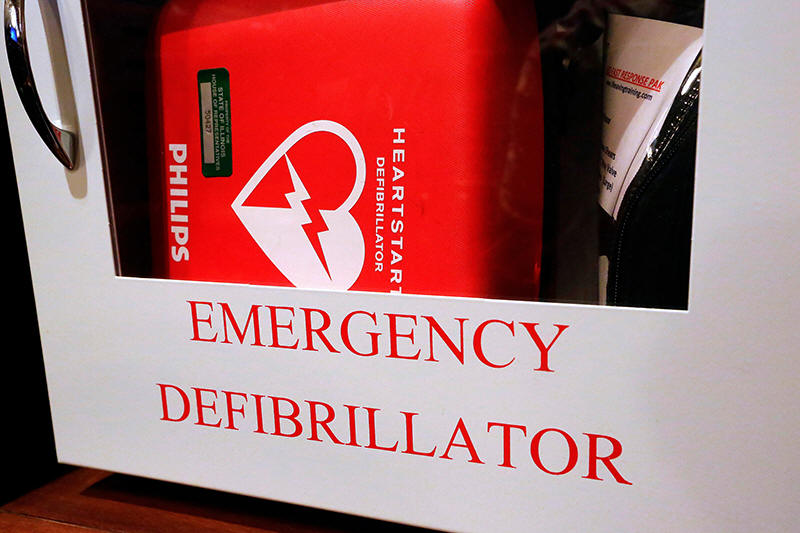
An emergency defibrillator, used to treat life threatening
conditions that affect the rhythm of the heart, hangs on the wall at
the Illinois State Capitol, July 1, 2014, in Springfield, Ill. (AP
Photo/Seth Perlman, File)

“The next phase really is about moving from the policy just to the
real-world preparedness,” Klein said. “The way to do that is with proper
and adequate funding to set our schools up for success.”
Heart-healthy schools
The Michigan Department of Health and Human Services reports 965 public
and nonpublic schools in the state currently hold active MI HEARTSafe
School Award status.
The designation recognizes many of the requirements outlined in the 2024
state law by requiring facilities maintain a written cardiac emergency
response plan and a team ready to carry out its directives.
MDHHS said 202 schools received the designation for the first time in
the 2024-2025 school year. Applications for the current school year are
due in May.
Project ADAM stewards the program and notes a steady increase in
applications. Fosse said 20% of the US population is at school on any
given day. Encouraging screening forms for student athletes before they
play in sports, training staff on emergency response and making AEDs
clearly available within three minutes of any location at school can
make “the whole community safer.”
There were seven cardiac emergency incidents on Michigan school grounds
reported to Project ADAM last year, with intervention helping to save
lives in six cases.
While only about one in five schools have received a MI HEARTSafe School
designation, Fosse said most schools in the state have at least one AED
on campus, though it may not be close enough to save someone having a
cardiac arrest.
Requirements for cardiac emergency drills can be more relevant today,
she said, than some other common school safety drills.
“The last time somebody died in a school in a fire in Michigan was
1927,” Fosse told Bridge. “The last time somebody died of a cardiac
arrest at a school was a couple months ago.”

Knowledge gaps
Only about half of parents report being aware that their teen’s school
has an AED on site, according to new findings from the University of
Michigan Health C.S. Mott Children’s Hospital National Poll on
Children’s Health
“The whole ball game in a sudden cardiac arrest is you need to act
promptly,” said Sarah Clark, co-director of the Mott Poll. “When we have
that much lack of awareness, people aren’t going to be in a position to
act.”
The Mott Poll found that while nearly half of parents have heard of
students experiencing sudden cardiac arrest, only 1 in 7 say their own
child had ever had a heart evaluation.
There is strong support for CPR/AED education among parents across the
country, according to the Mott Poll, while about 1 in 5 parents say
their teen has CPR training, and just 1 in 15 say their teen has been
trained to use an AED.
In Michigan, schools are required to teach middle and high schools
students CPR and AED use through their health curriculum.
A shared responsibility
The American Heart Association estimates about 1,000 people have a
cardiac arrest outside a hospital setting every day in the US. The state
saw 97.5 out-of-hospital incidences per 100,000 people in 2024,
according to the Cardiac Arrest Registry to Enhance Survival.
About 20% of sudden cardiac arrest deaths in youth occurred during
“periods of exertion” like sports, according to Dr. Swati Sehgal,
medical director of pediatric heart failure, cardiomyopathy, and heart
transplant for the Children’s Hospital of Michigan in Detroit.
Two underlying heart conditions are cited as the most frequent culprit.
“Most common are arrhythmia issues – a problem with the electrical
impulses in the heart – or cardiomyopathy, such as hypertrophic
cardiomyopathy in which there is increase in the heart wall muscle
thickness,” Sehgal said in an email.

Doctors say symptoms such as severe chest pain, abnormally fast heart
beat, unexplained fainting or passing out during physical exercise
should be evaluated by a health care professional. Recreational use of
stimulants and performance-enhancing drugs, and high doses of caffeine
can also exacerbate heart issues.
“A thorough history including family history and physical exam can raise
suspicion for these conditions; however, an (electrocardiogram) and in
some cases an echocardiogram will be required to make appropriate
diagnosis,” Sehgal said.
Universal EKG screening is not recommended by the American College of
Cardiology and U.S. Preventative Services Task Force, with physician
groups citing the rarity of sudden arrest in children, high cost-burden
and other systemic constraints.
Still, some countries with universal health care systems like Italy and
Japan regularly test the hearts of their youth, and some states are
requiring student athletes to get an EKG screening before play.
Regardless of preventive screening measures, physicians like Dr.
Mohammad-Ali Jazayeri, a medical director at the Cardiac Device Clinic
at Trinity Health in Ann Arbor, say having the right tools and training
for a cardiac emergency is vital.
Society can do a “better job” of educating people to act, he said, when
the alternative is “certain death.” “There’s an individual
responsibility, but then there’s also the group,” said Jazayeri. “Each
minute that somebody goes on with cardiac arrest without life-saving
treatment, their likelihood of death goes up by about 7 to 10%.”
All contents © copyright 2026 Associated Press. All rights reserved
 |