New subpoenas issued in inquiry on response to 2016 Russian election
interference, AP sources say
[February 18, 2026]
By ERIC TUCKER
WASHINGTON (AP) — The Justice Department has issued new subpoenas in a
Florida-based investigation into perceived adversaries of President
Donald Trump and the U.S. government's response to Russian interference
in the 2016 presidential election, according to multiple people familiar
with the matter.
An initial wave of subpoenas in November asked recipients for documents
related to the preparation of a U.S. intelligence community assessment
that detailed a sweeping, multiprong effort by Moscow to help Trump
defeat Democratic nominee Hillary Clinton in the 2016 election.
Though the first subpoenas requested documents from the months
surrounding the January 2017 publication of the Obama administration
intelligence assessment, the latest subpoenas seek any records from the
years since then, said the people, who spoke on condition of anonymity
to The Associated Press to discuss a nonpublic demand from
investigators.
The Justice Department declined to comment Tuesday.
The subpoenas represent continued investigative activity in one of
several criminal inquiries the Justice Department has undertaken into
Trump's political opponents. An array of former intelligence and law
enforcement officials have received subpoenas and lawyers for former CIA
Director John Brennan, who helped oversee the drafting of the
assessment, have said they have been informed he is a target but have
not been told of any “legally justifiable basis for undertaking this
investigation.”

The intelligence community assessment, published in the final days of
the Obama administration, found that Russia had developed a “clear
preference” for Trump in the 2016 election and that Russian President
Vladimir Putin had ordered an influence campaign with goals of
undermining confidence in American democracy and harming Clinton's
chance for victory.
That conclusion — and a related investigation into whether the 2016
Trump campaign colluded with Russia to sway the outcome of the election
— have long been among the Republican president's chief grievances, and
he has vowed retribution against the government officials involved in
the inquiries. Former FBI Director James Comey was indicted by the Trump
administration Justice Department last year on false statement and
obstruction charges, but the case was later dismissed.
Multiple government reports, including bipartisan congressional reviews
and a criminal investigation by former special counsel Robert Mueller,
have found that Russia interfered in Trump’s favor through a
hack-and-leak operation of Democratic emails as well as a covert social
media campaign aimed at sowing discord and swaying American public
opinion. Mueller’s report found that the Trump campaign actively
welcomed the Russian help, but it did not establish that Russian
operatives and Trump or his associates conspired to tip the election in
his favor.

[to top of second column]
|
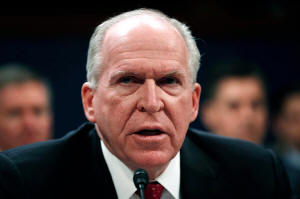
Former CIA Director John Brennan testifies on Capitol Hill in
Washington, before the House Intelligence Committee Russia
Investigation Task Force, May 23, 2017. (AP Photo/Pablo Martinez
Monsivais, File)

The Trump administration has freshly scrutinized the intelligence
community assessment in part because a classified version of it
incorporated in its annex a summary of the “Steele dossier,” a
compilation of Democratic-funded opposition research that was
assembled by former British spy Christopher Steele and was provided
to the FBI. That research into Trump’s potential links to Russia
included uncorroborated rumors and salacious gossip, and Trump has
long held up its weaknesses in an effort to discredit the entire
Russia investigation.
The investigation in Florida appears to be part of a broader
administration effort to revisit years-old findings and decisions
from the Russia investigation.
A declassified CIA tradecraft review released last July by current
Director John Ratcliffe did not refute the conclusion of Russian
election interference but found “multiple procedural anomalies” in
the intelligence community assessment and chided Brennan for the
fact that the classified version referenced the Steele dossier.
Brennan testified to Congress, and also wrote in his memoir, that he
was opposed to including information from the dossier in the
intelligence assessment since neither its substance nor sources had
been validated, and he has said the dossier did not inform the
judgments of the assessment. He maintains the FBI pushed for its
inclusion.
The new CIA review sought to cast Brennan’s views in a different
light, asserting that he “showed a preference for narrative
consistency over analytical soundness” and brushed aside concerns
over the dossier because he believed it conformed “with existing
theories.” It quotes him, without context, as having stated in
writing that “my bottomline is that I believe that the information
warrants inclusion in the report.”
It is unclear whether the investigation in Florida will result in
any criminal charges.

In a letter last December addressed to the chief judge of the
Southern District of Florida, Brennan's lawyers challenged the
underpinnings of the investigation, questioning what basis
prosecutors had for opening the inquiry in the state and saying they
had received no clarity from prosecutors about what potential crimes
were even being investigated.
“While it is mystifying how the prosecutors could possibly believe
there is any legally justifiable basis for undertaking this
investigation, they have done nothing to explain that mystery,” the
lawyers wrote, describing the investigation as “manufactured.”
____
Associated Press writer Alanna Durkin Richer contributed to this
report.
All contents © copyright 2026 Associated Press. All rights reserved |