Democrats offer muted praise of Pritzker’s speech, Republicans dismiss
‘campaign’ rhetoric
[February 19, 2026]
By Brenden Moore, Jenna Schweikert
SPRINGFIELD — Reaction to Gov. JB Pritzker’s combined State of the State
and fiscal year 2027 budget address on Wednesday fell mostly along
partisan lines.
Democrats offered muted praise of the largely status-quo spending plan
while Republicans dismissed his affordability message as campaign-style
rhetoric devoid of substance.
The $56 billion budget proposal and associated legislative priorities
outlined by Pritzker, including a sweeping plan to encourage
homebuilding through new statewide zoning standards and a renewed effort
to ban cellphones in the classroom, come amid deep uncertainty over the
status of federal funding under the Trump administration. About $1
billion in funds promised to the state are currently in limbo, the
governor’s office said.
This uncertainty was a common undercurrent as Democratic elected
officials offered their first impressions of Pritzker’s proposed
spending plan. Republicans found few items to praise though suggested
that the tone was better than last year, when Pritzker likened the
return of President Donald Trump to the rise of Nazism in 1930s Germany.
Democrats offer muted praise
House Speaker Emanuel “Chris” Welch, D-Hillside, told Capitol News
Illinois in an interview that Pritzker’s speech was “a State of the
State that needed to be said.”
“President Trump’s policies and a Republican Congress that’s been absent
and letting him do what he wants to do is causing the cost of living to
skyrocket,” Welch said. “Groceries are going up, health care is going
up, energy is going up. Everyday essentials are costing more. And you
have to talk about that.”

And with more federal cuts to come, Welch said it’s something lawmakers
“have to consider” as they “go through this process of presenting yet
another balanced budget.”
Comptroller Susana Mendoza, who is responsible for paying the state’s
bills, told Capitol News Illinois she plans to “stay the course” in
managing her office through the latest wave of financial uncertainty in
the state. The FY27 budget will mark the last that Mendoza will oversee
as she leaves office 11 months from now.
“We need to make sure that we’re not adding unnecessary spending to the
budget,” Mendoza said. “The governor was very clear today that that’s
not happening in this budget. This is a very conservative budget
relative to prior years, and I think it speaks to the moment that we’re
living in, which is a moment of unpredictability and a lack of stability
at the federal level. So here at the state level, we’ll continue to
prioritize the most vulnerable.”
Mendoza said the challenges the state faces now remind her of her ascent
into office in December 2016 during the state’s two-year budget impasse,
when many organizations that depend on state funding were also
struggling under the weight of lost government funding.
Sen. Elgie Sims, D-Chicago, told Capitol News Illinois that lawmakers
are “going to make the best decisions based on the information we have.”
“Nobody can predict if there’s going to be a rage tweet that happens in
the middle of the night that will lead to hundreds of millions of
dollars being in jeopardy,” Sims said. “We can’t predict that. What we
can predict is our response to it being responsible in this moment and
responding in a way that protects taxpayers, that protects our
neighbors, that also provides the services that people so desperately
need.”
Managing expectations
In his role as the top budget negotiator for Senate Democrats, Sims said
part of his job will be managing expectations among lawmakers and
advocates who want the final product to fund their priorities.

“We’re making sure that they understand that it’s not a lack of desire,
it’s a lack of a partner that’s willing to participate with us to help
make people’s lives better,” he said.
Rank-and-file Democratic lawmakers acknowledged the strain from federal
cuts and touted Pritzker’s efforts to protect key programs from the
chopping block. But some expressed disappointment in the largely
defensive posture the governor is staking out.
Some progressive lawmakers want to raise taxes substantially to fill
gaps in the budget and to increase funding for “critical services” like
health care, child care and education.
“This moment calls for more than simply holding the line,” Sen. Graciela
Guzmán, D-Chicago, said at a Latino Caucus press conference following
the governor’s 48-minute address. “These are essential infrastructure.
We should not be walking away from … our commitment to protect essential
services and make sure that families are not forced to choose between
their health, their rent and putting food on the table.”
Sen. Javier Cervantes, D-Chicago, said the governor’s proposal includes
“helpful investments” for child care assistance and early childhood
programs, but expressed disappointment that it did not include an
increase in the state’s Child Tax Credit.
Leaders from the Illinois Black Caucus said they appreciated the
governor mentioning the affordability of housing, education and energy,
but they also want to see commitment to issues affecting the Black
community.

[to top of second column]
|
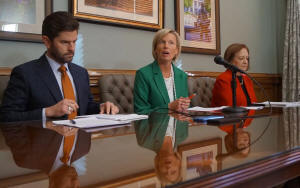
House Minority Leader Tony McCombie, center, R-Savanna, is joined by
Reps. Ryan Spain, R-Peoria, and Norine Hammond, R-Macomb, at a news
conference Wednesday, Feb. 18, 2026, following Gov. JB Pritzker’s
budget address. (Capitol News Illinois photo by Peter Hancock)

“We know that there are budget pressures, budget challenges. The White
House is not doing us any favors,” said Rep. Justin Slaughter, D-Orland
Park. “But with that being said, we are advocating for equity.
Advocating for a budget that reflects an intentional effort to address
the historical disparities that plague our black communities.”
This is the start of the conversation, lawmakers added, emphasizing
their commitment to affordability. Many statements issued by members of
the majority party said they would review the proposal “line-by-line”
and “in detail.”
Welch said he expects “about 90% of the what the governor proposed” to
end up in the budget lawmakers approve this spring. But unlike
Pritzker’s tax strategy of tweaking on the sides while avoiding changes
to broad-based taxes, Welch intends to push for a surcharge tax on
millionaires. Supermajorities in the legislature would have to approve
placing a constitutional amendment on the ballot by May 5, and then
voters would then have to approve it in the November election.
“I’m having meetings with advocacy groups, I’m talking to people, I’m
building support for it (and) making my case with data and facts because
I certainly believe that that’s one of the long-term answers to what
we’re dealing with here in Illinois,” Welch said.
He said he’s had “preliminary conversations” with Pritzker and Senate
President Don Harmon about the revenue-generating proposal.
Republicans respond
Predictably, Republicans were less generous in their assessment of the
budget picture Pritzker painted. But they found some items to agree on,
including slightly less charged rhetoric than his 2025 speech, which was
delivered just weeks into Trump’s second term.
“I think, like we discussed before, you know, you walk out and say,
‘Well, at least we weren’t called Nazis.’ That’s a positive step,” said
House Minority Leader Tony McCombie, R-Savanna. “The love stuff was
interesting and weird. And just the whole thing about the speech was
about his run for president. I mean, that was apparent.”
McCombie noted the “buzzword” of the year in Springfield is
“affordability.” Pritzker used it at least a dozen times in his remarks.
But she said the proposals don’t match the rhetoric.

“Let’s be clear about what affordability really means: It means families
can pay their mortgage and their utility bill in the same month, it
means seniors can stay in their homes, it means small businesses can
actually keep their doors open and it means tax relief, not gimmicks or
new revenue schemes,” McCombie said, referring to Pritzker’s revenue
plan, which includes a proposed tax on social media companies.
Senate Minority Leader John Curran, R-Downers Grove, summed up the
governor’s remarks as “less of a State of the State, and it was more of
a campaign speech.”
“Certainly a governor in campaign mode (and) a lot of pointing the
finger at President Trump and the federal administration when the
reality is we have to address Illinois’ fundamentals where we lack in
economic growth,” Curran said, though noting that there was “less name
calling” directed at Trump in this year’s remarks.
“He did keep the rhetoric above board this year, so that’s a positive
step,” Curran said.
Curran also said Pritzker’s executive order to promote the development
of nuclear power plants is “a positive step forward” on increasing grid
capacity. Curran also said Pritzker’s proposed cellphone ban “should get
bipartisan support and ultimate passage.”
GOP governor candidates
Two of the Republicans seeking to deny Pritzker a third term criticized
the proposal.
Former state Sen. Darren Bailey, R-Xenia, who lost to Pritzker by 12
percentage points in 2022, said the governor “offered more government
and no relief” and that “families continue to feel squeezed.”

“The governor can talk about upgrades in our credit rating, but Illinois
still holds the lowest bond rating in the country,” Bailey said. “He can
talk about economic growth, but families and businesses are still moving
out. He can talk about new programs, but structural challenges that have
plagued Illinois for decades still remain untouched.”
Former Wirepoints president Ted Dabrowski highlighted Illinois’ high tax
burden, outmigration and economic growth that lags the rest of the
country as signs the state of the state is not great.
“He sees things the way he wants to see them,” Dabrowski said. “I see
them grounded in reality. And if you look at the last seven years, they
have been miserable, they’ve been dismal under Gov. Pritzker.”
Peter Hancock and Ben Szalinski contributed.
Capitol News Illinois is
a nonprofit, nonpartisan news service that distributes state
government coverage to hundreds of news outlets statewide. It is
funded primarily by the Illinois Press Foundation and the Robert R.
McCormick Foundation. |