Former South Korean President Yoon receives life sentence for imposing
martial law
[February 19, 2026]
By KIM TONG-HYUNG
SEOUL, South Korea (AP) — Former South Korean President Yoon Suk Yeol
was sentenced to life in prison for his brief imposition of martial law
in a dramatic culmination to the country’s biggest political crisis in
decades.
Yoon was ousted from office after a baffling attempt to overcome an
opposition-controlled legislature by declaring martial law and sending
troops to surround the National Assembly on Dec. 3, 2024.
Judge Jee Kui-youn of the Seoul Central District Court said he found
Yoon guilty of rebellion for mobilizing military and police forces in an
illegal attempt to seize the liberal-led Assembly, arrest politicians
and establish unchecked power for a “considerable” time.
Martial law crisis recalled dictatorial past
Yoon’s martial law imposition, the first of its kind in more than four
decades, harkened back to South Korea’s past military-backed governments
when authorities occasionally proclaimed emergency decrees that allowed
them to station soldiers, tanks and armored vehicles on streets or at
public places such as schools to prevent anti-government demonstrations.
As lawmakers rushed to the National Assembly, Yoon’s martial law command
issued a proclamation declaring sweeping powers, including suspending
political activities, controlling the media and publications, and
allowing arrests without warrants.
The decree lasted about six hours before being lifted after a quorum of
lawmakers managed to break through a military blockade and unanimously
voted to lift the measure.

Yoon was suspended from office on Dec. 14, 2024, after being impeached
by lawmakers and was formally removed by the Constitutional Court in
April 2025. He has been under arrest since last July while facing
multiple criminal trials, with the rebellion charge carrying the most
severe punishment.
Yoon's lawyers reject conviction
Yoon Kap-keun, one of the former president’s lawyers, accused Jee of
issuing a “predetermined verdict” based solely on prosecutors’ arguments
and said the “rule of law” had collapsed. He said he would discuss
whether to appeal with his client and the rest of the legal team.
Yoon Suk Yeol told the court the martial law decree was only meant to
raise public awareness of how the liberals were paralyzing state
affairs, and that he was prepared to respect lawmakers if they voted
against the measure.
Prosecutors said it was clear Yoon was attempting to disable the
legislature and prevent lawmakers from lifting the measure through
voting, actions that exceeded his constitutional authority even under
martial law.
In announcing Yoon and Kim’s verdicts, Jee said the decision to send
troops to the National Assembly was key to his determination that the
imposition of martial law amounted to rebellion.
“This court finds that the purpose of (Yoon’s) actions was to send
troops to the National Assembly, block the Assembly building and arrest
key figures, including the National Assembly speaker and the leaders of
both the ruling and opposition parties, in order to prevent lawmakers
from gathering to deliberate or vote,” Jee said. “It’s sufficiently
established that he intended to obstruct or paralyze the Assembly’s
activities so that it would be unable to properly perform its functions
for a considerable period of time.”
[to top of second column]
|
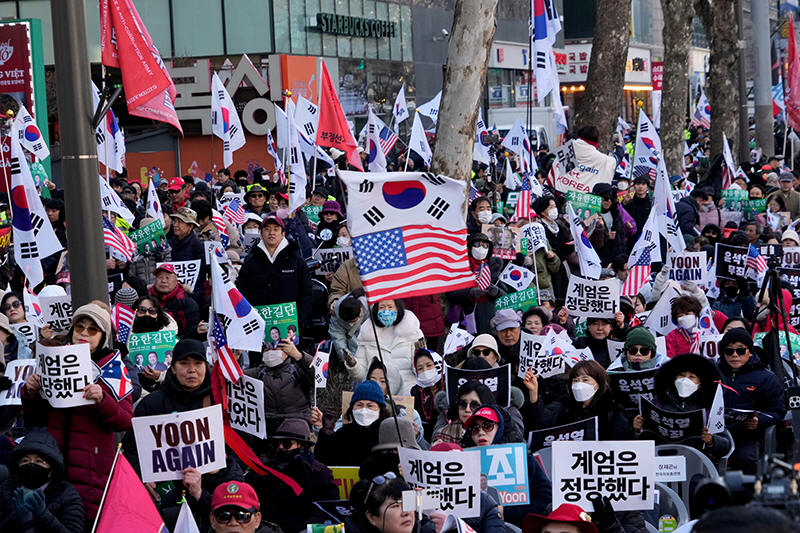
Supporters of former South Korean President Yoon Suk Yeol stage a
rally outside of Seoul Central District Court in Seoul, South Korea,
Thursday, Feb. 19, 2026. (AP Photo/Ahn Young-joon)

Protesters rally outside court
As Yoon arrived in court, hundreds of police officers watched
closely as Yoon supporters rallied outside a judicial complex, their
cries rising as the prison bus transporting him drove past. Yoon’s
critics gathered nearby, demanding the death penalty.
There were no immediate reports of major clashes following the
verdict.
A special prosecutor had demanded the death penalty for Yoon Suk
Yeol, saying his actions posed a threat to the country’s democracy
and deserved the most serious punishment available, but most
analysts expected a life sentence since the poorly-planned power
grab did not result in casualties.
South Korea has not executed a death row inmate since 1997, in what
is widely seen as a de facto moratorium on capital punishment amid
calls for its abolition.
Other officials sentenced for enforcing martial law
The court also convicted and sentenced several former military and
police officials involved in enforcing Yoon’s martial law decree,
including ex-Defense Minister Kim Yong Hyun, who received a 30-year
jail term for his central role in planning the measure and
mobilizing the military.
Last month, Yoon was sentenced to five years in prison for resisting
arrest, fabricating the martial law proclamation and sidestepping a
legally mandated full Cabinet meeting before declaring the measure.
The Seoul Central Court has also convicted two members of Yoon’s
Cabinet in other cases. That includes Prime Minister Han Duck-soo,
who received a 23-year prison sentence for attempting to legitimize
the decree by forcing it through a Cabinet Council meeting,
falsifying records and lying under oath. Han has appealed the
verdict.

Yoon is the first former South Korean president to receive a life
sentence since former military dictator Chun Doo-hwan, who was
sentenced to death in 1996 for his 1979 coup, a bloody 1980
crackdown on pro-democracy protesters in Gwangju that left more than
200 people dead or missing, and corruption.
The Supreme Court later reduced his sentence to life imprisonment,
and he was released in late 1997 under a special presidential
pardon. He died in 2021.
All contents © copyright 2026 Associated Press. All rights reserved |