Mikaela Shiffrin remembers her late
father after winning Olympic slalom gold
[February 19, 2026]
By STEVE DOUGLAS and ANDREW DAMPF
CORTINA D'AMPEZZO, Italy (AP) — Mikaela Shiffrin stood atop the
Olympic podium, looking almost in disbelief at the gold medal around
her neck.
The American skiing star hadn’t simply won a slalom race to end her
eight-year medal drought at the Winter Games and underline her
status as surely the greatest Alpine skier of all time.
She’d also won a battle with herself.
“It’s like,” Shiffrin said, before pausing, “... being born again.”
Racing in what she described as a “spiritual state,” Shiffrin put in
two dominant runs in gorgeous conditions amid the jagged peaks of
the Dolomites to win by a massive 1.50 seconds, making her the first
American skier to win three Alpine gold medals.
In emotional scenes after the race, the 30-year-old Shiffrin was
embraced by Camille Rast of Switzerland, who took silver, and
bronze-medalist Anna Swenn Larsson before fighting back tears as she
approached her mom and coach, Eileen, for a long, deep hug next to
the finish area.
Through it all, Shiffrin said, she never stopped thinking about her
father, Jeff, who died at the age of 65 in an accident at the family
home in Colorado in February 2020.
“This was a moment I have dreamed about — I’ve also been very scared
of this moment,” Shiffrin said. “Everything in life that you do
after you lose someone you love is like a new experience.

“And,” she added, her voice starting to tremble, “I still have so
many moments where I resist this. I don’t want to be in life without
my dad. And maybe today was the first time that I could actually
accept this, like, reality.”
It was the largest margin of victory in any Olympic Alpine skiing
event since 1998 and the third biggest in women’s slalom — the event
she won as a fresh-faced 18-year-old in Sochi in 2014 to buttress
her rising status as a skiing superstar.
Twelve years later — and having failed to meet huge expectations at
the 2022 Olympics, become the most successful World Cup skier of all
time with a record 108 victories, and overcome the two biggest
crashes of her career and an ensuing battle with post-traumatic
stress disorder — she delivered again in her favorite event.
Her skiing career, in a sense, had just come full circle.
“Maybe,” she added, “just today, I realized what happened to me in
Sochi.”
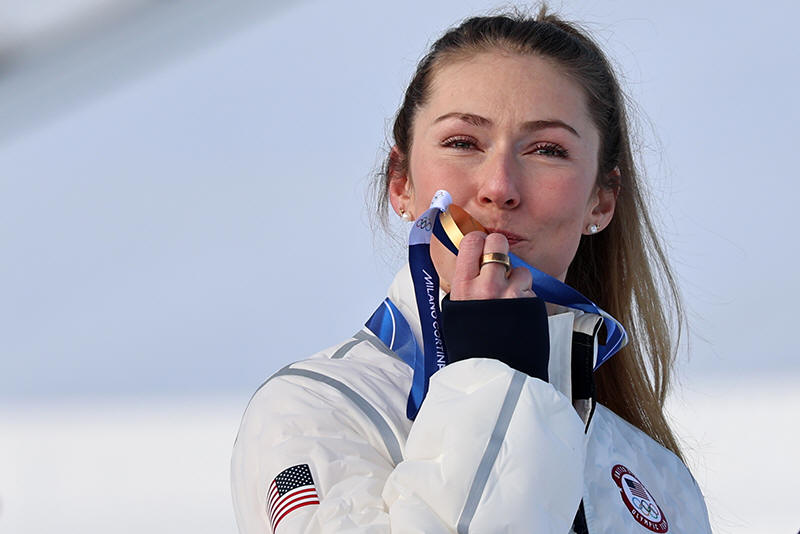
At the medal ceremony, she shook both of her hands by her side as
she was about to receive her medal. When it was placed around her
neck, she put one hand to her mouth.
For Shiffrin, this also was a release of the pressure that had been
building after going eight Olympic races without a medal since
adding gold and silver to her collection in Pyeongchang in 2018.
A nightmarish 0-for-6 performance in Beijing was followed in Cortina
this year by a fourth-place finish in the team combined — when
Shiffrin placed 15th in the slalom portion after teammate Breezy
Johnson led the downhill leg — and then 11th place in the giant
slalom.
It was fodder for the “keyboard warriors,” Shiffrin acknowledged,
but she ignored all of them in a masterpiece Tuesday.
[to top of second column] |
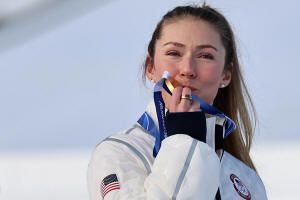
United States' Mikaela Shiffrin kisses the gold medal of the alpine
ski, women's slalom race, at the 2026 Winter Olympics, in Cortina
d'Ampezzo, Italy, Wednesday, Feb. 18, 2026. (AP Photo/Marco Trovati)

“I couldn’t think of a more well-deserved medal for
an athlete to win,” said Sophie Goldschmidt, president and CEO of
the U.S Ski and Snowboard Association. “She’s been so dominant but
as we know these big sporting moments in the Olympics bring extra
pressure and scrutiny. And to see her ski that well and just go for
it, I couldn’t be prouder of her.”
Shiffrin has now won three golds and a silver at
the Olympics to add to her record total of World Cup wins — which
include 71 in slalom, also a record. There’s also world titles in
slalom (four), giant slalom and super-G to fill out arguably the
greatest career in Alpine racing.
“In another league,” was how Larsson put it.
Shiffrin led by 0.82 seconds after the first run on a mostly flat
course that Team USA officials described to her over the radio as a
“high-tempo ripper.”
There was one wobble when she struck a gate and for a fraction of a
second, it appeared she was headed for another Olympic
disappointment.
Not this time.
She snapped back into form to post a time, in the No. 7 bib, no one
could get near.
“When I saw one second (behind) after the first run,” Rast said, “I
was like, ‘OK, the gold is gone.’”
While she attempted to nap before her second run, Shiffrin said she
started to cry because she was thinking about her dad.
“And then,” she added, “I was thinking about the fact that I
actually can show up today and honestly say in the start gate that I
have all the tools that are necessary to do my best skiing, and to
earn that moment.”

Given her emotions, Shiffrin’s second run was impressively smooth as
she got through the tough top section without a hitch and pushed
through the slower middle section.
After crossing the finish line, Shiffrin slowly squatted and took a
private moment to think about all the people who'd got her to this
moment.
“I felt every range of emotion in the last three months, the last
four months, the last four years, the last eight years,” Shiffrin
said. “There’s so many different journeys I’ve been on to just be
here today.”
All contents © copyright 2026 Associated Press. All rights reserved |