US trade deficit declined in 2025, but gap for goods hits a record
despite Trump tariffs
[February 20, 2026] By
PAUL WISEMAN
WASHINGTON (AP) — The U.S. trade deficit slipped modestly in 2025, a
year in which President Donald Trump upended global commerce by slapping
double digit tariffs on imports from most countries. But the gap in the
trade of goods such as machinery and aircraft — the main focus of
Trump's protectionist policies — hit a record last year despite sweeping
import taxes.
Overall, the gap the between the goods and services the U.S. sells other
countries and what it buys from them narrowed to just over $901 billion,
from $904 billion in 2024, but it was still the third-highest on record,
the Commerce Department reported Thursday.
Exports rose 6% last year, and imports rose nearly 5%.
And the U.S. deficit in the trade of goods widened 2% to a record $1.24
trillion last year as American companies boosted imports of computer
chips and other tech goods from Taiwan to support massive investments in
artificial intelligence.
Amid continuing tensions with Bejing, the deficit in the goods trade
with China plunged nearly 32% to $202 billion in 2025 on a sharp drop in
both exports to and imports from the world's second-biggest economy. But
trade was diverted away from China. The goods gap with Taiwan doubled to
$147 billion and shot up 44%, to $178 billion, with Vietnam.
Economist Chad Bown, senior fellow at the Peterson Institute for
International Economics, said the widening gaps with Taiwan and Vietnam
might put a "bulls eye'' on them this year if Trump focuses more on the
lopsided trade numbers and less on the U.S. rivalry with China.
[to top of second column] |

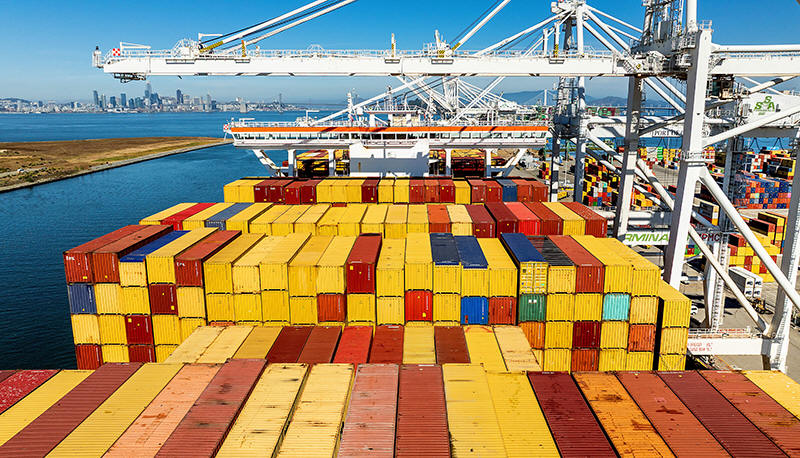
Cargo containers line a ship at the Port of Oakland on Wednesday,
Aug. 6, 2025, in Oakland, Calif. (AP Photo/Noah Berger, File)
 In 2025, U.S. goods imports from
Mexico outpaced exports by nearly $197 billion, up from a 2024 gap
of $172 billion. But the goods deficit with Canada shrank by 26% to
$46 billion. The United States this year is negotiating a renewal of
a pact Trump reached with those two countries in his first term.
The U.S. ran a bigger surplus in the trade of services such as
banking and tourism last year — $339 billion, up from $312 billion
in 2024.
The trade gap surged from January-March as U.S. companies tried to
import foreign goods ahead of Trump’s taxes, then narrowed most of
the rest of the year.
Trump’s tariffs are a tax paid by U.S. importers and often passed
along to their customers as higher prices. But they haven’t had as
much impact on inflation as economists originally expected. Trump
argues that the tariffs will protect U.S. industries, bringing
manufacturing back to America and raise money for the U.S. Treasury.
All contents © copyright 2026 Associated Press. All rights reserved |