Trump climate health rollback likely to hit poor, minority areas
hardest, experts say
[February 20, 2026]
By DORANY PINEDA and SETH BORENSTEIN
In a stretch of Louisiana with about 170 fossil fuel and petrochemical
plants, premature death is a fact of life for people living nearby. The
air is so polluted and the cancer rates so high it is known as Cancer
Alley.
“Most adults in the area are attending two to three funerals per month,”
said Gary C. Watson Jr., who was born and raised in St. John the Baptist
Parish, a majority Black community in Cancer Alley about 30 miles
outside of New Orleans. His father survived cancer, but in recent years,
at least five relatives have died from it.
Cancer Alley is one of many patches of America — mostly minority and
poor — that suffer higher levels of air pollution from fossil fuel
facilities that emit tiny particles connected to higher death rates.
When the federal government in 2009 targeted carbon dioxide and other
greenhouse gases as a public health danger because of climate change, it
led to tighter regulation of pollution and cleaner air in some
communities. But this month, the Trump administration's Environmental
Protection Agency overturned that “endangerment finding.”
Public health experts say the change will likely mean more illness and
death for Americans, with communities like Watson's hit hardest. On
Wednesday, a coalition of health and environmental groups sued the EPA
over the revocation, calling it unlawful and harmful.
“Not having these protections, it’s only going to make things worse,”
said Watson, with the environmental justice group Rise St. James
Louisiana. He also worries that revoking the endangerment finding will
increase emissions that will worsen the state's hurricanes.

The Trump administration said the finding — a cornerstone for many
regulations aimed at fighting climate change — hurts industry and the
economy. President Donald Trump has called the idea “a scam” despite
repeated studies showing the opposite.
Growing evidence shows that poor and Black, Latino and other racial and
ethnic groups are typically more vulnerable than white people to
pollution and climate-driven floods, hurricanes, extreme heat and more
because they tend to have less resources to protect against and recover
from them. The EPA, in a 2021 report no longer on its website, concluded
the same.
The finding's reversal will affect everyone, but “overburdened
communities, which are typically communities of color, Indigenous
communities and low-income communities, they will, again, suffer most
from these actions,” said Matthew Tejada, senior vice president for
environmental health at the Natural Resources Defense Council and a
former deputy with the EPA's office for environmental justice.
Hilda Berganza, climate program manager with the Hispanic Access
Foundation, said: “Communities that are the front lines are going to
feel it the most. And we can see that the Latino population is one of
those communities that is going feel it even more than others because of
where we live, where we work.”
Research shows the unequal harms of pollution, climate change
A study published in November found more than 46 million people in the
U.S. live within a mile of at least one type of energy supply
infrastructure, such as an oil well, a power plant or an oil refinery.
But the study found that “persistently marginalized” racial and ethnic
groups were more likely to live near multiple such sites. Latinos had
the highest exposure.
[to top of second column]
|
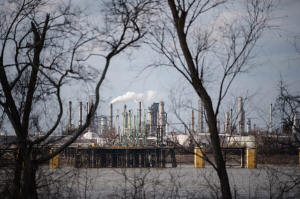
A Marathon Petroleum Refinery operates in Garyville, La., Wednesday,
Feb. 18, 2026. (AP Photo/Matthew Hinton)
 The EPA, in that 2021 report,
estimated that with a 2-degree Celsius (3.6 Fahrenheit) rise in
global warming, Black people were 40% more likely to live in places
with the highest projected rise in deaths because of extreme heat.
Latinos, who are overrepresented in outdoor industries such as
agriculture and construction, were 43% more likely to live where
labor hour losses were expected to be the highest because of heat.
Julia Silver, a senior research analyst at the University of
California, Los Angeles' Latino Policy and Politics Institute, found
in her own research that California Latino communities had 23 more
days of extreme heat annually than non-Latino white neighborhoods.
Her team also found those areas have poor air quality at about
double the rate, with twice as many asthma-related emergency room
visits. Other research shows that Latino children are 40% more
likely to die from asthma than white children in part because many
lack consistent health care access.
“What we’re risking with a rollback like this at the federal level
is really human health and well-being in these marginalized groups,”
Silver said.
Experts say the disparate impacts will be significant
Armando Carpio, a longtime pastor in Los Angeles, has seen firsthand
how vulnerable his mostly Latino parishioners are. Many are
construction workers and gardeners who work outside, often in
extreme heat. Others live and work near polluting freeways. He sees
children with asthma and elders with dementia, both linked to
exposure to air pollution.
“We’re regressing,” he said. “I don't know how many years back, but
all of this really affects us.”
It is difficult to quantify how much more communities of color could
be impacted by the finding’s revocation, but experts who spoke with
The Associated Press all said it would be significant.
“You will see statistically significant increases in excess
morbidity and mortality when it comes to climate impacts and health
impacts associated with co-pollutants” in communities of color, said
Sacoby Wilson, a University of Maryland professor and executive
director of the nonprofit Center for Engagement, Environmental
Justice and Health INpowering Communities.

Beverly Wright, founding director of the Deep South Center for
Environmental Justice in New Orleans, said at least four Black
communities in Cancer Alley no longer exist because of the expansion
of industrial facilities. The repeal will bring more pollution,
higher cancer rates, more extreme weather and the disappearance of
more historic communities, she said.
“It has us going in the wrong direction, and our communities are now
at greater risk,” she said.
All contents © copyright 2026 Associated Press. All rights reserved |