‘I lost a lot of hope’: Nevada pays $100K to woman convicted for
miscarriage under 1911 law
[February 20, 2026]
By KATE REYNOLDS/The Nevada Independent
Nevada’s ban on taking drugs to end a pregnancy after the 24th week
makes it the only state left in the nation that explicitly criminalizes
abortions, advocates say, and legislative efforts last year to change
that fell flat.
Patience Rousseau was the only person ever charged and convicted under
the law, according to Laura FitzSimmons, a Carson City-based lawyer who
has represented her since 2020. FitzSimmons helped get Rousseau’s
conviction vacated in 2021 for ineffective assistance of counsel.
Now Nevada will pay Rousseau $100,000 for her ordeal, a settlement
approved without comment during last Tuesday’s meeting of the Board of
Examiners — a panel consisting of the governor, the attorney general and
the secretary of state.
The compensation marks the conclusion of an eight-year fight that
upended Rousseau’s life and brought national attention to a Nevada law
that abortion advocates describe as uniquely punitive toward women who
want to end their pregnancy.
“Even in the states with the most draconian abortion bans, there is
language explicitly saying that a person who has an abortion has not
committed a crime,” said lawyer and abortion rights advocate Farah Diaz-Tello.
“Not Nevada.”
In 2018, 26-year-old Rousseau, then going by the name Patience Frazier,
was living in Winnemucca when she delivered a stillborn baby, whom she
named Abel and whose remains she buried in her backyard.

Forty days later, Rousseau was arrested and charged with felony
manslaughter. Her charges stemmed from a law on the books in Nevada
since 1911, stating that a woman who ingests drugs with the intent to
terminate a pregnancy past 24 weeks has committed manslaughter.
Rousseau told The Indy last Tuesday she was grateful for the money but
had “lost a lot of hope that I’m still struggling to get back.” She said
she struggles with trauma from the case and faces community stigma.
When she learned she was pregnant in 2018, Rousseau was not sure how far
along she was. She scheduled an abortion in Reno, but a broken-down car
prevented her from reaching the appointment. Searching the internet for
advice on how to naturally end an unwanted pregnancy, she began to
consume copious amounts of cinnamon and lift heavy objects.
Prosecutors could not prove that those actions, which are not
scientifically linked to pregnancy issues, caused Rousseau’s
miscarriage.
But Rousseau struggled with substance use disorder and had ingested
methamphetamines and marijuana during her pregnancy. Prosecutors argued
she took those drugs to induce a miscarriage, thus violating the state’s
law.
At the encouragement of her public defender, Rousseau pleaded guilty to
the manslaughter charges and went to prison in 2019. Her conviction was
vacated in 2021 for ineffective assistance of counsel and her case was
officially dismissed in 2025.
Nevada’s unique law
Nevada’s ban on inducing a miscarriage makes it “the only state where it
is a felony to have an abortion,” said Diaz-Tello. She said other states
criminalize women’s behavior during and after pregnancy in less explicit
ways.
In last year’s legislative session, bill SB139 would have overturned the
statute but died without receiving a hearing in the Democrat-controlled
Legislature.
The New Republic reported that Senate Democratic leadership, along with
some of the state’s pro-choice groups, opted against lobbying for the
bill because they wanted to focus efforts on a ballot measure to
enshrine abortion rights up to 24 weeks in the state Constitution.
Voters approved the measure, Question 6, by nearly a two-thirds majority
in November 2024 but must approve it again this November before it is
amended to the state Constitution.

Sen. Rochelle Nguyen (D-Las Vegas), who introduced SB139, wrote in a
statement to The Indy that she supported the change “because I believe
Nevada’s legal system shouldn’t punish women for their medical
situations or pregnancy outcomes.”
Nguyen also wrote that “making laws can be complicated, and not every
bill passes.”
[to top of second column]
|
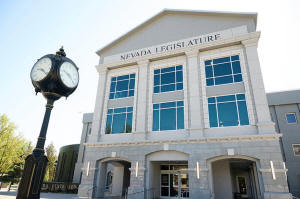
The Nevada state Legislature is seen on May 30, 2025, Carson City,
Nev. (AP Photo/Bridget Bennett, File)
 Abortions are legal in Nevada for
any reason through 24 weeks of gestation, after which they are only
permitted if the life or health of the pregnant person is
endangered. The state is one of 28 states where abortion
restrictions depend on how far along the pregnancy is.
But most states that ban abortions after a certain date penalize
doctors for performing late-term procedures, rather than the women
seeking them.
Some states find other ways to punish women for
abortions, through laws banning child abuse, concealing a birth or
taking drugs during pregnancy.
Diaz-Tello said that in those other states, punishing women for
getting abortions means prosecutors must invoke unrelated or
adjacent statutes or charge women with separate offenses.
“Nevada is now the only state with a law on its books explicitly
criminalizing ending one’s pregnancy,” she said.
A September 2025 report by the reproductive health care advocacy
group Pregnancy Justice counted 412 pregnancy-related prosecutions
in the two years after Roe v. Wade fell. Of these cases, only nine
involved allegations related to obtaining an abortion or abortion
medication.
The state’s abortion rights advocates have long hailed the 1911
statute as outdated and unjust, arguing it punishes women who cannot
access reproductive health care because of geographic restrictions,
income barriers or social pressure.
“In these rural counties where we do not have abortion medical care
… if a woman has a drug problem, she’s not going to go get help if
she’s pregnant,” said FitzSimmons. She also said the law could
theoretically be used to charge women who take legal abortion pills
past 24 weeks.
Vulnerable pregnant women need “someone that’s willing to help”
Rousseau told The Indy that her manslaughter conviction was a
devastating punishment for a period in her life when she needed help
most of all.
Many young women want abortions because “they don’t feel like they
can care for another child,” Rousseau said, “whether it’s their
living situation, their financial situation, they’re struggling or
barely making it by with what they have.”

She said the state should invest more in affordable housing, mental
and physical health care, and in demonstrating to young moms that
“there’s someone out there that’s willing to help, that’s not
judging you.”
After serving more than two years in prison, a Nevada district judge
vacated Rousseau’s conviction in 2021, deeming her original counsel
ineffective.
Her lawyer by then was FitzSimmons, an attorney for indigent clients
who helped secure Nevadans’ reproductive rights in a 1990
referendum.
FitzSimmons successfully argued that the prosecution could not prove
Rousseau’s drug use caused her miscarriage or that she took the
drugs to induce miscarriage. The lawyer also argued that Rousseau,
who was unsure when she got pregnant, could not have known she
passed the 24-week threshold for legal abortion.
After a judge vacated her conviction in 2021, Rousseau moved to
South Dakota. Soon she had another child, a boy turning 4 this year.
Rousseau told The Indy that she has a stable job but as a single
mom, still struggles with paying rent and juggling her three sons’
schedules for school. Her neighbors know about her past, she said,
and many of them still think of her as the woman who killed her
child.
Last Tuesday’s settlement was a relief, Rousseau said, but only a
temporary one.
“What does it really mean for me? How long is it going to last? I
can cushion everything, but it’s not going to fix my problems,” she
said.
All contents © copyright 2026 Associated Press. All rights reserved |