Wisconsin passes expanded Medicaid for moms, would leave Arkansas as
only state without it
[February 20, 2026]
By SCOTT BAUER
MADISON, Wis. (AP) — Women in Wisconsin will soon be eligible to receive
expanded Medicaid coverage for up to a year after giving birth following
near-unanimous passage of a measure Thursday by the Wisconsin Assembly
that would leave Arkansas as the only state yet to expand such benefits.
Wisconsin Democrats, and even most Republicans, have pushed for years to
expand Medicaid coverage for new mothers, only to be blocked by powerful
Republican Assembly Speaker Robin Vos. Vos had argued that he opposed
expanding welfare programs, but he relented late Wednesday.
The Assembly on Thursday also unanimously passed another bill with
bipartisan support to require insurance to cover additional cancer
screenings for women with dense breast tissue. The Medicaid bill passed
95-1.
Both measures overwhelming passed the state Senate already, meaning they
will next go to Democratic Gov. Tony Evers who is expected to sign them
next week.
Once that happens, Arkansas will be the only state without expanded
Medicaid coverage for new mothers.
The state — which has one of the highest maternal mortality rates in the
country — did pass significant maternal healthcare legislation last
year. Pregnant women are now allowed to temporarily receive Medicaid
coverage while their eligibility is being processed, and Medicaid covers
doula services and remote monitoring of vitals.
But the legislation did not extend postpartum Medicaid coverage, to the
chagrin of Democrats and some Republicans.

Gov. Sarah Huckabee Sanders, a Republican, called for the maternal
health package after opposing the postpartum extension, saying that
there are other coverage options.
In Wisconsin, the Medicaid expansion and breast cancer screening bills
broke a logjam that comes amid a flurry of last-minute negotiations near
the end of the two-year legislative session. Republicans and Evers were
also trying to negotiate a package of tax cuts, school spending and
other measures, tapping the state's estimated $2.5 billion budget
surplus.
[to top of second column]
|
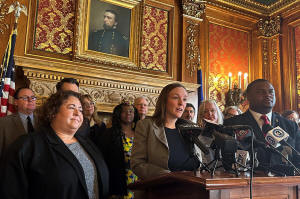
Democratic Wisconsin Assembly Minority Leader Greta Neubauer,
surrounded by Democratic colleagues, speaks in support of measures
to expand Medicaid coverage for new mothers and insurance coverage
for breast exams at a news conference in the state Capitol on
Wednesday, Feb. 18, 2026, in Madison, Wis. (AP Photo/Scott Bauer)
 Democratic Assembly Minority Leader
Greta Neubauer led the charge for passage of the Medicaid and breast
cancer screening bills. Neubauer announced on Wednesday that she was
pregnant and that her mother had breast cancer, saying that
Democrats would “stop at nothing to get a vote on these bills.” She
called the expected passage of both measures "an incredible win for
women and the people of Wisconsin.”
Republican lawmakers, including Senate Majority Leader Devin
LeMahieu, had also shared stories about how their loved ones had
been affected by breast cancer as part of the push for passage of
the screening bill.
The Medicaid expansion will allow low-income mothers who make more
than the poverty level to remain on the state's Medicaid program for
a full year after giving birth, instead of the current two months.
Despite agreement on those measures, several other high-profile
bills were poised to die at the end of the session. Republicans have
not agreed on a measure to provide funding to keep WisconsinEye, a
nonprofit state version of CSPAN, on the air.
And the state's nearly 40-year-old land conservation program also
faced extinction as lawmakers had yet to agree on a plan to continue
funding beyond June 30.
Republicans have complained for years that the program is too
expensive and removes too much land from property tax rolls, hurting
municipalities. Bills to keep it alive, but with dramatically less
funding, have yet to pass.
___
Associated Press writers Todd Richmond in Madison, Wisconsin, and
Isabella Volmert in Lansing, Michigan, contributed to this report.
All contents © copyright 2026 Associated Press. All rights reserved |