Venezuela approves amnesty that could release hundreds detained for
political reasons
[February 20, 2026]
By REGINA GARCIA CANO
CARACAS, Venezuela (AP) — Venezuela's acting president on Thursday
signed into law an amnesty bill that could lead to the release of
politicians, activists, lawyers and many others, effectively
acknowledging that the government has held hundreds of people in prison
for political motivations.
The approval marks a reversal for authorities in the South American
nation, who for decades have denied holding any political prisoners. It
is the latest policy reversal following last month’s stunning U.S.
military raid in the country’s capital, Caracas, to capture
then-President Nicolás Maduro.
The measure is expected to benefit opposition members, activists, human
rights defenders, journalists and many others who were targeted by the
ruling party over the past 27 years. But families hoping for the release
of their loved ones — some of whom have been gathered outside detention
facilities for weeks — say that acting President Delcy Rodríguez has
failed to deliver on earlier promises to release prisoners.
In the days after Maduro’s Jan. 3 capture, Rodríguez’s government
announced it would release a significant number of prisoners. However,
relatives and human rights watchdogs have criticized the slow pace of
releases and the restrictive conditions under which many have been
placed after leaving prison.
The new law was not a prerequisite for the government to free prisoners,
but families held out hope that it could speed up releases. Some
gathered outside detention facilities in Caracas grew impatient as hopes
of immediate releases were disappointed Thursday night, retreating to
their tents as Christian music played from a loudspeaker.

Venezuela-based prisoners’ rights group Foro Penal has tallied 448
releases since Jan. 8. The group estimates that more than 600 people are
still in custody for political reasons.
Rodríguez, who proposed the bill late last month, signed the measure
into law shortly after it was approved by the country's legislature.
She said during the signing that it showed that the country’s political
leaders were “letting go of a little intolerance and opening new avenues
for politics in Venezuela."
The bill’s purpose is to grant people “a general and full amnesty for
crimes or offenses committed” during specific periods since 1999 that
were marked by politically-driven conflicts in Venezuela, including
“acts of politically motivated violence” in the context of the 2024
presidential election. The aftermath of that election led to protests
and the arrest of more than 2,000 people, including minors.
The debate over the bill was suspended last week after lawmakers were
unable to agree on some issues, including whether people who left the
country to avoid detention can be granted amnesty, and laid bare the
resistance from some ruling-party loyalists to seeing opposition members
granted relief. Lawmakers on Thursday overcame the disagreement by
allowing those abroad to have a lawyer seek amnesty on their behalf
instead of forcing them to return to Venezuela to request the relief in
person.
[to top of second column]
|
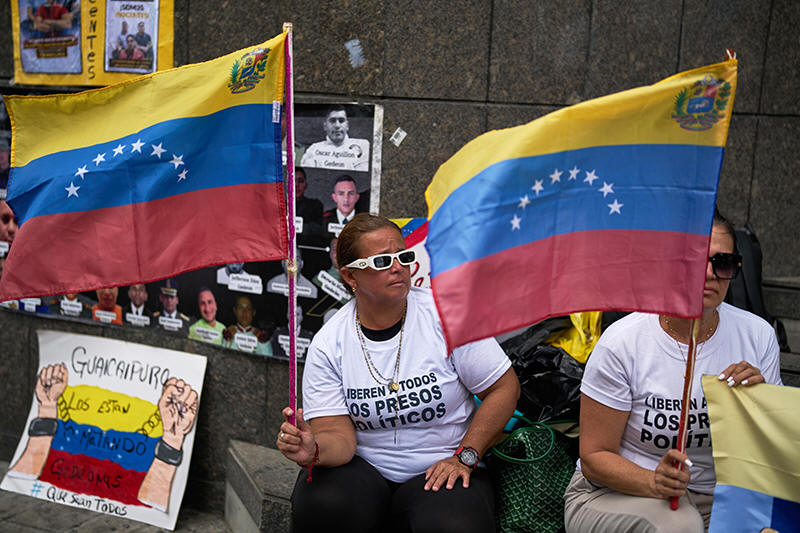
People who consider their detained family members to be political
prisoners protest for their releases outside the United Nations
office in Caracas, Venezuela, Wednesday Feb. 18, 2026. (AP Photo/Ariana
Cubillos)

Once someone abroad has filed a request for amnesty, the law shields
them from arrest when they return to the country to appear in court
for a ruling on their request.
“It's not perfect, but it is undoubtedly a great step forward for
the reconciliation of Venezuela,” opposition lawmaker Nora Bracho
said in the debate. “It will undoubtedly alleviate the suffering of
many Venezuelans.”
People convicted of human rights violations, war crimes, murder,
drug trafficking and corruption do not qualify for amnesty, nor do
people “who are being prosecuted or may be prosecuted or convicted
for promoting, instigating, soliciting, invoking, favoring,
facilitating, financing, or participating in armed or forceful
actions against” Venezuela “by foreign states, corporations or
individuals.” That could leave out members of the opposition who
have supported Trump’s policy toward Venezuela.
General amnesty has long been a central demand of Venezuela’s
opposition and human rights organizations, but they have viewed the
proposal with cautious optimism and raised several concerns about
eligibility and implementation.
The law was criticized Thursday by some members of the opposition,
including Pedro Urruchurtu, international relations director for
opposition leader and Nobel Peace Prize laurate María Corina
Machado.
Urruchurtu has lived in exile since May, when he and other Machado
staffers left the Argentine diplomatic compound in Caracas, where
they had sheltered for more than a year to avoid arrest. He rejected
the law's requirement that exiles return to Venezuela and appear in
court.
“A true amnesty doesn’t require laws, but rather will, something
that is lacking in this discussion,” Urruchurtu said on X. "It is
not only an invalid and illegitimate law, but also a trap to buy
time and revictimize those persecuted."
Some relatives of prisoners called on Trump to pressure Venezuela's
government into freeing their loved ones.
“From the beginning, they have been liars, deceivers and mockers,”
Marielis Guzmán said of Venezuelan authorities while standing
outside a prison in Caracas on Thursday. “What the Venezuelan state
has done is abuse its power.”
All contents © copyright 2026 Associated Press. All rights reserved
 |