US economic growth weaker than thought in fourth quarter with government
shutdown, consumer pullback
[February 21, 2026] By
CHRISTOPHER RUGABER
WASHINGTON (AP) — U.S. economic growth slowed in the final three months
of last year, dragged down by the six-week shutdown of the federal
government and a pullback in consumer spending.
The nation's gross domestic product — the total output of goods and
services — increased at a 1.4% annual rate in the fourth quarter, the
Commerce Department reported Friday, down from 4.4% in the
July-September quarter and 3.8% in the quarter before that.
The figures point to what could be a more modest pace of growth in the
coming quarters, as consumers have taken on more debt and saved less to
maintain their spending, a process that may be difficult to sustain.
Business investment, other than data centers and equipment dedicated to
artificial intelligence, grew at only a moderate pace.
Still, a measure of underlying growth that focuses on consumer and
business spending was mostly healthy at 2.4%, economists said. The sharp
slowdown in government outlays because of the shutdown shaved a full
percentage point from growth.
Consumers and companies spent at a “reasonably solid" pace, said Martha
Gimbel, executive director of the Budget Lab at Yale and former
economist in the Biden White House. “This is not a disastrous report.”
Also Friday, the Supreme Court struck down many of President Donald
Trump's tariffs, which have lifted inflation slightly and likely
discouraged many companies from hiring by raising their costs. At a news
conference, Trump quickly promised to reimpose the tariffs under
different laws than the one the court invalidated.

Consumer spending also rose 2.4% in the fourth quarter, a solid increase
but notably below the third quarter’s healthy 3.5% gain. Federal
government outlays plunged nearly 17% amid the shutdown. That decline
should mostly reverse in the coming quarters, however.
The outsize growth last summer and fall — when the economy expanded at
about a 4% annual pace — partly reflected sharply lower imports.
Companies ramped up imports in the first quarter of last year to get
ahead of President Donald Trump's tariffs. After boosting growth in the
second and third quarters, trade had little impact at the end of last
year.
Diane Swonk, chief economist at KPMG, said the report reflected a
“one-legged” economy boosted mostly by artificial intelligence, which is
fueling business spending and has also lifted wealth for those
households that own stocks and have benefited from rising share prices.
Many households, however, have had to take on more debt to fuel their
spending. The saving rate dropped to just 3.6% in the fourth quarter,
the second-lowest figure since August 2008, when the economy was mired
in the Great Recession.
“The economy looks golden on paper, but beneath the surface is lead,”
Swonk said.
Early Friday, before the figures were released, Trump attacked
congressional Democrats for shutting down the government last fall. He
also reiterated his criticism of Federal Reserve Chair Jerome Powell for
not cutting interest rates more quickly.
[to top of second column] |

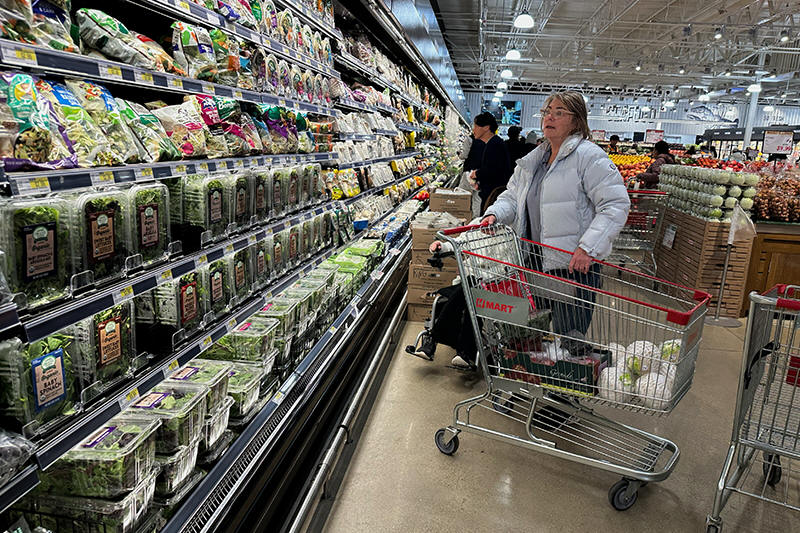
Shoppers shop at a grocery store in Schaumburg, Ill., Monday, Feb.
9, 2026. (AP Photo/Nam Y. Huh)
 “The Democrat Shutdown cost the
U.S.A. at least two points in GDP,” Trump posted on his social media
site. “That’s why they are doing it, in mini form, again. No
Shutdowns! Also, LOWER INTEREST RATES. “Two Late” Powell is the
WORST!!!”
A separate report Friday showed that inflation, according to the
Fed's preferred measure, accelerated in December, as the cost of
goods such as furniture, clothes, and groceries picked up. That
makes it less likely the Fed will reduce its key interest rate in
the coming months.
Earlier this month, Trump predicted a blowout gain in GDP of more
than 5% even if the government shutdown was factored into the
figures. Trump has been trying to claim that the economy is at its
strongest point in history, even though the new data shows that
growth slowed, compared with 2024, following his return to the White
House.
The data arrives before Trump delivers the State of the Union
address on Tuesday, where he is expected to say that the economy is
booming.
The report also underscores an odd aspect of the U.S. economy: It is
growing steadily, but without creating many jobs. Growth was a solid
2.2% in 2025, yet a government report last week showed that
employers added less than 200,000 jobs last year — the fewest since
COVID struck in 2020.
Economists point to several possible reasons for the gap: The Trump
administration’s crackdown on immigration has sharply slowed
population growth, reducing the number of people available to take
jobs. It’s one reason that the unemployment rate rose only slightly
— to 4.3% from 4% — last year, even with the nearly non-existent
hiring.
Some businesses may also be holding back on adding jobs out of
uncertainty about whether artificial intelligence will enable them
to produce more without finding new employees. And the cost of
tariffs has reduced many companies’ profits, possibly leading them
to cut back on hiring.
The economy is also unusual right now because growth is solid,
inflation has slowed a bit, and unemployment is low, but surveys
show that Americans are generally gloomy about the economy. In
January, a measure of consumer confidence fell to its lowest level
since 2014, yet consumers have kept spending, propelling growth.
Some of that spending may be disproportionately driven by
upper-income consumers, in a phenomenon known as the “K-shaped”
economy. Yet data from many large banks suggests lower-income
consumers are still raising their spending, even if by not as much.
___
Associated Press Writer Josh Boak contributed to this story.
All contents © copyright 2026 Associated Press. All rights reserved |