Cuba's health care system pushed to the brink by US fuel blockade, Cuban
minister says
[February 21, 2026]
By ANDREA RODRÍGUEZ and MILEXSY DURÁN
HAVANA (AP) — Cuba’s debilitated health care system has been pushed to
the brink of collapse by the U.S. blockading the country’s oil supply, a
Cuban official said Friday.
The country’s medical system was already perpetually crisis-stricken
along with the island’s economy, with lack of supplies, staff and
medicine long being the norm. But the turmoil has reached a new extreme
in recent weeks. Ambulances are struggling to find fuel to respond to
emergencies. Persistent outages have plagued deteriorated hospitals.
Flights bringing vital supplies have been suspended as Cuba’s government
says it’s now unable to refuel airplanes in its airports.
Experts and some leaders of other countries have warned that the island
could be on the verge of a humanitarian crisis.
In an interview with The Associated Press, Cuba’s Health Minister José
Ángel Portal Miranda said that U.S. sanctions are no longer just
crippling the island's economy, they're threatening “basic human
safety.”
“You cannot damage a state’s economy without affecting its inhabitants,”
Portal said. “This situation could put lives at risk.”

According to Portal, 5 million people in Cuba living with chronic
illnesses will see their medications or treatments affected. This
includes 16,000 cancer patients requiring radiotherapy and another
12,400 undergoing chemotherapy.
Cardiovascular care, orthopedics, oncology and treatment for critically
ill patients who require electrical backup are among the most impacted
areas, he said. Kidney disease treatments and emergency ambulance
services have also been added to the list of impacted services.
The energy crisis Cuba has been grappling with for years entered new
extremes last month when U.S. President Donald Trump signed an executive
order that would impose a tariff on any country that sells or provides
oil to Cuba. It came just weeks after Trump deposed Venezuelan President
Nicolás Maduro and announced no more Venezuelan oil would go to Cuba.
Cuba, which produces only 40% of its own fuel and largely depends on oil
to power the island, has long relied on allies like Venezuela, Mexico
and Russia to fill its energy deficit. But those shipments have now
dried up.
Trump has openly said that his larger hope is to push regime change in
Cuba by intensifying economic pressure on the island, which has already
struggled to cope with decades of U.S. sanctions.
[to top of second column]
|
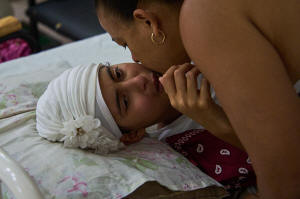
Niala Gonzalez, a cancer patient is kissed by her mother at the
National Institute of Oncology and Radiology in Havana, Cuba,
Friday, Feb. 20, 2026. (AP Photo/Ramon Espinosa)
 Cuban people — who the U.S.
government has said it seeks to defend — are the ones feeling the
harsh ripple effects of the U.S. fuel blockade as hardship mounts
every day. Buses have slashed routes, gas has been put under strict
rationing and is only being sold in foreign currency, and endemic
blackouts have reached a new extreme.
“There’s been a drastic change since January,” said Aniliet
Rodríguez, a 25-year-old pregnant woman who was admitted that month
to a maternal care center for an extreme case of anemia. “There’s no
bread, no milk for nutrition … . There are no medicines.”
Cuba's health care system follows a universal and free model,
providing local clinics on nearly every block and state subsidized
medicine. But it's also entered a state of crisis in recent years,
especially since the COVID-19 pandemic. Thousands of doctors being
paid state wages that can hardly afford them a carton of eggs have
emigrated from the country and hospitals have rapidly deteriorated.
Medicine shortages have forced many to buy them on the black market
instead.
Such problems are expected to worsen in the coming weeks even though
Cuba's government has struggled to adjust to the new reality, Portal
said. Solar panels have been installed in clinics while authorities
prioritize care to children and the elderly.
But he also said they have placed restrictions on some more
energy-reliant technologies like CT scans and laboratory tests,
noting doctors will have to rely on more basic methods to treat
patients, effectively cutting many off from high levels of care.
"We are facing an energy siege with direct implications for the
lives of Cubans, for the lives of Cuban families," Portal said.
All contents © copyright 2026 Associated Press. All rights reserved
 |