Court clears way for Louisiana law requiring Ten Commandments in
classrooms to take effect
[February 21, 2026]
By HANNAH SCHOENBAUM and REBECCA BOONE
A U.S. appeals court has cleared the way for a Louisiana law requiring
poster-sized displays of the Ten Commandments in public school
classrooms to take effect.
The 5th U.S. Circuit Court of Appeals voted 12-6 to lift a block that a
lower court first placed on the law in 2024. In the opinion released
Friday, the court said it was too early to make a judgment call on the
constitutionality of the law.
That’s partly because it’s not yet clear how prominently schools may
display the religious text, if teachers will refer to the Ten
Commandments during classes or if other texts like the Mayflower Compact
or the Declaration of Independence will also be displayed, the majority
opinion said.
Without those sorts of details, the panel decided it did not have enough
information to weigh any First Amendment issues that might arise from
the law. In other words, there aren’t enough facts available to “permit
judicial judgment rather than speculation,” the majority wrote in the
opinion.
In a concurring opinion, Circuit Judge James Ho, an appointee of
Republican President Donald Trump, wrote that the law “is not just
constitutional — it affirms our nation’s highest and most noble
traditions.”
The six judges who voted against the decision wrote a series of
dissents, with some arguing that the law exposes children to
government-endorsed religion in a place they are required to be,
presenting a clear constitutional burden.
Circuit Judge James L. Dennis, an appointee of Democratic President Bill
Clinton, wrote that the law "is precisely the kind of establishment the
Framers anticipated and sought to prevent.”
The ruling is the result of the court's choice to rehear the case with
all judges present after three of them ruled in June that the Louisiana
law was unconstitutional. The reversal comes from one of the nation's
most conservative appeals courts, and one that's known for propelling
Republican policies to a similarly conservative U.S. Supreme Court.
Republican Gov. Jeff Landry celebrated the ruling Friday, declaring,
“Common sense is making a comeback!”
The ACLU of Louisiana, one of several groups representing plaintiffs,
pledged to explore all legal pathways to continue fighting the law.

Arkansas has a similar law that has been challenged in federal court.
And a Texas law took effect on Sept. 1, marking the widest reaching
attempt in the nation to hang the Ten Commandments in public schools.
[to top of second column]
|
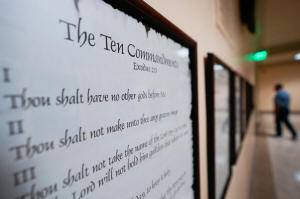
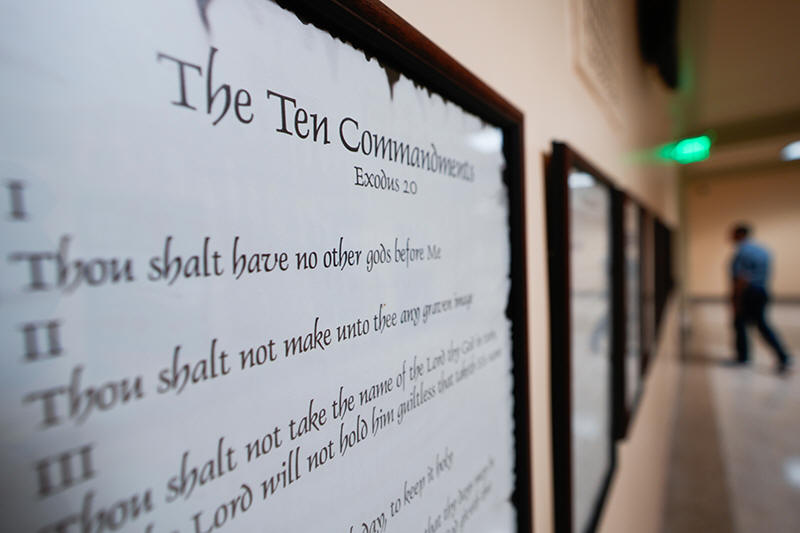
A copy of the Ten Commandments is posted along with other historical
documents in a hallway of the Georgia Capitol, June 20, 2024, in
Atlanta. (AP Photo/John Bazemore, File)

Some Texas school districts were barred from posting them after
federal judges issued injunctions in two cases challenging the law,
but they have already gone up in many classrooms across the state as
districts paid to have the posters printed themselves or accepted
donations.
The laws are among pushes by Republicans, including Trump, to
incorporate religion into public school classrooms. Critics say it
violates the separation of church and state, while backers say the
Ten Commandments are historical and part of the foundation of U.S.
law.
Joseph Davis, an attorney representing Louisiana in the case,
applauded the court for upholding America’s “time-honored tradition
of recognizing faith in the public square.”
Families from a variety of religious backgrounds, including
Christianity, Judaism and Hinduism, have challenged the laws, as
have clergy members and nonreligious families.
The Freedom From Religion Foundation, another group involved in the
challenge, called the ruling “extremely disappointing” and said the
law will force families "into a game of constitutional whack-a-mole”
where they will have to separately challenge each school district’s
displays.
Louisiana Attorney General Liz Murrill said after the ruling that
she had sent schools several correct examples of the required
poster.
In 1980, the Supreme Court ruled that a similar Kentucky law
violated the Establishment Clause of the U.S. Constitution, which
says Congress can “make no law respecting an establishment of
religion.” The court found that the law had no secular purpose but
served a plainly religious purpose.
And in 2005, the Supreme Court held that such displays in a pair of
Kentucky courthouses violated the Constitution. At the same time,
the court upheld a Ten Commandments marker on the grounds of the
Texas state Capitol in Austin.
All contents © copyright 2026 Associated Press. All rights reserved |