Trump warns he's considering limited strikes as Iranian diplomat says
proposed deal is imminent
[February 21, 2026]
By FARNOUSH AMIRI and SEUNG MIN KIM
WASHINGTON (AP) — President Donald Trump warned on Friday that limited
strikes against Iran are possible even as the country’s top diplomat
said Tehran expects to have a proposed deal ready in the next few days
following nuclear talks with the United States.
In response to a reporter's question on whether the U.S. could take
limited military action as the countries negotiate, Trump said, “I guess
I can say I am considering that.” A few hours later, he told reporters
that Iran “better negotiate a fair deal.”
Earlier Friday, Iranian Foreign Minister Abbas Araghchi said in a TV
interview that his country was planning to finalize a draft deal in “the
next two to three days” to send to Washington.
“I don’t think it takes long, perhaps, in a matter of a week or so, we
can start real, serious negotiations on the text and come to a
conclusion,” Araghchi said on MSNOW's “Morning Joe” show.
The tensions between the longtime adversaries have ramped up as the
Trump administration pushes for concessions from Iran and has built up
the largest U.S. military presence in the Middle East in decades, with
more warships and aircraft on the way.
On Friday, the USS Gerald R. Ford carrier strike group passed through
the Strait of Gibraltar and entered the Mediterranean Sea after being
sent by Trump from the Caribbean, according to images of the ship by
maritime photographers posted to social media.

Both Iran and the U.S. have signaled that they are prepared for war if
talks on Tehran’s nuclear program fizzle out. “We are prepared for
diplomacy, and we are prepared for negotiation as much as we are
prepared for war,” Araghchi said Friday.
Ali Vaez, an Iran expert at the International Crisis Group, said Iran
“would treat any kinetic action as an existential threat.”
Vaez said he doesn’t think Iran’s leaders are bluffing when they say
they would retaliate, while they likely believe they could maintain
their hold on power despite any U.S. airstrikes.
What Iran and the US are negotiating
Trump said a day earlier that he believes 10 to 15 days is “enough time”
for Iran to reach a deal following recent rounds of indirect
negotiations, including this week in Geneva, that made little visible
progress. But the talks have been deadlocked for years after Trump’s
decision in 2018 to unilaterally withdraw the U.S. from Iran’s 2015
nuclear deal with world powers. Since then, Iran has refused to discuss
wider U.S. and Israeli demands that it scale back its missile program
and sever ties to armed groups.
Araghchi also said Friday that his American counterparts have not asked
for zero enrichment of uranium as part of the latest round of talks,
which is not what U.S. officials have said publicly.
[to top of second column]
|
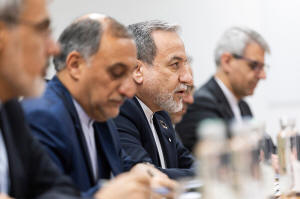
Iranian Foreign Minister Abbas Araghchi, speaks during a bilateral
meeting between Switzerland and Iran, in Geneva, Switzerland,
Tuesday, Feb. 17, 2026 (Cyril Zingaro/Keystone via AP)

"What we are now talking about is how to make sure that Iran’s
nuclear program, including enrichment, is peaceful and will remain
peaceful forever," he said.
He added that in return, Iran will implement some
confidence-building measures in exchange for relief on economic
sanctions.
In response to Araghchi’s claim, a White House official said Trump
has been clear that Iran cannot have nuclear weapons or the capacity
to build them and that it cannot enrich uranium. The official wasn’t
authorized to comment publicly and spoke on condition of anonymity.
Tehran has long insisted that any negotiations should only focus on
its nuclear program and that it hasn’t been enriching uranium since
U.S. and Israeli strikes last June on Iranian nuclear sites. Trump
said at the time that the strikes had “obliterated” Iran’s nuclear
sites, but the exact damage is unknown as Tehran has barred
international inspectors.
Although Iran insists its nuclear program is peaceful, the U.S. and
others suspect it is aimed at eventually developing weapons.
What Congress has to say
Trump's comments have faced pushback from some lawmakers who say the
president should get Congress' approval before any strike.
Democratic Sen. Tim Kaine of Virginia said Friday that he has filed
a war powers resolution that would require that step. Though it has
no chance of becoming law — in part because Trump himself would have
to sign it — some bipartisan consensus has arisen recently among
senators who forced votes on previous resolutions on military action
in Venezuela.
None of those resolutions passed, but they were successful in
showing how lawmakers are troubled by some of Trump’s aggressive
foreign policy maneuvers.
“If some of my colleagues support war, then they should have the
guts to vote for the war, and to be held accountable by their
constituents, rather than hiding under their desks,” Kaine said in a
statement.
All contents © copyright 2026 Associated Press. All rights reserved
 |