From dabblers to day traders, small investors' impact on Wall Street
grows even in volatile market
[February 23, 2026] By
ALEX VEIGA
LOS ANGELES (AP) — For years, retail investors were dismissed by some on
Wall Street as “dumb money.”
That typically referred to those prone to trading on hype, or chasing
trends rather than company or industry fundamentals, or responding late
to big market moves.
That's no longer the case. An analysis of where retail investors put
their money last year shows they outperformed two of the most popular,
professionally managed index funds, SPY and QQQ, whose goal is to mirror
the performance of the S&P 500 and Nasdaq 100, respectively.
Retail investors accounted for $5.4 trillion in trading activity in 2025
across stocks and exchange-traded funds, or ETFs, according to Vanda, an
independent data and research firm. That’s a nearly 47% increase from
the previous year and the most going back to at least 2014.
“I personally want to dispel the myth of retail being dumb money,
because it’s not dumb money anymore,” said Joe Mazzola, head trading and
derivatives strategist at Charles Schwab, at an investor education event
held in Anaheim, California, last November that drew around 800 of the
financial services company’s clients.
Many Americans have long invested in the stock market, although largely
hands-off through managed funds in retirement plans, such as a 401(k).
But over the last decade, the advent of mobile trading apps,
zero-commission trading, stock market-focused communities on social
media and online tools for education and research has helped usher in a
new era of do-it-yourself trading in stocks, crypto and other
investments.
The COVID-19 lockdowns were an inflection point. A new crop of
investors, many young newcomers using investing apps like Robinhood,
helped drive the “meme stock” frenzy that catapulted the price of
GameStop, AMC Entertainment and other stocks.

Meme stocks aside, years of mostly uninterrupted, strong stock market
gains provided an attractive backdrop for more people to take up
investing. The benchmark S&P 500 has posted an annual loss only three
times going back to 2015.
By early last year, the number of people moving money from checking
accounts to investment accounts reached its highest levels since 2021,
according to a report by JPMorgan Chase. Some may have been younger
Americans who couldn't afford to buy a house and instead put the money
in stocks, the report suggests.
All told, money coming into the market from individual investors jumped
about 50% from 2023 to early 2025, according to the report.
“I would say they are considerably more important as a force in markets
right now,” said Steve Sosnick, chief strategist at Interactive Brokers.
“Markets used to be really dominated by institutional investors, but if
you put enough ants together, they can move a very big log.”
Buying the dip
Frank Sabia from Encino, California, started dabbling in investing in
2018. Over the years, he's leveled up his market and trading knowledge
by joining private investor chat groups online or attending investing
seminars like Schwab's.
“I learned a lot more about options strategies and charting and
everything from there,” he said in an interview in November. “Now I’m
independent. I just look for my own trades. I have my own strategy. I
hunt on my own.”
Sabia, a high school registrar, said he trades in cryptocurrencies and
other assets, but that his “bread and butter” is options trading.
That involves trading contracts to buy or sell a stock at a specific
price before a specified date. This can be less costly upfront than
buying stocks, but can also be riskier, because options expire and a
small move in a stock's price can translate into a big swing in the
value of options contracts.

Last April, Sabia opened a Roth IRA account and bought into the market
as stocks tanked after President Donald Trump announced a sweeping set
of tariffs that were more severe than investors expected. The
announcement sent the S&P 500 into a two-day tailspin of more than 10%,
the type of plunge not seen since the 2020 COVID crash.
“I just bought the dip,” Sabia said.
He was wasn't alone. Retail investors seized on the market skid, buying
more than $5 billion in stocks over the two days, according to Vanda.
[to top of second column] |
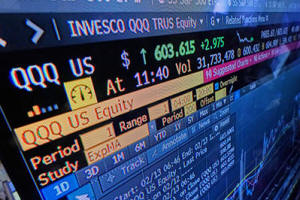
A screen on the floor of the New York Stock Exchange displays an
intraday number for the QQQ, tracking the Nasdaq-100, Friday, Feb.
13, 2026. (AP Photo/Richard Drew)
 “In April, it was retail (investors)
that bought the dip,” Mazzola said. “They were the ones that were
willing to step in front. They saw the opportunity.”
Retail investors also had one of their biggest
buy-the-dip days of the year on Oct. 10, when the market dropped
2.7% after Trump threatened a “massive increase on tariffs” on
China.
The AI trade and silver
Retail investors haven't slowed down this year. Their trading
activity hit an all-time high on a rolling monthly basis last month,
according to J.P. Morgan. They were particularly active in the last
week of January, coinciding with the S&P 500 climbing to an all-time
high.
Retail traders also had a hand in turbocharging the
price of silver last month to record highs by buying a record amount
of silver ETFs, according to data from Vanda.
A recent analysis by Charles Schwab of trading and stock positions
by its millions of retail investor clients found they were net
buyers of stocks in January, with Microsoft, Netflix and Tesla among
the most popular stock buys.
Some take on more risk
Many retail investors have gone beyond stocks or ETFs and into other
investment vehicles. Options trading, which can expose them to
higher risk, accounted for about $650 billion of retail investors’
trading last year and has been mostly rising steadily going back to
at least 2019, according to Vanda.
Noah Goodwin, a junior in high school in the L.A. suburb of Castaic,
started options trading on Robinhood Markets early last year using
in his mother’s custodial account. It paid off right away.
He bought $148 worth of Nvidia options on Jan. 20, 2025, the same
day shares of the tech giant plunged on news of AI advances by
Chinese startup DeepSeek.
Goodwin sold his options later that day.
“I made a $200 profit. My very first trade!” Goodwin said in an
interview in November.
Not all his trades have gone his way. In July, he thought he could
capitalize on market volatility caused by more uncertainty over
tariffs, but he miscalculated.
“I lost a lot of money, like probably like around $600 to $800,” he
said. “So, a horrible month for me.”

“For the most part, with only some exceptions, buying the dip has
tended to be a very profitable tactic for many retail investors,”
said Sosnick. But he cautioned that the strategy had led to retail
investors making trading decisions without giving full consideration
to the risks and rewards.
“The risk to it is that for many of them it’s become sort of
mechanical,” he said.
Balancing short-term and long-term trading
It’s not uncommon for retail investors to strike a balance between
higher-risk moves and making trades to build out a long-term
investment portfolio.
Andy Hu, a financial analyst in Los Angeles who attended the Schwab
event in November, said he had 50% of his investment portfolio in
the SPDR S&P 500 ETF Trust, a popular fund that aims to track the
performance of the S&P 500.
For his short-term trades, he tends to buy micro-cap stocks, which
are very small publicly traded companies that can see big swings in
price because of small trading volume.
The approach had his active trading account up by around 20% through
the first 11 months of last year, he said.
Hu stopped making trades toward the end of last year when a pullback
in big tech companies helped drag the S&P 500 to a monthly loss in
December, clouding sentiment on Wall Street.
“I haven’t made a single trade in the last two months,” Hu said.
All contents © copyright 2026 Associated Press. All rights reserved |